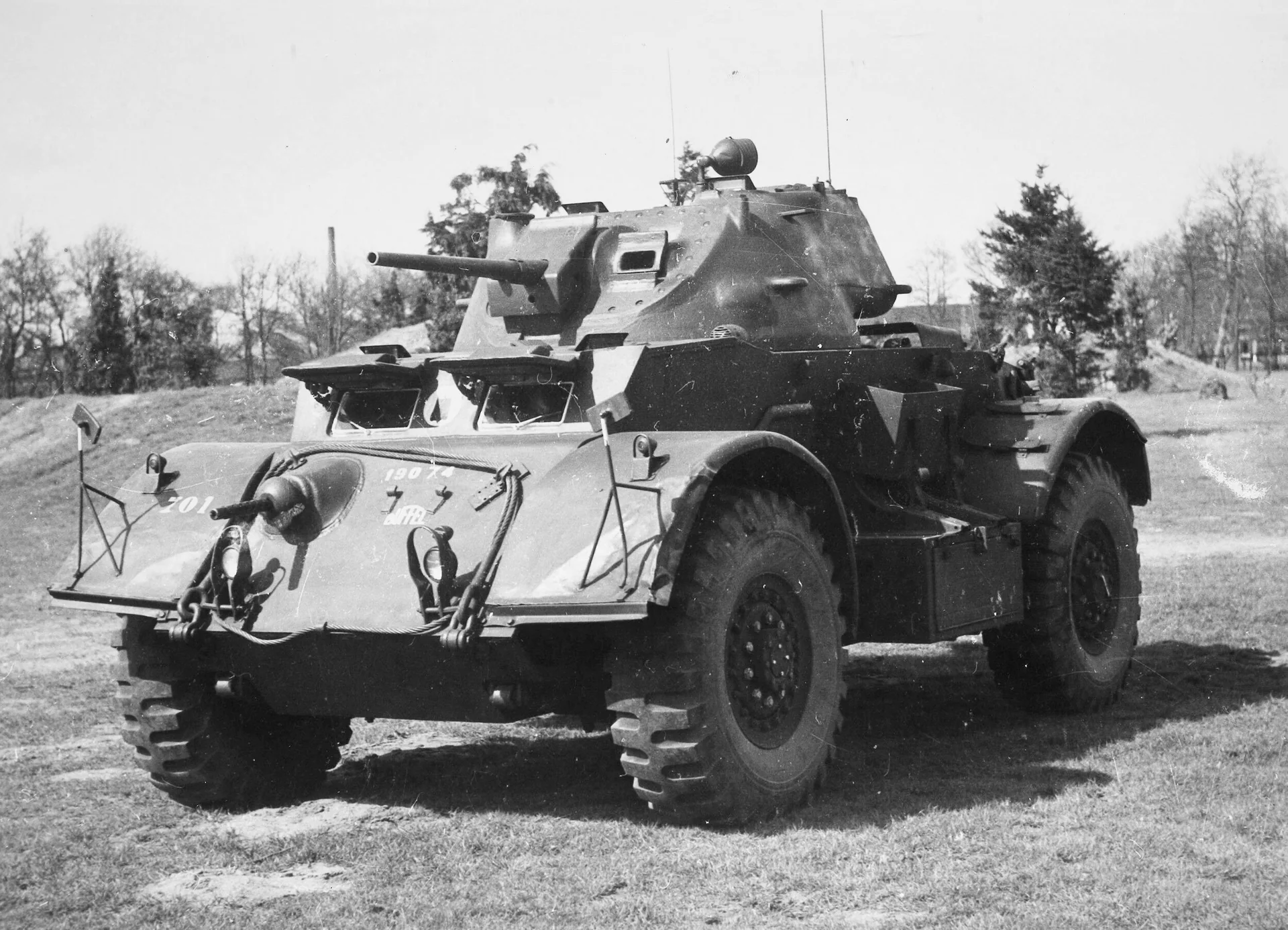
An American design for British service
The T17E1 came out of the U.S. Army Ordnance Department's 1941 search for new wheeled armored vehicles. Britain selected Chevrolet's larger car alongside the lighter M8 and gave it the name Staghound. 1
American manufacture did not mean American combat employment. Britain adopted the 37 mm-armed vehicle as the Staghound Mk I, and its wartime identity became associated with British and Commonwealth formations rather than U.S. Army reconnaissance units. 2
Overloon's collection description identifies an American-built, five-person armored car armed with a 37 mm gun and used by Britain rather than adopted for U.S. Army service. That distinction places the vehicle within wartime production for an allied customer. An American origin does not mean that its organizational history should be reconstructed from a U.S. cavalry unit table. The preserved type belongs to the history of British and Commonwealth reconnaissance and headquarters equipment even though its manufacturing base was across the Atlantic. 2
Five positions, and one crew’s working arrangement
The Staghound had a nominal complement of five men. Its employment extended beyond scouting: in Northwest Europe the car also carried commanders and served at headquarters, where room for personnel was useful alongside the turreted gun. 2
Bill Neely recalled usually operating with four men: a driver, co-driver, gunner and wireless operator. The operator also loaded the gun. An officer sometimes occupied the fifth position. In his 2018 interview, Neely described ammunition around the fighting compartment and his own responsibility for aiming, firing and caring for the weapons. 4
Two engines and automatic transmissions
The power compartment contained two rear-facing six-cylinder engines. Each worked through an automatic transmission, with drive passing through a transfer case to the axles. The regimental museum describes four forward ratios and one reverse. These coupled automotive units supplied the car's four-wheel-drive system without requiring the driver to change gears through a conventional manual transmission. 3
The car could run on either engine or use both together. Single-engine running therefore formed part of its automotive arrangement, rather than requiring removal of the second engine. The Museum of American Armor identifies the powerplants as GMC 270 units. 1
The regimental museum describes two rear-mounted six-cylinder engines, each connected to an automatic transmission, with their output brought into a common drive arrangement. The engineering point is not simply that two engines supplied more power. The driveline had to combine two power sources in one wheeled vehicle and transmit that output to the axles. That arrangement belongs to the Staghound itself, rather than to a generic assumption that all large wartime armored cars used tank-type powertrains. 3
Weight did not make it a tank
The Staghound's bulk could not remove the imbalance between its gun and heavier enemy weapons. Neely remembered radioing headquarters for help when his car faced opposition it could not handle. An antitank gun eventually arrived to reinforce the position. The episode left him remembering the need for heavier firepower rather than the protection of his own car. 4
The Mk I’s gun and machine guns
The standard Mk I mounted a 37 mm gun in its turret, supported by two .30-caliber machine guns. This combination gave the five-man crew a cannon and machine-gun armament typical of Allied armored cars of the period. 1
The close-support Mk II
The Mk II exchanged the 37 mm gun for a three-inch howitzer and dispensed with the bow machine gun. The Queen's Royal Hussars museum describes these close-support cars in headquarters sections. The howitzer conversion gave the same chassis a support assignment alongside the original gun cars. 3
The same account identifies the Staghound Mk II as a close-support conversion with a three-inch howitzer replacing the 37 mm gun and the bow machine gun removed. Those are linked changes to the vehicle's task and internal arrangement, not merely a new ammunition choice for the standard cannon. Exact conversion totals are not established here. The museum's separate statements about Mk III armament still require reconciliation and are not used to assign an unqualified weapon standard to every surviving Mk III photograph. 3
Reconnaissance and headquarters duties
Staghounds served with British and Commonwealth formations in Italy and Northwest Europe. The Museum of American Armor identifies its preserved vehicle as a Mk I, the principal wartime gun version. 1
The regimental museum describes the roomy car as useful for command and liaison, but cumbersome for some scouting duties. In the headquarters arrangement it records, three cars served at regimental headquarters and another three at each of four squadron headquarters. Staghounds therefore worked among the officers directing operations as well as the crews sent out on reconnaissance. 3
Neely's service illustrates another assignment. He identified his formation as the 18th Armoured Car Regiment and his posting as headquarters' Blitz Troop, sent to help squadrons needing reinforcement. Trained as a wireless operator, he became a gunner because the unit needed men for that job. 4
Preserved examples
The War Museum at Overloon includes a Staghound in its military-vehicle collection. Its account places the type's Northwest European employment principally in the command role. The surviving vehicle thus represents an American-built design adopted for British service, rather than a standard wartime U.S. Army reconnaissance car. 2
Sources and further reading
- Museum of American Armor, Staghound T17E1 exhibit description
- Overloon War Museum, Staghound collection description
- Queen’s Royal Hussars Museum, Staghound
- Canadian War Museum, Bill Neely interview with Eric Brunt, 8 July 2018, transcript pp.12–13 and 28
See Armor in Person
This vehicle family is connected to 1 verified museum through 1 documented display record.