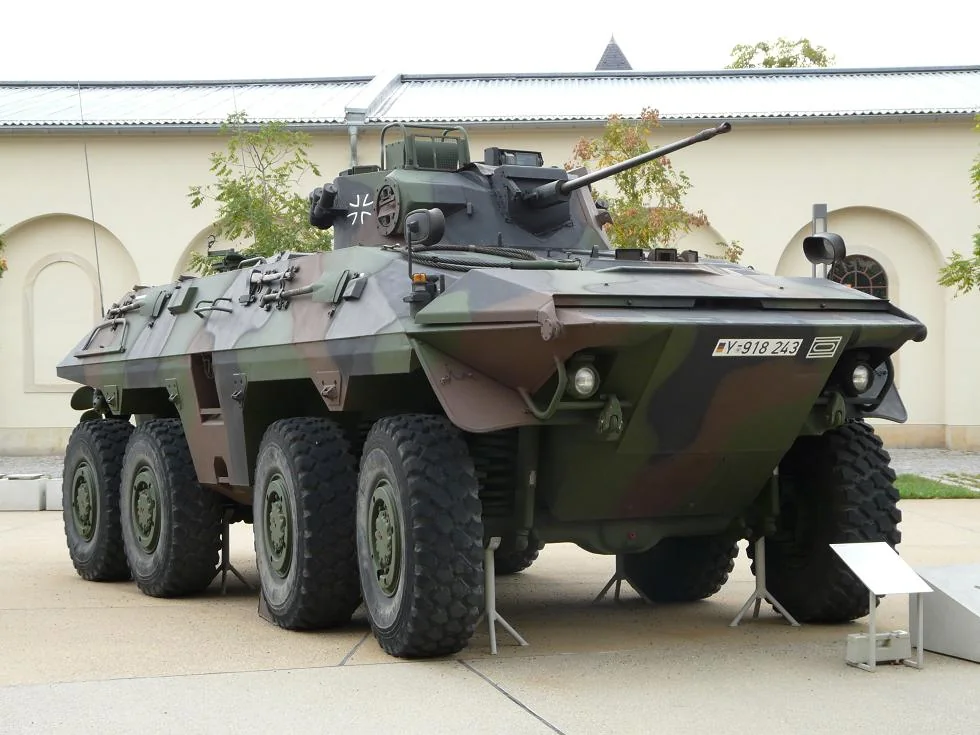
Requirement and development
West Germany developed Luchs for armored reconnaissance units that expected to operate over the dense road network and varied terrain of Central Europe. The design consciously revived features associated with earlier German eight-wheel reconnaissance cars, especially steering and the use of a second driver for rapid withdrawal. Production vehicles entered Bundeswehr service in the mid-1970s, and published sources identify a total fleet of 408. The requirement favored quiet movement, long road reach, rapid changes of direction, and enough armament for security tasks rather than tank-like protection. That combination remained recognizable throughout more than three decades of service. 1, 2, 3
Layout, crew, and architecture
Luchs used an eight-wheel hull with four crewmen: commander, gunner, forward driver, and a rear driver who also handled radio-related duties. The second driving position allowed the vehicle to reverse away from contact without first turning the entire hull, a valuable reconnaissance feature inherited conceptually from earlier German armored cars. A small turret carried the 20 mm Rh 202 cannon. The vehicle’s dimensions and systems made it much larger than a Ferret-type scout but still purpose-built for reconnaissance rather than troop transport. Internal arrangements supported prolonged observation and communications while retaining the ability to disengage rapidly. 1, 2, 3
Mobility and operational reach
The Luchs was built around mobility and low acoustic signature. Published data gives a road speed around 90 km/h and a range of roughly 800 km, while all-wheel steering improved maneuverability at lower speeds. Early vehicles were amphibious and used rear water propulsion, although later protection and modernization changes altered that capability. The 8×8 arrangement spread weight and provided good road performance without tracks, which suited NATO reconnaissance patrols in Central Europe. The unusual rear driving position added tactical mobility of a different kind: crews could leave an exposed observation area quickly while keeping the vehicle’s protected frontal orientation toward the threat. 1, 2, 3
A Bundeswehr description published on 4 September 2023 identifies the Luchs with eight steerable wheels, a 20 mm cannon and amphibious capability. This is a retrospective written description accompanying a video, not an inspected trial report. It corroborates the broad recognition features while leaving the effect of later protection and equipment changes to configuration-specific evidence. 4
Protection and survivability
Luchs protection reflected the reconnaissance philosophy of avoiding decisive engagement. Steel armor and later modernization measures improved resistance to common battlefield threats, while an NBC protection system supported Cold War operations. The vehicle was nevertheless far lighter than tanks and infantry fighting vehicles expected to fight through defended positions. Its size offered more protected volume than very small scouts but also made concealment more demanding. Later service in peace-support environments, including the Balkans, placed additional emphasis on mine awareness and patrol survivability. Protection changes had consequences for weight and the original amphibious arrangement, illustrating the recurring tradeoff between survivability and mobility. 1, 2, 3
Weapons, sensors, and reconnaissance task
The Rh 202 20 mm cannon gave Luchs enough firepower for self-defense, light-vehicle engagements, and security missions without defining the platform as a tank destroyer. Observation, radios, navigation, and the ability to move quietly were more central to its purpose. The crew could scout, maintain contact, report, and use the gun to discourage or defeat limited threats while preserving the option to withdraw. The rear driver was especially relevant to this mission because reconnaissance vehicles often need to leave an observation position along the same covered route by which they arrived. Firepower and mobility were therefore integrated around the information-gathering task. 1, 2, 3
Variants and configuration changes
The retained accounts distinguish Luchs A1 and A2 and describe changes to observation equipment, protection and other systems. Improved night observation is not identical to verified performance in all weather. Added equipment also means that an early amphibious or weight figure cannot be assigned automatically to a later configuration. The familiar eight-wheel layout and 20 mm armament help identify the family, but a preserved vehicle’s particular equipment state still needs to be established. 1, 2, 3
Operational service and employment
Luchs served Bundeswehr reconnaissance units through the Cold War and into the later period described in the retained histories, including Balkan deployments. Fennek belongs to the subsequent reconnaissance lineage, but a successor’s design does not by itself establish why Luchs remained in service or which qualities determined its replacement. Those explanations require dated requirement and service records rather than an inference from the length of the career. 1, 2, 3
Limitations and tradeoffs
The Luchs was unusually sophisticated mechanically for a reconnaissance car, and sophistication brings maintenance as well as tactical benefits. Eight driven wheels, steering arrangements, amphibious equipment, two driving positions, and a turret created a capable but comparatively large and complex vehicle. Its 20 mm cannon was useful against light threats but could not justify exposing the vehicle to heavier armor. The hull provided more room than a tiny scout car yet remained constrained as sensors and protective systems grew. By the 2000s, the Army sought a smaller, sensor-centered replacement rather than another large gun-armed eight-wheeler. 1, 2, 3
Historical place
The Cold War Spähpanzer Luchs combined eight-wheel mobility, a rear driving position and a 20 mm turret with the communications demands of Bundeswehr reconnaissance. Its eventual replacement by Fennek reflected a different combination of size, sensors and crew tasks. That transition does not mean gun-armed reconnaissance disappeared or that every later vehicle called Luchs continued the same chassis family. This profile concerns the Cold War 8×8, with early and later equipment states kept distinct. 1, 2, 3
Sources and further reading
References and further reading are listed below. Image identification, credit and reuse terms remain with each photograph.
- Spähpanzer Luchs overview
- Luchs (Spähpanzer) German overview
- Deutsches Panzermuseum collection listing
- Bundeswehr, Spähpanzer Luchs in 60 seconds, description dated 4 September 2023 (written description; video not inspected)
See Armor in Person
This vehicle family is connected to 1 verified museum through 1 documented display record.