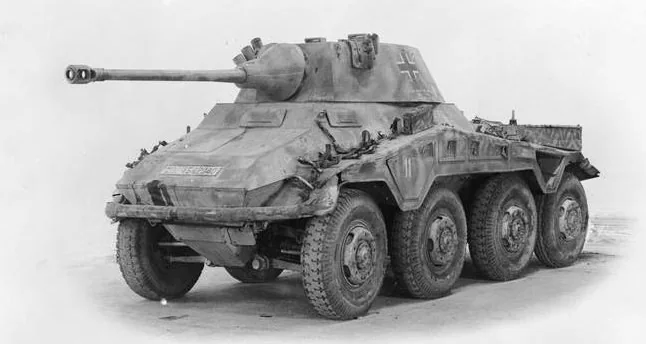
A late-war reconnaissance family
The Sd.Kfz. 234 family combined a diesel-powered, eight-wheeled vehicle with four distinct armament arrangements. It belonged to Germany’s late-war reconnaissance force, but the different versions did not perform an identical job. Alongside the smaller-caliber gun cars, the short-barreled 75 mm version supplied supporting fire and the long-barreled version carried an antitank weapon. 1
The turreted car and its crew
The U.S. Ordnance catalogue described the 234/2 as a four-man car powered by an air-cooled, twelve-cylinder diesel. Its transmission provided six forward and six reverse ratios, with dual steering controls. The enclosed turret carried a 50 mm KwK 39/1 and a coaxial machine gun in a common cast mantlet. A muzzle brake, a spring equilibrator and a hydropneumatic recoil mechanism formed part of the gun installation. These details concern the turreted /2, not every member of the family. 2
Crew space caused practical difficulties. Panzer-Aufklärungs-Abteilung 7 reported that the driver’s hand struck a machine-gun-box support when changing gear. It also wanted the air filters made easier to remove for daily cleaning. Such complaints connect the vehicle’s layout to the work of driving and servicing it, rather than merely to its external dimensions. 4
Mechanical promise and workshop demands
On 20 May 1944, the 1st Company of Panzer-Aufklärungs-Lehr-Abteilung 130 reported on experience in Hungary and during a rest period in France. It explicitly had not yet tested the type under enemy fire. The company regarded the twelve-cylinder Tatra-Büssing engine favorably, while blaming many faults on inadequate assembly and acceptance checks. 3
Its complaints included injection pumps delivered without oil, loose pump couplings, fuel-system faults, damaged wiring and broken engine-mounting bolts. Poor lubrication made steering and gear changing excessively stiff on some cars. Crews lubricated and adjusted components, while asking for changes that would reduce repair time. The report therefore describes both factory-delivery problems and the maintenance needed to keep these particular vehicles usable; it is not a fleet-wide reliability measurement. 3
The 3 June report from Panzer-Aufklärungs-Abteilung 7 concerned six received vehicles. It agreed with much of the earlier report, but had not encountered every steering or accelerator problem. Its own complaints included differential-lock wear, unavailable replacement tires and turret binding. The unit said hand traverse could become so difficult on a slope that two men could not turn the turret. These were reported operational limitations, not results from a standardized comparative trial. 4
Protection depended on the installation
The American description of the /2 recorded 30 mm front turret and superstructure plates, with thinner side armor. The rounded mantlet incorporated the coaxial machine-gun opening as well as the main gun. Thickness, slope and location must therefore be read together: a single armor figure does not describe every surface or establish protection against every weapon. 2
Four weapon arrangements
The 234/1 used a 20 mm KwK 38. The 234/2 mounted a 50 mm KwK 39 in an enclosed turret. The 234/3 carried the short 75 mm KwK 51, while the 234/4 mounted the long 75 mm PaK 40 antitank gun. The /3’s supporting-fire role must not be confused with the /4 merely because both guns had the same caliber. 1
The American identification handbook separately recognized the turreted 234/2 with its 5 cm KwK 39. That specific identification does not describe the weapons of the other three versions. 6
The Tank Museum summarizes the four principal Sd.Kfz. 234 weapon branches: the /1 with a 20 mm KwK 38, the /2 with a 50 mm KwK 39 in an enclosed turret, the /3 with a short 75 mm KwK 51, and the /4 with a long 75 mm PaK 40 antitank gun. It gives 478 vehicles for the family in total and 88 for the /3. Those numbers reinforce why armament, crew arrangement and tactical employment must be stated by variant rather than as one generic 234 specification. 1
Variant numbers and the Puma name
The informal name Puma was not confined consistently to the 50 mm vehicle in wartime writing. A training-department document circulated on 30 January 1945 reproduced Major Petri’s use of the name for both a long-75 mm proposal and a 50 mm car. Its closing comment supported retaining a combination of 20 mm 234/1 and long-75 mm 234/4 vehicles, rather than replacing the lighter weapon throughout. The suffix remains the more precise identifier. 5
A reconnaissance mission under air attack
Petri also described joining a patrol during the December 1944 western offensive to find a route to an encircled unit. A wheeled armored car accompanied lighter vehicles; a supply convoy was to follow. During an air attack the lighter vehicles were disabled, while he reported no penetration of the 50 mm car. This is one officer’s account of one episode. It does not establish general immunity to aircraft fire or validate the much broader protection claims he drew from it. 5
A surviving 234/3 had a different postwar history. The Tank Museum records that British forces captured its example in working order and subsequently used it in mobility tests against newer vehicles. Its survival documents that particular car, not the condition of every vehicle at surrender. 1
Reconnaissance required more than a larger gun
In its 1945 account of German practice, the U.S. handbook described patrols advancing by bounds and sending information through a battalion message center. It distinguished obtaining information from becoming diverted into combat. That distinction helps explain why an armored-car family could need both reconnaissance weapons and supporting fire. Neither a heavier gun nor a favorable road-speed figure, by itself, describes whether a patrol could observe, communicate and return. 7
Sources and further reading
References and further reading are listed below. Image identification, credit and reuse terms remain with each photograph.
- The Tank Museum, Sd Kfz 234/3
- U.S. Office of Chief of Ordnance, Catalog of Enemy Ordnance, Sd.Kfz.234/2, p.42.1 (1 April 1945), archived transcription
- 1./Panzer-Aufklärungs-Lehr-Abteilung 130, experience report, 20 May 1944 (Spanish translation published by Panzer-Elmito)
- Panzer-Aufklärungs-Abteilung 7, experience report, 3 June 1944 (Spanish translation published by Panzer-Elmito)
- Abteilung Ausbildung V (Pz.Aufkl.), extract from Major Petri’s December 1944 observations, circulated 30 January 1945 (Spanish translation, Panzer-Elmito)
- U.S. War Department, TM-E 30-451, Handbook on German Military Forces (15 March 1945), Chapter VII, VI.5, Armored Cars
- U.S. War Department, TM-E 30-451, Handbook on German Military Forces (15 March 1945), Chapter IV, II, Reconnaissance
Visit an Armor Museum
Explore the worldwide museum directory to find armored vehicles, collections, and visitor-planning information.
Browse armor museums