Six wheels and eight wheels
The numbers Sd.Kfz. 231, 232 and 263 belonged to six-wheeled as well as eight-wheeled German armored cars. They do not identify a single chassis. The six-wheeled family also had controls at both ends, so a rear driving position alone does not distinguish an 8-Rad. The six-wheel design steered through its front wheels; axle count and steering arrangement are essential when comparing the two families. 1
The American ordnance catalog also has a separate entry for six-wheeled 231, 232 and 263 vehicles. The repeated numbers are therefore not sufficient identifiers on their own. A production date, chassis arrangement or photograph is needed to determine which generation an account concerns. This matters especially when a later reference combines a familiar designation with dimensions or mobility figures copied from another entry. The six-wheel predecessor and the later purpose-built eight-wheel family belong in the same development story, but they must not share an undifferentiated specification table. 1
Four crew and two driving positions
The eight-wheeled 231 carried a commander, gunner and two drivers. Its driving stations faced opposite ends, allowing the crew to drive back along a withdrawal route without first turning the whole car. 2
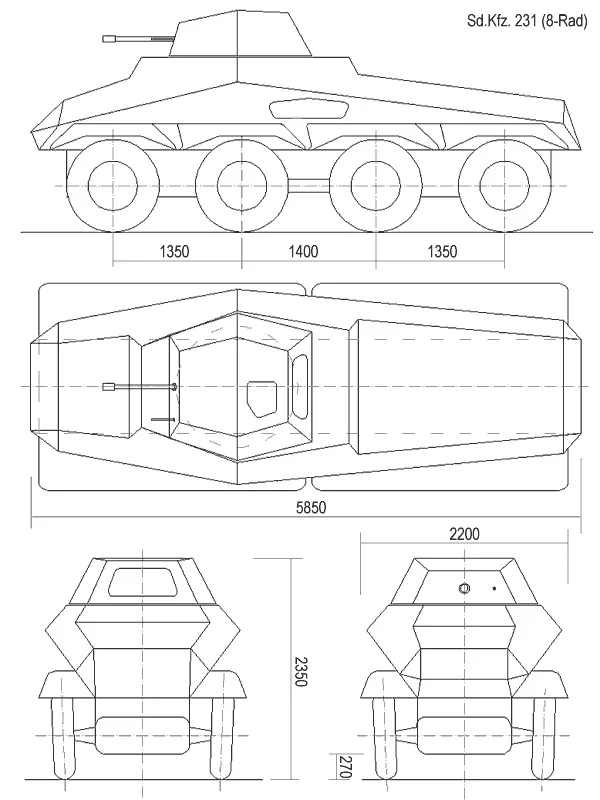
The Ordnance catalogue gives the 231 (8 Rad) an overall length of 5.85 metres, width of 2.20 metres and height of 2.35 metres. Its axle-spacing entry divides the wheelbase into three intervals: 1.35, 1.40 and 1.35 metres. These dimensions describe the gun car rather than the taller radio installation; they should not be applied indiscriminately to every vehicle carrying a 231-series number. 3
The August 1943 American intelligence description treats the eight-wheel cars as a distinct automotive arrangement, with steering at both ends and provision for travel in either direction. It also differentiates the turreted cars from the taller radio vehicle. That distinction is more useful than assuming that every vehicle carrying the 231, 232 or 263 number had the same hull and crew. The report reflects captured-equipment knowledge at a particular point in the war, so its observations should remain tied to the vehicle versions it actually describes. 2
Drive and steering
Power reached all eight wheels. The March 1945 U.S. handbook describes the 231 with an eight-cylinder gasoline engine and quotes 155 brake horsepower. That is the handbook’s stated configuration, not a common engine rating for every production change within the wider family. 4
All eight wheels steered. The 1943 report records six forward and six reverse ratios, with controls at both driving stations. It nevertheless warns that the suspension could deflect under power in mud, sand, snow or dust. 2
Armor thickness varied by location
Protection was unevenly distributed around the 231. The 1945 handbook lists 18 mm at the nose and superstructure front, 15 mm at the turret front, and 8 mm at the turret sides and rear. Quoting only the thickest plate would therefore give a misleading impression of the side protection. These are the handbook’s figures for the 231, not specifications for every related car. 4
Cannon and machine gun
The 231 combined a 20 mm automatic cannon with a coaxial 7.92 mm MG 34. The 232 retained that gun-and-machine-gun arrangement: additional radio equipment did not turn it into an unarmed communications vehicle. Its rotating turret remained part of the installation. 2, 4
Radio and short 75 mm configurations
The 232’s overhead aerial frame pivoted above the turret, with supports toward the rear. The 263 instead had a fixed superstructure and five crew, including two drivers. The two radio vehicles therefore had different crew arrangements and turret operation. 2
The Sd.Kfz. 233 supplied a different kind of equipment. The 1945 handbook explicitly pairs it with the 7.5 cm Kw.K. L/24 in its list of close-support and assault self-propelled artillery. This identifies the short 75 mm support car separately from the cannon-armed 231 and the radio variants. 4
The report describes the conspicuous aerial arrangement on the radio-equipped 232 and the different fixed superstructure associated with the 263. It notes a captured 263 without a machine gun while discussing the type's possible armament. The condition of that captured example therefore should not be converted into a rule that every 263 was unarmed. Equipment removed, damaged or absent on one examined vehicle is not automatically a production-standard feature. 2
Captured vehicles and operating records
A 263 inspected in the Middle East had no fitted armament, according to the 1943 report. An MG 34 could be installed on the type; that one inspected example does not establish that every 263 served unarmed. 2
The Ordnance catalogue records a 180-litre fuel capacity for both its 231 (8 Rad) and 232 (8 Rad) entries. Their separate road and terrain consumption columns also reflect the practical difference between travelling on a road and crossing rough ground. Tank capacity was only one part of operating range; route conditions and consumption affected how far the available fuel could carry the car. 3
Related roles, different chassis
The six-wheel and eight-wheel families shared designation numbers and the ability to drive from either end, but not the same dimensions or running gear. The Ordnance catalogue treated them separately. Its 8 Rad entries describe the larger four-axle vehicles; the six-wheel car had three axles. Similar names and driving arrangements did not make them the same automotive design. 1, 3
Sources and further reading
- U.S. Office of the Chief of Ordnance, six-wheeled Sd.Kfz. 231/232/263 identification
- U.S. Military Intelligence Service, Eight-Wheeled Armored Cars, 26 August 1943
- Office of the Chief of Ordnance, Catalog of Enemy Ordnance, 1945, German pages 74.63-74.64, eight-wheel Sd.Kfz. 231 and 232; full-feed transcription
- U.S. War Department, TM-E 30-451, Handbook on German Military Forces, 15 March 1945, Chapter VII, sections V.6a and VI.5c; published transcription
Visit an Armor Museum
Explore the worldwide museum directory to find armored vehicles, collections, and visitor-planning information.
Browse armor museums