Requirement and development
Rooikat was created for a South African reconnaissance problem dominated by distance, heat, rough ground, mine threats, and the need to operate far from dense logistical infrastructure. The South African Armour Museum dates development from 1982, a final prototype to 1987, and service acceptance to 1989. Designers emphasized mobility, protection appropriate to reconnaissance, and a gun powerful enough to influence armored contacts. The result was larger and more heavily armed than many European scout cars. Rather than conceal itself through tiny dimensions, Rooikat sought the endurance and mobility to range widely while retaining the ability to fight light and older armored threats encountered during reconnaissance and security missions. 1, 2, 3
Layout, crew, and architecture
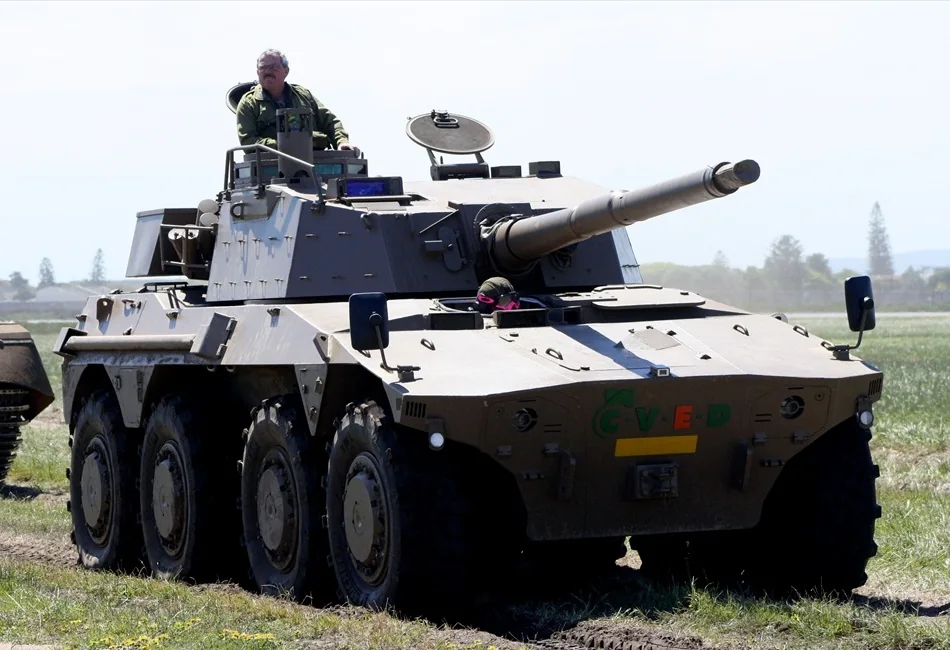
Rooikat is an 8×8 armored fighting vehicle with a four-man crew and a fully rotating turret carrying the GT4 76 mm gun. The South African Armour Museum gives a combat mass of 28 tons, placing the vehicle well above small scout cars such as Ferret or Fennek. Independent suspension, a powerful diesel, and a long hull were part of a design optimized for speed and ride over large operating areas. The turret gave the commander and gunner strong direct-fire capability, but the vehicle still belonged to the reconnaissance tradition: its automotive range, crew observation, and ability to maintain high tempo over long routes were as important as the gun itself. 1, 2, 3
Mobility and operational reach
Museum data lists road speed of 120 km/h, cross-country speed around 50 km/h, road range of 1,000 km, and cross-country range around 500 km for the Rooikat 76 Mk1C/Mk1D lineage. Fully independent trailing-arm suspension and an 8×8 drivetrain supported movement across terrain where long road marches could be followed by extended cross-country patrols. Those figures reflect the South African requirement for operational reach without constant transporter or fuel support. Mobility also contributed to survivability by allowing reconnaissance forces to choose routes, maintain standoff, and reposition quickly across wide fronts. The vehicle’s size and weight, however, imposed a larger logistical footprint than very light scouts. 1, 2, 3
Protection and survivability
The Rooikat combined armored protection with a chassis designed for long-distance movement. It was not protected to main battle tank standards. Mines, ambushes and operations at a distance from heavy support shaped the reconnaissance requirement, while the crew still depended on mobility, observation and route selection to avoid prolonged exposure to heavier weapons. 1, 2, 3
Weapons, sensors, and reconnaissance task
Rooikat’s stabilized 76 mm GT4 gun gave the reconnaissance vehicle unusually strong direct-fire capability. That broad role explains why the gun mattered: the platform was expected not only to observe but also to dominate lighter vehicles and protected positions encountered during wide-ranging patrols. The same breadth creates classification ambiguity, since Rooikat can look like a wheeled tank in photographs. Its doctrine and mobility, however, place reconnaissance and security at the center of the original design. 1, 2, 3
Variants and configuration changes
The production Rooikat 76 and later demonstrations with other weapons must be kept distinct. The South African Armour Museum describes the conversion of 80 Mk1C vehicles to Mk1D standard between 2000 and 2006 under Project Arum Lily. This was a modernization within the 76 mm fleet, not evidence that the entire force received a 105 mm gun. Its Mk1C/Mk1D exhibit material is also the context for the road and cross-country performance figures quoted here. 1
Project Arum Lily is a useful dated modernization boundary. The South African Armour Museum states that about 80 Mk1C vehicles were brought to Mk1D standard between 2000 and 2006. The project belongs to the service history of the 76 mm fleet; later 105 mm and other proposed or demonstrated Rooikat configurations should not be folded into Mk1D data unless a source explicitly connects them. 1
Operational service and employment
The South African Armour Museum describes Rooikat as a combat-reconnaissance vehicle expected to scout, support other forces, engage lighter armored threats, and operate over long distances. Its service history therefore belongs to a reconnaissance system that could fight when required, not to a wheeled tank category created only from the size of its gun. The same museum separates the original Mk1C fleet from the later Mk1D modernization, a useful boundary when discussing service configuration. 1
Limitations and tradeoffs
Rooikat achieves endurance and firepower by accepting the size, weight, and complexity of a relatively large 8×8 fighting vehicle. Those characteristics can make concealment more difficult than with a small sensor scout and increase fuel, tire, and maintenance requirements. The 76 mm gun broadens tactical options but also creates the risk of using reconnaissance crews in direct-fire tasks against threats that exceed the vehicle’s protection. Its mobility is well matched to large operating areas but cannot eliminate terrain restrictions faced by wheeled vehicles. The design therefore works best when commanders exploit its reach and information-gathering role rather than judging it by tank criteria. 1, 2, 3
Assessment and related development
Rooikat 76 combined a large wheeled chassis, four-person crew and 76 mm gun for combat reconnaissance. Its long-range automotive performance was part of the mission, not simply a road-speed demonstration. The Mk1D program continued the 76 mm line through modernization. Demonstrators with other weapons belong alongside that service history, but should not replace it. 1, 2, 3
Sources and further reading
References and further reading are listed below. Image identification, credit and reuse terms remain with each photograph.
- South African Armour Museum — Rooikat 76 Mk1C
- South African Armour Museum — vehicle exhibits
- Rooikat overview
See Armor in Person
This vehicle family is connected to 1 verified museum through 1 documented display record.