From naval improvisation to an armored-car pattern
The Rolls-Royce armored car grew from the Royal Naval Air Service’s use of improvised armored vehicles early in the First World War. The Admiralty then obtained purpose-built cars, bringing a machine-gun turret and armored body to the Rolls-Royce chassis. Their mobility was useful where roads and open ground allowed movement, but the developing trench system reduced opportunities on the Western Front. The Middle East offered a different setting for the same combination of wheels, armor and machine gun. 1
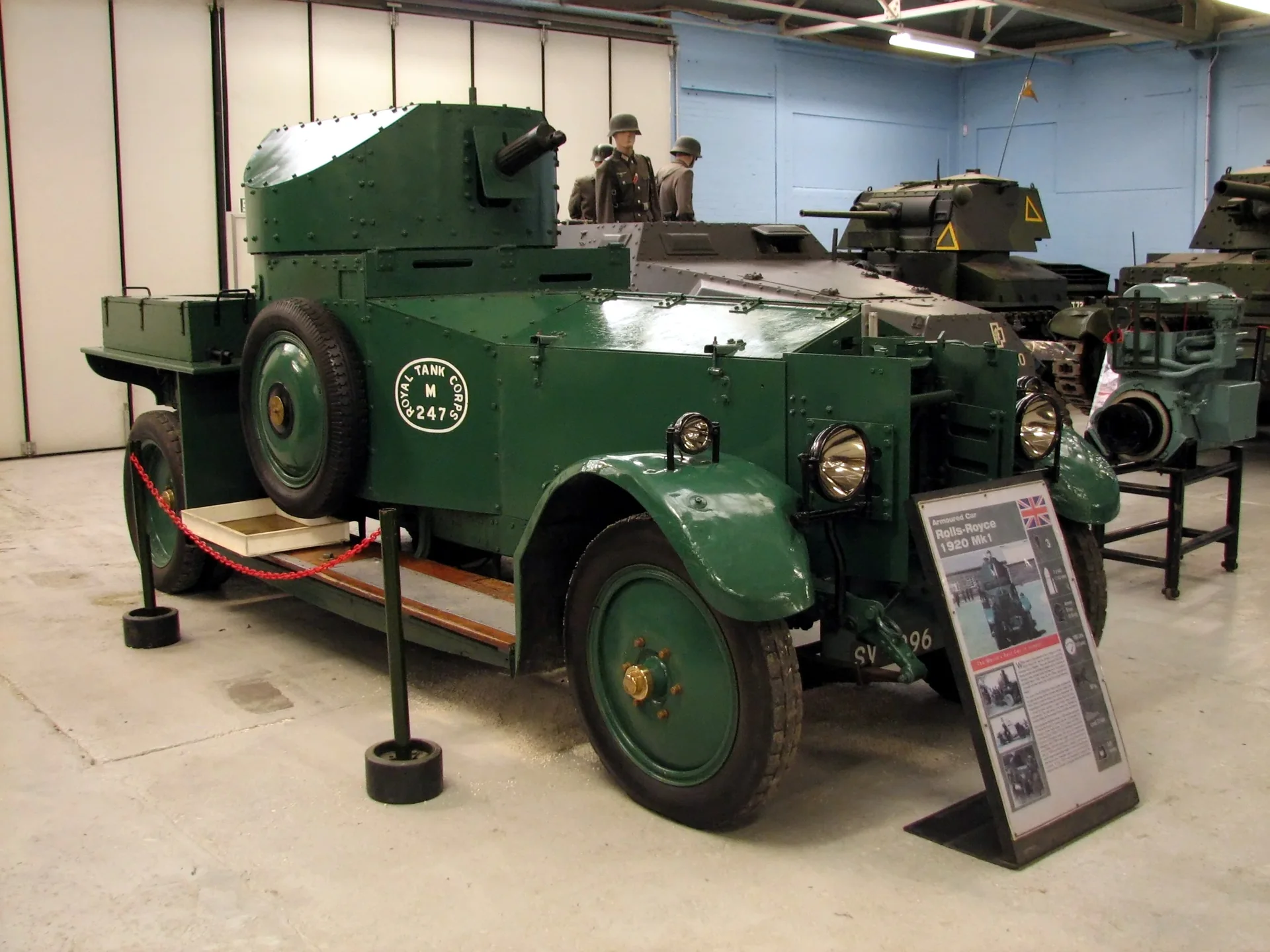
Production did not end with the wartime design. A 1920-pattern car preserved by The Tank Museum began with a chassis built at Derby, received its armored body at Woolwich in October 1920, and was delivered to the War Office that November. The sequence separates the automotive manufacture from the fitting of military armor. It also places that survivor firmly in postwar production, rather than among the cars improvised by naval personnel in 1914. 2
Silver Ghost machinery and a three-person crew
The Irish Defence Forces’ preserved Sliabh na mBan retains the basic mechanical identity of the type: a Silver Ghost chassis, a water-cooled six-cylinder petrol engine of 7,434 cc, and four forward gears with one reverse. Leaf springs and friction dampers supported the vehicle, with twin tires at the rear. A three-person crew served its .303-inch Vickers machine gun. The 40/50 designation identifies the Rolls-Royce chassis model; it should not be read as a modern measured-power specification. 4
Army service and RAF experiments
Between the wars, Rolls-Royce armored cars served in places including Ireland, Shanghai, Iraq and India. The British Army still held 76 in 1939. Some remained in Britain for defense duties, while the 11th Hussars used them in Egypt during Operation Compass. Their continued service did not mean the design had ceased to age; it meant that a familiar armored car could still be employed where its particular mobility and armament were useful. 1
The RAF began using Rolls-Royce cars in Iraq, Palestine and Transjordan in 1922. Open desert suited them better than broken or rocky ground. In 1923 the Air Ministry pursued a tracked alternative using the Royal Ordnance Factory’s Dragon artillery tractor. The scheme allowed a Rolls-Royce armored body and turret to be carried on the tractor, with an armored driving position added. Only two went to Iraq for trials. 3
Those experiments followed separate careers. One became an armored personnel carrier; the other retained a turret. Known as Seal and Walrus, the tracked machines were still involved in the defense of Habbaniya in 1941. They demonstrate an effort to adapt existing armored bodies to difficult terrain, but they were not an additional wheel or suspension option on the standard Rolls-Royce car. Their unusual photographs belong to the history of those two conversions. 3
The Tank Museum traces the 1920 Pattern beyond the First World War into interwar service in Ireland, Shanghai, Iraq and India. It states that the Army still held 76 Rolls-Royce armored cars in 1939, with vehicles in Britain used for home defense and the 11th Hussars employing them in Egypt during Operation Compass. The museum's own 1920 vehicle also served in Ireland, Shanghai and Egypt before returning to Britain, providing a specific survivor history rather than a universal fleet itinerary. 1
Sliabh na mBan and the 1920 survivors
Sliabh na mBan, registration ARR2, was one of thirteen 1920-pattern cars acquired by the Irish National Army after the 1921 treaty. It accompanied Michael Collins’s convoy at Béal na Bláth on 22 August 1922. Retired in March 1947, it was retained at the Curragh rather than disposed of with the other cars. Its later refurbishment preserved a specific vehicle with an identifiable military history, not simply a representative body placed on a convenient chassis. 4
The Tank Museum’s centenary account described its own 1920 car as still running in 2020. That is a dated observation about a preserved machine, not a claim that all survivors remain mechanically original or operational. A working restoration can convey the scale, sound and arrangement of the vehicle, while its chassis history establishes when it was actually made. Those two kinds of evidence are complementary. 2
A design sustained by changing employment
The Rolls-Royce story spans naval armored-car origins, interwar policing and military service, desert operations, and specialized experiments. The separate lives of the wheeled cars and the RAF’s tracked conversions show how an armored body could outlast its initial tactical setting. Their service should not be reduced to a single desert image or a single famous passenger: production pattern, operator and individual chassis history all affect what a surviving car represents. 1, 3
Sources and further reading
References and further reading are listed below. Image identification, credit and reuse terms remain with each photograph.
- The Tank Museum, Rolls-Royce Armoured Car
- The Tank Museum, Iconic Rolls-Royce Armoured Car turns 100 years old, 10 November 2020
- RAF Museum, Bryan Legate, Two Dragons or a Seal and a Walrus?, 8 September 2014
- Irish Defence Forces, Sliabh na mBan
Visit an Armor Museum
Explore the worldwide museum directory to find armored vehicles, collections, and visitor-planning information.
Browse armor museums