Requirement and development
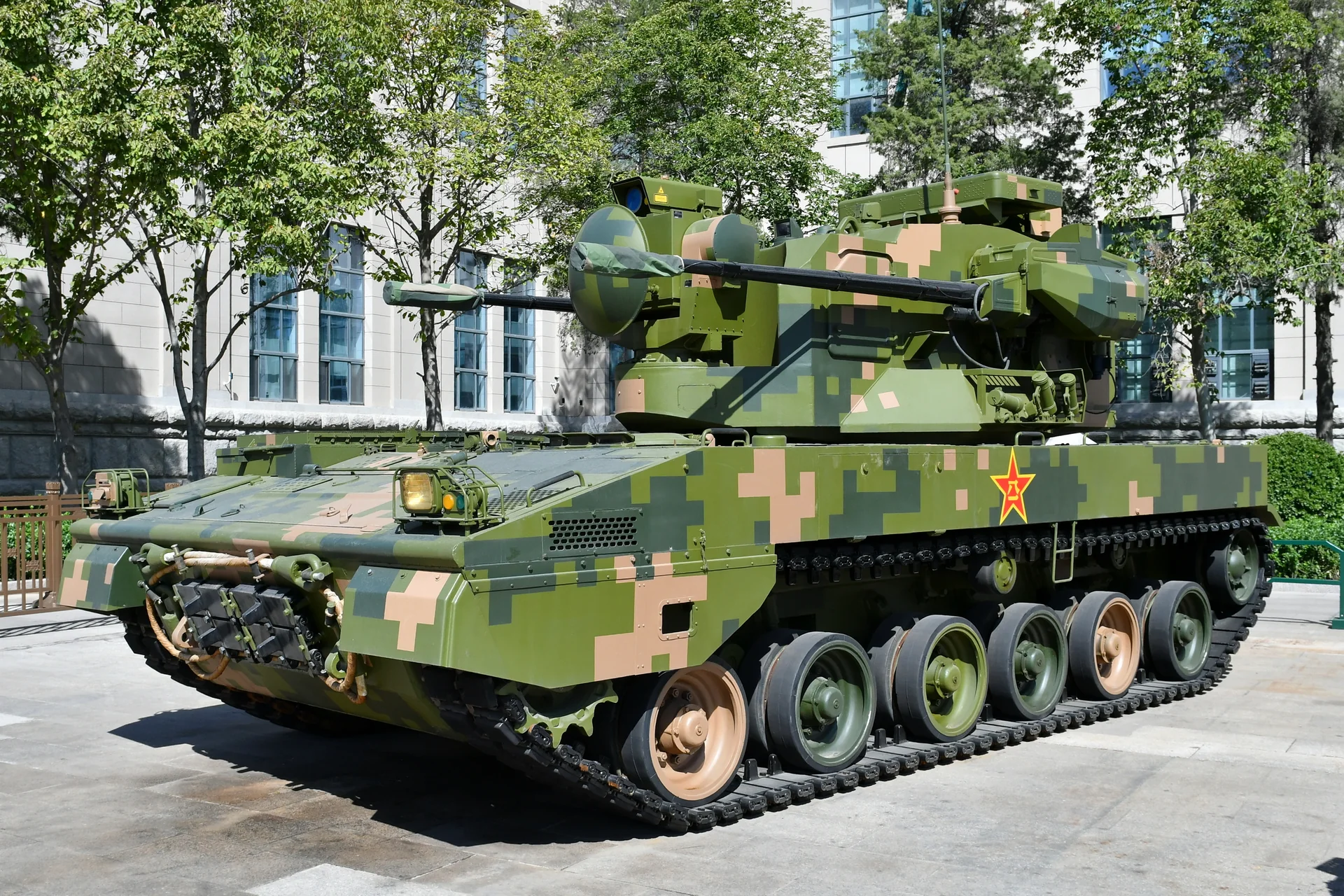
PGZ-09 belongs to China’s development of self-propelled 35 mm air-defense guns. It combined larger-caliber weapons with a tracked carrier and an integrated sensor installation rather than simply changing the barrels on PGZ-95. The distinction between gun ancestry and vehicle ancestry is important: the related towed Type 90/PG99 gun is not a complete description of PGZ-09. Published introduction dates and exact automotive relationships are less securely established than the recognizable twin-gun arrangement, so they should not be treated as a single settled specification. 1, 2, 3
Vehicle architecture and crew arrangement
The Australian Army’s Decisive Action Training Environment is a training-adversary system. Its PGZ-09 equipment entry lists twin 35 mm guns and a crew of three. Those are fields in a training reference, not a Chinese operator’s technical specification or an acceptance-test report. They do not establish an engine model or a shared production chassis with PLZ-05. A similar external arrangement is insufficient to settle that automotive relationship. 3, 4
Weapons and engagement concept
The DATE entry gives a maximum range of 4,000 m for the twin-35 mm system. It does not define a target-specific firing envelope, ammunition type, test conditions or measured probability of effect. The figure is therefore attributed to the training reference rather than presented as an operator-certified engagement distance. Missile fittings and programmable ammunition require separate configuration evidence. Neither is established merely by the caliber or the short training entry. 3
Sensors, fire control, and target information
PGZ-09 combines search and tracking functions associated with the turret, alongside optical or electro-optical equipment. These distinguish the self-propelled system from a towed gun that depends on a separate director. Detection distance is not gun range: search equipment may find a target before it enters the local engagement zone. Precise radar figures depend on the actual set, target and conditions, however, and the available evidence does not justify presenting one quoted distance as universal across the vehicle’s configurations. 1, 2, 3
Mobility, protection, and sustainment
The tracked carrier gives the turret, ammunition and electronics a mobile base for service with mechanized formations. Its payload includes more than the guns: sensors, electrical power, crew stations and stowage all occupy weight and space. Those demands help explain the substantial carrier beneath the turret without establishing an exact engine output. Automotive figures for a related artillery chassis cannot be transferred automatically. Armor and tracked mobility support the air-defense mission rather than making PGZ-09 a tank substitute. 1, 2, 3
Place in the air-defense system
PGZ-09 functions within a layered PLA ground-force air-defense structure that also includes short- and medium-range missiles. Its radar and cannon give it a close-defense role against targets that penetrate other layers or are uneconomical to engage with larger missiles. External air-defense networks can provide earlier cueing, while the onboard sensors allow the vehicle to complete tracking and engagement locally. 1, 2, 3
The Australian Army's training reference describes a three-person PGZ-09 with two 35 mm guns and assigns it a short-range air-defense role. Its significance as evidence is specific: it shows how a foreign military represents the vehicle for training and equipment recognition. It is not a Chinese issue table or a factory acceptance document. In particular, the range shown in such a compact reference should not be expanded into a universal engagement envelope covering every aircraft, missile and unmanned target named in its role description. 3
Variants and modernization
Older public descriptions use several labels for Chinese 35 mm self-propelled systems, including PGZ-07 and Type 07. Similar appearance and earlier reporting names do not establish identical production standards. PGZ-09 identifies the twin 35 mm tracked gun vehicle in this account, while optional missile installations and ammunition developments remain configuration-specific. The presence of a fitting on one vehicle is not evidence that every vehicle in the family received it. 1, 2, 3
Service history and operators
Retained histories associate PGZ-09 with Chinese field air defense from around the end of the 2000s. The DATE entry supplies a training category, not a service-entry certificate or a unit replacement record. It cannot show which formations exchanged earlier systems for PGZ-09, or how many vehicles were available at a later date. No current quantity, readiness or complete replacement claim is derived from it. 3, 4
Constraints and changing threat environment
The 35 mm guns provide useful range and projectile effect but still defend a comparatively local volume of airspace. Radar line of sight, ammunition expenditure, and the exposure created by active emissions remain important constraints. Small unmanned aircraft also create an economic and detection challenge: guns can be attractive compared with missiles, but only if sensors can find and track the target early enough for the short gun engagement window. 1, 2, 3
The same entry's crew and armament information belongs to the PGZ-09 as described on that page. It does not establish that every vehicle photographed under a similar English label has identical missiles, radar equipment or ammunition. Keeping the identified twin-gun vehicle separate from proposed or later combinations avoids creating a composite specification assembled from several different systems. The publication history and exact equipment standard remain more useful identifiers than an unqualified claim that all later Chinese gun vehicles share one sensor package. 3
Historical place
PGZ-09 shows the continuing relevance of radar-directed automatic cannon in an era dominated by surface-to-air missiles. China combined a larger 35 mm weapon with modern sensors and a heavy tracked chassis, reflecting the need to defend maneuver forces against both traditional aircraft and increasingly small precision or unmanned threats. The vehicle also marks a clear technological step from the 25 mm PGZ-95 toward a more sensor-intensive close-defense layer. 1, 2, 3
Sources and further reading
- GlobalSecurity , PGZ-09 overview
- GlobalSecurity , PGZ-09 specifications
- Australian Army DATE equipment reference, PGZ-09
- Australian Army, Decisive Action Training Environment overview
Visit an Armor Museum
Explore the worldwide museum directory to find armored vehicles, collections, and visitor-planning information.
Browse armor museums