Requirement and development
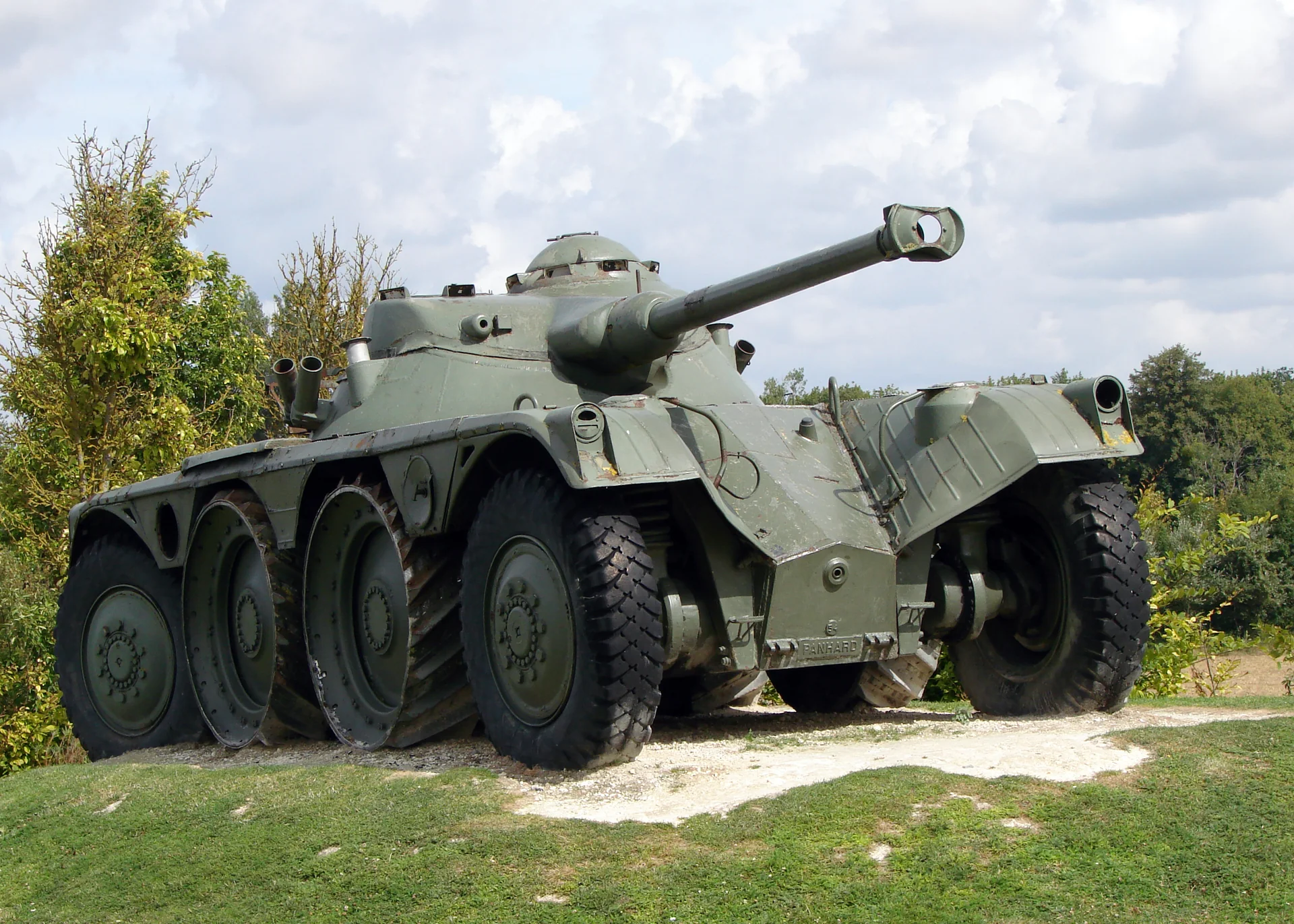
The EBR emerged from French work on a purpose-built wheeled reconnaissance vehicle, with a low hull, two driving positions and an unusual arrangement of retractable central wheels. Its development and later turret changes should be traced as separate stages rather than treated as a single fixed design. The retained manufacturer-history references require full-page reconciliation before precise program decisions or production milestones are treated as settled. 1, 2, 4
Layout, crew, and automotive architecture
The EBR's architecture was remarkable even by French postwar standards. Four conventional pneumatic tires at the corners handled normal road travel, while four metal center wheels could be lowered for cross-country movement, distributing weight and adding traction. The hull was nearly symmetrical and included a driver at each end, allowing the vehicle to reverse direction quickly without performing a large turn. A low-profile oscillating turret sat above the center, and the flat multi-cylinder Panhard engine was packaged under the fighting compartment to preserve the dual-driving layout. This produced a compact and tactically flexible vehicle, but the mechanical complexity made maintenance and crew training more demanding than on ordinary truck-derived armored cars. 1, 2, 4
Mobility and terrain behavior
On roads, the EBR could travel quickly on the four outer pneumatic wheels with the central wheels raised. For rougher terrain, lowering the middle metal wheels transformed the contact pattern and reduced ground pressure, giving the vehicle a cross-country ability unusual for a wheeled scout of its era. The second driving station was just as important: a reconnaissance patrol could disengage along its own route without turning the vehicle under observation. Arquus cites long range and high road speed as central to the original requirement, while the vehicle's complicated transmission and wheel system imposed a maintenance cost for that mobility. It was a sophisticated answer to French cavalry needs, not a general-purpose solution that every army could support easily. 1, 2, 4
Protection and survivability
The EBR used a sharply shaped armored hull intended to defeat small-arms fire and fragments while keeping mass within the limits of a reconnaissance vehicle. Its low silhouette and ability to reverse rapidly contributed as much to survivability as plate thickness. The oscillating turret minimized frontal area but introduced distinctive sealing and mechanical considerations. As weapons improved, the EBR could not rely on armor to withstand tank or anti-tank fire; its doctrine depended on speed, scouting, and selective use of its gun. The two driving positions also meant that crew protection and visibility had to be provided at both ends, one reason the hull appears unusually symmetrical compared with conventional armored cars. 1, 2, 4
Armament, observation, and communications
Early EBRs used 75 mm armament in French oscillating turrets, giving reconnaissance units much more firepower than a machine-gun scout. Later modernization reflected changing threats. Arquus records a program beginning in 1964 that converted hundreds of FL11-turret vehicles to a 90 mm gun related to that used by the AML-90, improving anti-armor capability while retaining the established chassis. Other EBRs used different turret and gun combinations, so the family cannot be summarized by one weapon. The armament supported the French concept of aggressive reconnaissance and cavalry screening, but the EBR still relied on radios, observation, and mobility to perform its principal role. 1, 3, 4
Variants and production evolution
The main distinctions are the turret and gun configurations. FL11 and FL10 installations carried different 75 mm weapons, while the later FL11 modernization introduced 90 mm armament. Their similar hulls and running gear can obscure substantial differences in the fighting compartment and ammunition. The broader Panhard lineage also includes related vehicles, but that does not establish an unlisted command or specialist EBR variant. A photograph should be identified by turret and weapon standard before a set of specifications is assigned to it. 1, 3, 4
Operational service
The retained histories place EBR in French cavalry service from the early 1950s into the early 1980s, including assignments in Europe and North Africa. Its two driving stations and substantial gun distinguish the vehicle’s reconnaissance arrangement, but they do not prove why an individual unit retained or replaced it. The appearance of AML or AMX-10RC is a later equipment development, not in itself a documented verdict on EBR maintenance costs or weapon usefulness. 1, 2, 4
Historical place
The EBR departed from truck-based armored-car design through its liftable center wheels, two driving stations, low engine installation and oscillating turret. These features addressed mobility and armed reconnaissance together, rather than making the gun the vehicle’s sole purpose. Later French cavalry vehicles retained substantial direct-fire power without copying the whole mechanism. EBR is therefore a distinctive branch of that lineage, not a universal template for every later wheeled scout. 1, 2, 3, 4
Its arrangement also complicates identification and preservation. Hull appearance alone is insufficient to distinguish the 75 mm and 90 mm standards, and the unusual under-floor engine and wheel system are as important to understanding the vehicle as the turret. A surviving display can show one configuration while representing a chassis that passed through several equipment states. Keeping those states separate avoids turning a long modernization history into an apparently fixed design. 1, 2, 3, 4
Sources and further reading
References and further reading are listed below. Image identification, credit and reuse terms remain with each photograph.
- Arquus Heritage , EBR requirement and development
- The Tank Museum , Tank Chats #167 Panhard EBR
- Arquus Heritage , EBR FL11 90 mm modernization
- Arquus , EBR history publication and service summary
Visit an Armor Museum
Explore the worldwide museum directory to find armored vehicles, collections, and visitor-planning information.
Browse armor museums