Requirement and development
France sought a light, well-armed reconnaissance vehicle in the late 1950s to replace Ferret scout cars and support operations where the larger EBR was more vehicle than the mission required. Arquus dates the AML prototype to 1959 and French service from 1960. Panhard deliberately designed a compact three-man 4×4 chassis that could accept different turrets rather than locking the vehicle into one weapon. This modularity became central to export success. The AML-60 addressed reconnaissance and fire-support needs with a mortar-based turret, while the AML-90 added a 90 mm gun for greater direct-fire capability. Reduced French orders encouraged Panhard to pursue foreign markets, turning a relatively small domestic scout into a global armored-car family. 1, 2, 3, 4
Arquus Heritage places the French requirement for a light, well-armed successor to the Ferret in 1958, with an AML prototype completed in 1959. Its AML-60 history says that configuration entered French Army and Gendarmerie service in 1960 and remained until the mid-1990s. Those dates belong to the AML-60 branch; they provide useful family chronology without making the mortar carrier's weapon installation or later withdrawal details universal to AML-90 export vehicles. 2
Layout, crew, and automotive architecture
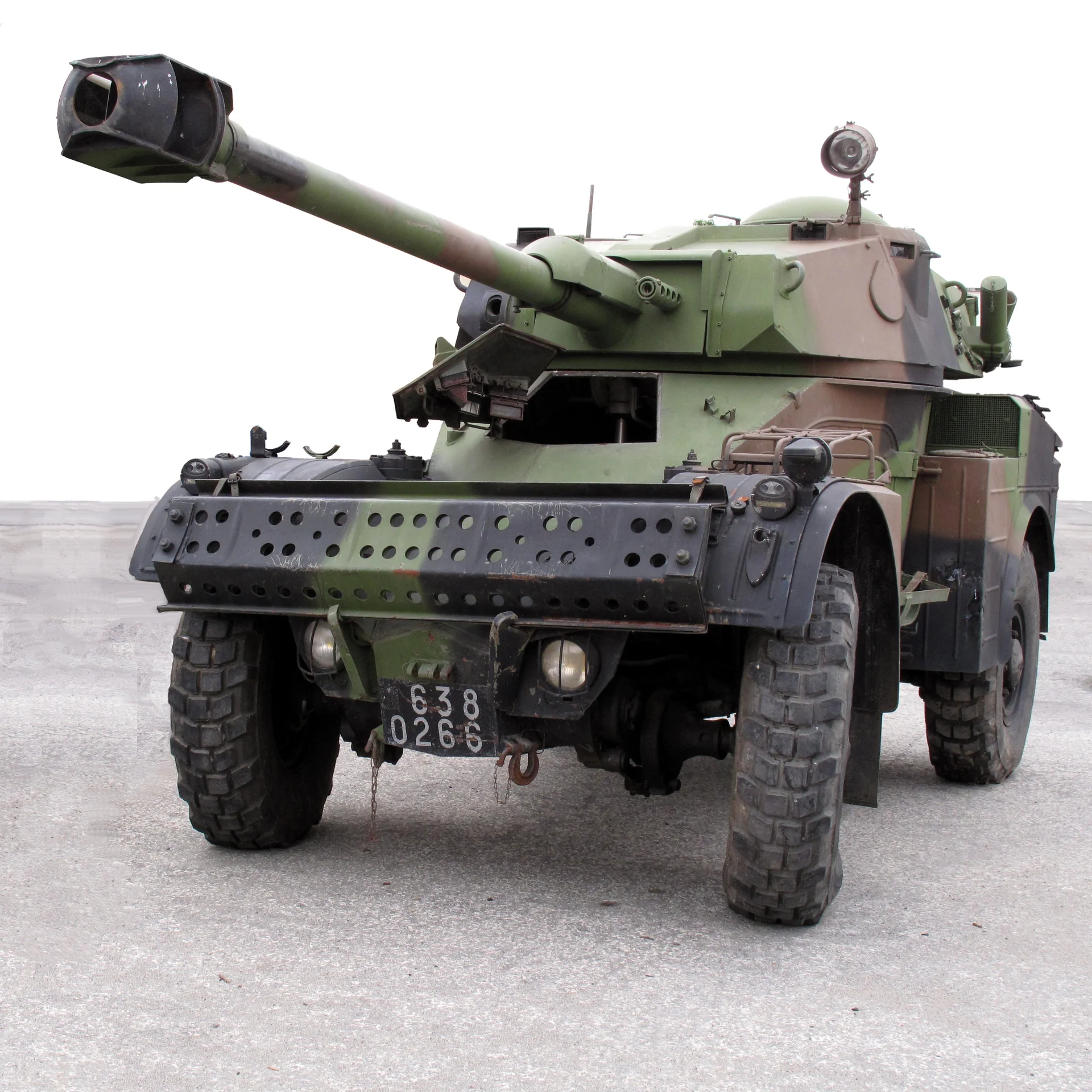
The AML placed the driver in the front hull, a two-man turret in the center, and a compact Panhard engine at the rear. Its small dimensions and three-man crew produced a low mass suitable for air transport and use on roads and bridges that constrained heavier vehicles. The hull used sloped welded armor and a characteristic pointed front, while different turrets changed the vehicle's height, ammunition stowage, and tactical role. Arquus notes that the AML-60 and AML-90 shared the basic automotive platform but differed significantly in fighting-compartment equipment. This common-chassis approach simplified logistics for users that operated multiple variants and helped explain why the AML family could spread across armies with very different budgets and missions. 1, 2, 3
Mobility and terrain behavior
The AML was optimized for speed, range, and deployability rather than for the extreme cross-country performance of tracks. A light 4×4 chassis with independent suspension and a compact engine gave it high road speed and useful mobility on firm ground, while the small size eased transport by air and movement over weak infrastructure. Arquus emphasizes varied-terrain performance and the ability to cross relatively demanding slopes and ditches for such a light vehicle. Deep mud, very soft sand, and severe obstacles still imposed limits, especially because there was no central tire-inflation system on early standard vehicles comparable to later designs. In expeditionary service, the ability to move far on roads and tracks often mattered more than absolute off-road capability. 1, 2, 3, 4
Protection and survivability
AML armor was intentionally light so the vehicle could remain compact and mobile. The welded hull protected against many small-arms and fragment threats but could not support tank-like employment, particularly once heavy machine guns, autocannon, mines, and modern anti-armor weapons became widespread. The crew also worked in a very small internal volume, making ergonomics and ammunition stowage important constraints. The pointed hull front and low silhouette improved the protection-to-weight balance without changing the fundamental category. South African Eland derivatives and later rebuilds introduced local changes, but they did not erase the basic AML principle: reconnaissance survivability came from mobility, concealment, and information, with armor providing a useful margin rather than permission to fight head-on. 1, 2, 3, 4
Armament, observation, and communications
AML armament depended on the turret configuration. AML-60 combined a 60 mm mortar with machine guns, while AML-90 carried a 90 mm gun in a two-person turret. These gave the same compact carrier different support and direct-fire roles. A turret designation should not be inferred solely from the caliber, and the shared 90 mm caliber of several French armored-car weapons does not establish ammunition interchangeability. Turret, gun and national equipment fit need to be identified together. 1, 2, 3, 4
Variants and production evolution
AML-60 and AML-90 were the most famous branches, but the platform supported many turret and export configurations. Arquus records thousands of vehicles sold to roughly thirty countries and notes large-scale licensed production in South Africa as the Eland. The Eland itself developed into a distinct local family with South African automotive and equipment changes, so it should not be treated as simply a French-built AML with different markings. French vehicles also received updates over their service lives. The family illustrates the commercial strength of a modular chassis: by changing turrets and local components, operators could tailor the same basic armored car to reconnaissance, patrol, internal-security, and direct-fire roles without buying an entirely different fleet. 1, 2, 3, 4
Operational service
AMLs served in French units from 1960 into the 1990s and were deployed widely overseas. Arquus notes early operational use for route security, reconnaissance, and public-order missions, while export customers employed AMLs in conflicts across Africa, the Middle East, and elsewhere. The vehicle's small size and modest logistical demands were important advantages where road infrastructure and heavy transport were limited. At the same time, combat repeatedly showed the risks of committing lightly armored cars against stronger weapons. Some operators retained or modernized AML-derived vehicles for decades because they were simple, familiar, and relatively inexpensive, even after newer reconnaissance vehicles offered better protection, sensors, and automotive performance. 1, 2, 3, 4
Historical place
The AML became one of the clearest demonstrations of the postwar light armored-car formula: compact size, good road mobility, modular weapons, and export affordability. Its commercial success influenced Panhard's later M3, ERC, VCR, and VBL-era thinking and showed that reconnaissance vehicles did not need to grow continuously heavier to remain useful. The AML-90 also highlighted the appeal, and danger, of placing a relatively large gun on a very light chassis. Later French designs split the mission more clearly between lightly protected scouts such as VBL and heavier gun vehicles such as AMX-10RC and Jaguar. The AML sits between those categories and explains why many armies found a small armored car so adaptable for so long. 1, 2, 3, 4
Export history magnified the AML's influence beyond French doctrine. Countries with limited heavy-vehicle infrastructure could obtain a small armored car that was easier to transport and maintain than a tank while still selecting a turret appropriate to local missions. Licensed Eland production in South Africa demonstrated how far the concept could be localized. That adaptability also explains the AML's longevity: users could rebuild engines, sights, radios, or turrets without discarding the entire fleet. Its success was commercial and organizational as much as purely technical. 1, 2, 3, 4
Sources and further reading
References and further reading are listed below. Image identification, credit and reuse terms remain with each photograph.
- Arquus Heritage , presentation of the Panhard AML prototype
- Arquus Heritage, Panhard AML 60
- Arquus Heritage , Panhard AML 90
- Panhard AML overview
Visit an Armor Museum
Explore the worldwide museum directory to find armored vehicles, collections, and visitor-planning information.
Browse armor museums