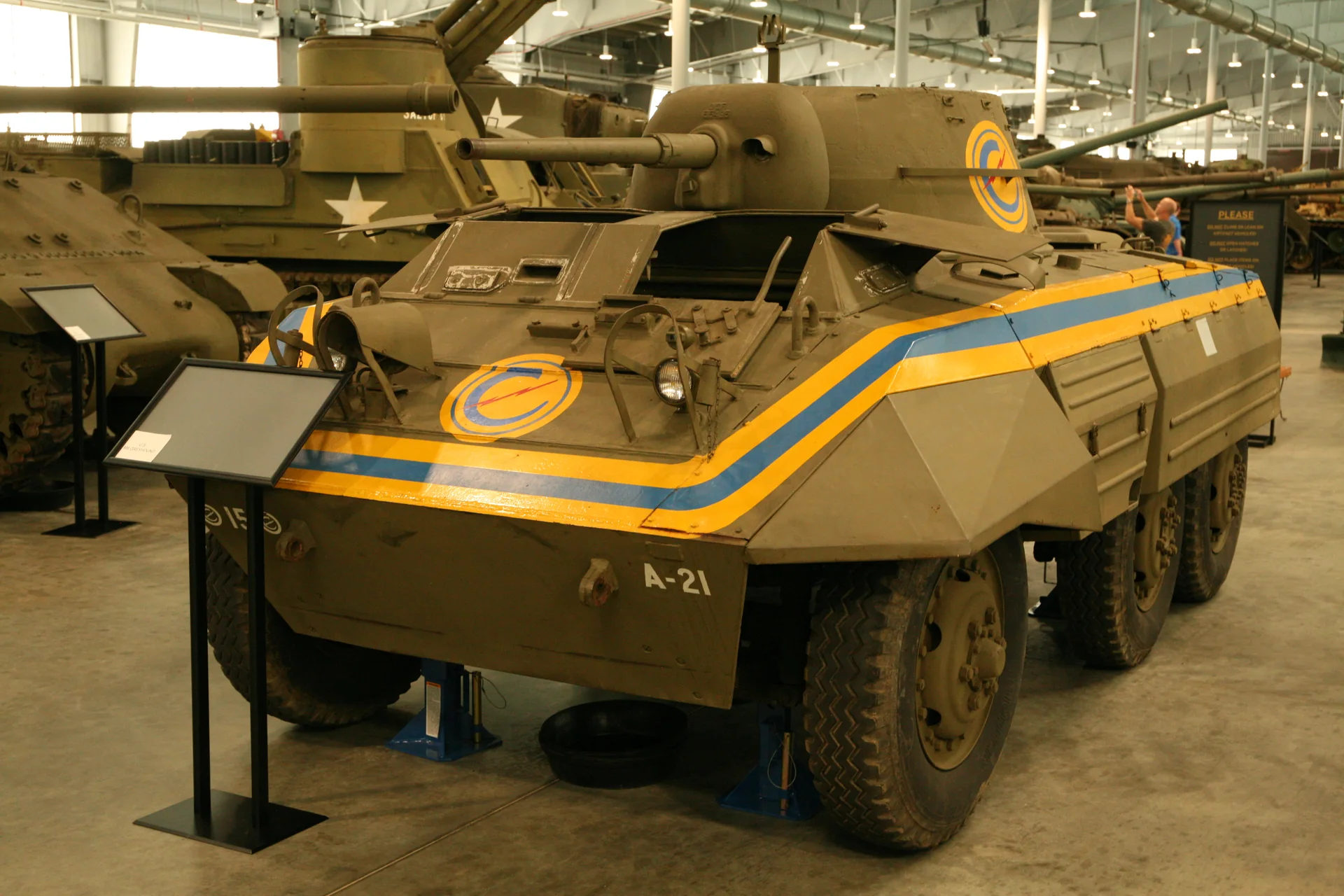
From an antitank requirement to reconnaissance
The M8 began as an answer to an American requirement for a light antitank vehicle. By the time it reached service, its 37 mm gun and thin armor were better suited to reconnaissance than to fighting the principal enemy tanks. The change of role preserved the value of a fast wheeled chassis while abandoning the expectation that its small gun would make it a front-line tank destroyer. Ford’s armored car became a means of finding and reporting the enemy rather than a substitute for a medium tank. 1
The M20 took the same basic vehicle in another direction. Removing the turret created an open working compartment for command and utility duties. Its early designation, M10 armored utility car, was changed to M20 to avoid confusion with the tracked, 3-inch-gun M10 tank destroyer. The two wheeled cars thus shared automotive ancestry but served different functions within mobile formations. 5
The Museum of the American G.I. records 8,523 M8 Greyhounds and describes the vehicle's shift from an antitank requirement to reconnaissance after its 37 mm gun and light armor proved inadequate for the original tank-destroyer role. The same collection record lists a four-man crew and the 37 mm M6 gun. Those figures describe the M8, not the turretless M20 utility car, whose crew space and mission differed despite the shared chassis. 1
The six-wheel chassis and turret
The March 1943 technical manual described a six-wheel-drive vehicle with its Hercules JXD engine at the rear. A conventional steering wheel controlled the front wheels. The transmission and transfer arrangement provided eight forward and two reverse ratios. The crew’s working area occupied the hull ahead of the engine, with the turret above it. Rear engine placement separated the powerplant from the driving positions but left the crew dependent on communications inside a compact, noisy armored body. 2
The turret could be turned by hand through a complete circle, and its two seats moved with it. In front, the driver and assistant driver had protected vision arrangements. The 37 mm M6 gun and coaxial machine gun gave the car more firepower than an unarmored scout vehicle, but its armor remained light. The hand-worked turret and small crew also placed practical limits on how quickly the car could observe, communicate and engage at the same time. 1, 2
Four men and overlapping jobs
The cavalry crew manual assigned the M8 four men: a commander, gunner, driver and radio operator. The commander also acted as loader for the turret gun. That combined job matters when considering the vehicle’s effectiveness. While handling ammunition, the commander was also responsible for directing the car and observing the situation outside. The arrangement saved space and manpower, but concentrated several demands on one member of a small crew. 3
Communications were a separate responsibility, not a task left to whoever was free. The radio operator’s routine included the aerials, connections, headsets and radio equipment, while the crew shared inspections and maintenance. A reconnaissance report was useful only after it reached the formation that needed it. The radio and the crew’s ability to keep the car running were therefore as central to its mission as the gun in the turret. 3
Work ahead of the gun companies
M8s also served in the reconnaissance elements of tank-destroyer battalions. The November 1944 reconnaissance manual showed them operating with quarter-ton vehicles, rather than as an independent line of gun cars. The platoon’s tasks included examining routes to combat areas, searching ground ahead of the battalion, maintaining contact with the enemy and protecting the battalion’s movement. The armored cars formed part of an information-gathering organization supporting heavier weapons. 4
The manual stressed accurate, prompt reporting and obtaining information without fighting when possible. Combat could become necessary for protection or to complete a mission, but destroying tanks was the gun companies’ work. In that setting, the M8’s cannon provided local support and a measure of security while scouts established what lay ahead. Success could consist of discovering an obstacle or enemy position in time to prevent the main body from entering trouble. 4
Road mobility and wartime employment
The M8 entered combat in Italy in 1943 and also served in the Pacific. Its quiet engine and road speed suited reconnaissance, although difficult ground limited mobility. Fast road travel did not guarantee that it could follow tanks across broken or soft terrain. American service continued beyond the Second World War, ending after the Korean War. 1
For a scout car, mobility was also a matter of crew workload and mechanical condition. The wartime technical manual paired its description of the vehicle with extensive inspection and maintenance requirements. A high maximum speed offered little benefit if a fault stopped the car before its report reached headquarters. The M8’s everyday effectiveness depended on the automotive system, the radio installation and four men keeping both in order. 2, 3
The M20 utility car
The M20 replaced the M8 turret with a low armored superstructure and an open compartment. A ring-mounted .50-caliber machine gun provided its principal mounted armament. Command vehicles carried additional radio equipment, and the type also transported personnel or cargo. Ford manufactured more than 3,700 during 1943 and 1944. Its value lay in carrying people and equipment under some armor while retaining the mobility of the wheeled family. 5
Removing the turret sacrificed the 37 mm gun but released space for a command party or useful load. The M20 provided those capabilities through adaptation of an existing chassis, retaining the family’s automotive basis while changing what the crew could do inside the vehicle. 5
Two vehicles for a mobile formation
The M8 and M20 illustrate the difference between possessing a gun and belonging to a reconnaissance organization. The M8 offered a protected observation and communications platform with a light cannon. The M20 used the same family’s mobility for command and support. Neither was armored for prolonged exchanges with tanks. Together they supported the movement and decisions of larger formations, with their crews’ observations and reports often more valuable than an opportunity to fire. 3, 4, 5
Sources and further reading
References and further reading are listed below. Image identification, credit and reuse terms remain with each photograph.
- Museum of the American G.I., M8 Greyhound (1943-1945)
- War Department, TM 9-743: Light Armored Car M8 (10 March 1943), sections I–II
- War Department, FM 2-6: Crew Drill, Light Armored Car M8 (December 1943), section II and appendix
- War Department, FM 18-22: Tank Destroyer Reconnaissance Platoon (27 November 1944), pages 1–2 and figure 3
- Tucson Military Vehicle Museum, Ford M20 Armored Utility Car
See Armor in Person
This vehicle family is connected to 1 verified museum through 1 documented display record.