Development
The National Museum of the Marine Corps records that the Army rejected Ontos while the Marine Corps accepted it and moved to procurement in 1955. Within about a year, vehicles were in Fleet Marine Force armored units. That chronology is important because Ontos was not simply an experimental antitank carrier later improvised for combat; it became an issued Marine system before its battlefield role evolved. 3
Peter Brush's documented history traces an early Army interest in a small protected reconnaissance vehicle before the better-known antitank role. The requirements were not identical: a scout needed useful speed, range and stowage as well as protection, while a gun carrier had to accommodate its weapons and ammunition. Brush describes Army dissatisfaction with the reconnaissance proposal even though its cross-country movement attracted attention. The development story therefore should not be reduced to the Army rejecting an otherwise identical Marine Corps requirement. 1
The same study places Marine interest within the postwar search for a means of dealing with heavily armored opponents and identifies work with Allis-Chalmers in the early 1950s. The company's La Porte plant belonged to that industrial history. These links help explain how a compact vehicle could move between reconnaissance studies, antitank planning and later infantry support without those roles ever becoming synonymous. The sources describe a sequence of changing requirements and employment, not a single unchanging concept that was fulfilled exactly as first proposed. 1
Layout and crew
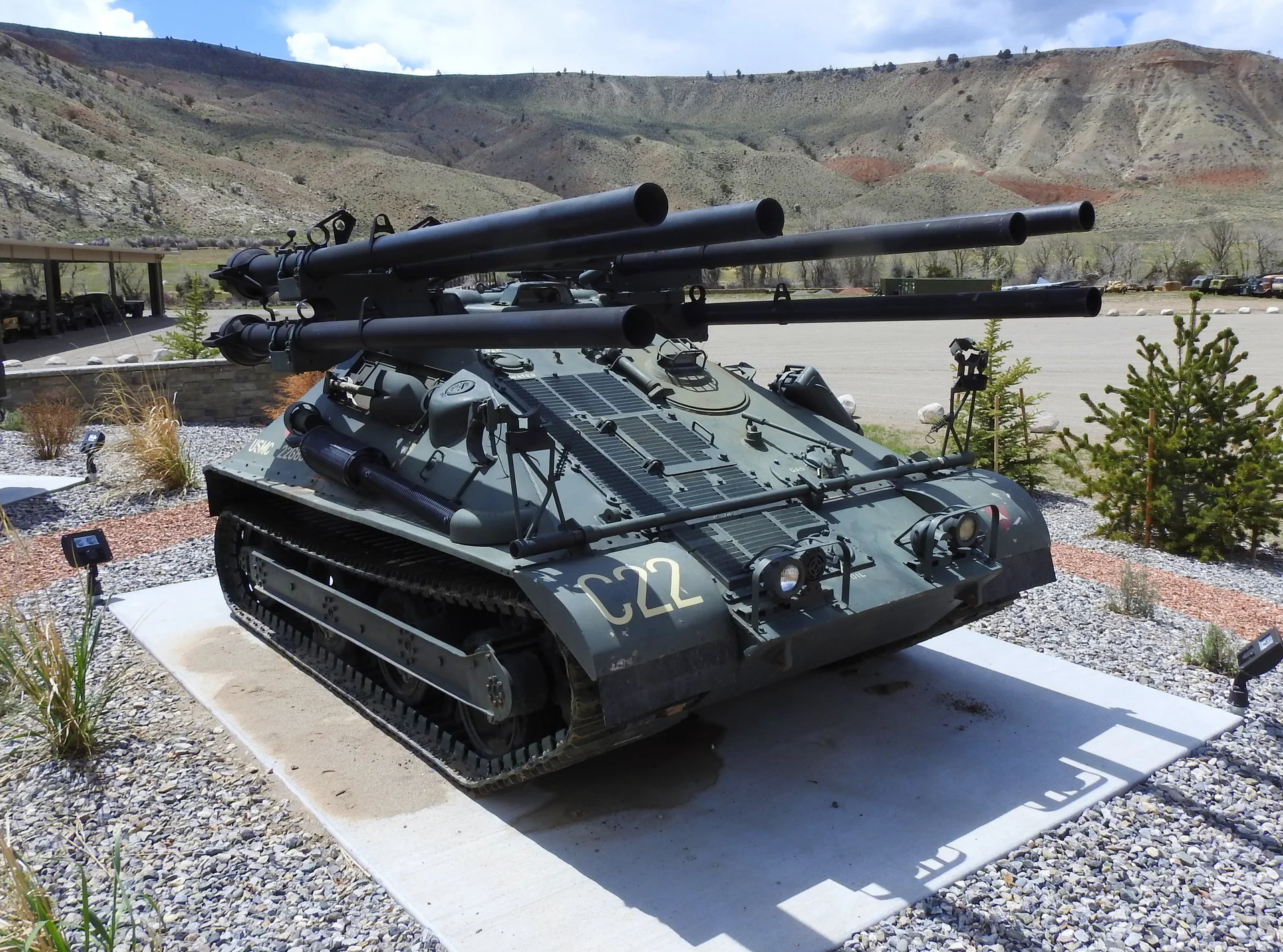
The compact armored hull carried the crew, while the main weapons were mounted externally in two groups. This avoided putting a single large conventional gun inside a heavy turret. It also separated the crew’s protected accommodation from the work needed to replenish the main armament. 1, 2
Armament
Recoilless rifles provided substantial shell effect without the same mounting demands as a conventional large tank gun. Four spotting rifles supplemented the six main weapons. Counting every visible tube as an identical weapon therefore misidentifies both the vehicle’s armament and the function of its smaller rifles. 1, 2
Crew protection
The vehicle’s light armor provided limited shelter rather than tank-level protection. Vietnam accounts describe vulnerability to mines and antitank weapons, as well as the exposure involved in reloading. Firepower, protection in transit, and protection during a complete firing-and-reloading cycle were different aspects of the design. 1, 2
Mobility and support
A relatively light tracked platform could offer mobility where heavier vehicles faced difficulties, but that should not be generalized into an ability to cross any terrain. Mechanical condition and spare parts remained important. Air transportability likewise does not imply that every contemporary helicopter could lift a complete, combat-loaded Ontos. 1
Versions and conversions
M50A1 identifies a later development that included a changed engine installation; it is not a different number of main weapons. Original and upgraded vehicles should not be assigned one undifferentiated powerplant description. Surviving hulls later stripped of their weapons also require identification as conversions, not intact combat Ontos. 1
Service history
At Hue in 1968, Ontos vehicles supported Marines fighting through the city. Dale Dye's account describes the value of their direct fire against defended positions during the Tet fighting. The externally mounted rifles gave nearby infantry access to heavy shell effects from a compact vehicle, in a role distinct from the antitank mission around which Ontos had originally been developed. 2
Dye also recalls the loader leaving protection to replenish those rifles under fire. That part of his testimony connects the fighting-compartment arrangement to the crew's experience: armor sheltered men inside the hull, but not every task could be completed there. His account records one witness's experience at Hue rather than a measure of every Ontos engagement. 2
The museum describes that role shift clearly in Vietnam, where Ontos was used increasingly for direct fire against defended positions and is associated with fighting at Chu Lai, Khe Sanh and Hue. Those examples do not erase the original antitank requirement. They show how a fielded weapon could be retained for a different effect when its six recoilless rifles proved useful against fortifications and urban strongpoints. 3
The Marine Corps museum places acceptance for procurement in 1955 and integration into Fleet Marine Force armored units within the following year. Its Vietnam account then distinguishes the weapon's intended antitank origin from the direct-support work it actually describes at Chu Lai, Khe Sanh and Hue. This is a change in employment, not a claim that the original vehicle had been designed around every later urban fighting experience. 3
For Hue, the museum describes Ontos operating alongside M48 tanks and records Colonel Stanley Hughes's favorable assessment of its support to his Marines. That is a named commander's retrospective judgment in a particular battle. It should not become an unqualified ranking of weapons in all settings, or proof that a lightly armored Ontos could replace the tank's other functions. The episode instead shows two different vehicles contributing to the same infantry fight. 3
Operating constraints
Six loaded weapons did not provide unlimited sustained fire. Once ammunition had been expended, the same exposed reloading problem returned. The vehicle’s limited space and aging support base also constrained its usefulness. Its record is best understood as adaptation to particular missions rather than proof of an ideal general-purpose fighting vehicle. 1, 2
Design legacy
Ontos entered Marine service as an antitank vehicle, but infantry support became central to its record in Vietnam. The external recoilless rifles delivered heavy shell effects from a small tracked platform, while their location left the loader exposed when replenishing them. Hue made both sides of that arrangement conspicuous. The same features that gave the vehicle distinctive firepower also shaped the risks carried by its crew. 1, 2
Sources and further reading
- Peter Brush, The Ontos Anti-Tank Vehicle, Marine Corps Tankers Vietnam Historical Foundation
- Dale Dye, “M50 Ontos — ‘The Thing’ in Vietnam” (2023)
- National Museum of the Marine Corps, M50A1 Ontos iconic artifact
Visit an Armor Museum
Explore the worldwide museum directory to find armored vehicles, collections, and visitor-planning information.
Browse armor museums