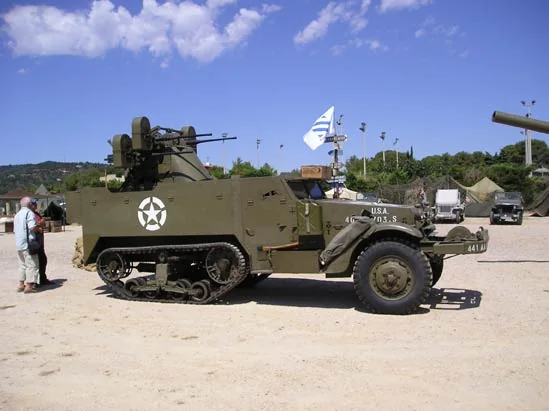
Development of the quad-.50 carrier
American antiaircraft development before and early in World War II tested multiple powered machine-gun mounts on trucks and half-tracks. The Maxson mounts proved comparatively rugged and simple, leading from twin-.50 arrangements to the four-gun T61/M45 Quadmount and a standardized M3 half-track carrier. 1, 2
The resulting M16 replaced earlier M13 twin-gun vehicles in production during 1943. It combined a mature vehicle with an electrically driven weapon mount rather than asking industry to create a new chassis, an approach that allowed thousands of mobile antiaircraft vehicles to reach units during the war. 1, 2
M3 half-track conversion
The front of the M16 remained recognizably M3 half-track, with engine and armored driving compartment ahead of a rear fighting area. The troop compartment was reworked around the circular M45 mount, ammunition boxes, generator, and positions for the gunner and two cannoneers. 1, 2
Folding side panels helped give the quad mount firing clearance while preserving some protection during movement. The arrangement was spacious compared with a small turret but left much of the weapon crew open to the weather and battlefield fire, a compromise accepted in exchange for unrestricted traverse and elevation. 1, 2
The M45 Quadmount
Four Browning M2HB .50-caliber machine guns gave the M16 an exceptionally dense stream of fire for a vehicle of its size. Each gun fed from an ammunition chest on the mount, and the electrical drive allowed rapid traverse and elevation around a seated gunner. 1, 2
The four machine guns were intended for close air defense, but units also employed them against ground targets. That use did not change the vehicle into a tank or remove its light armor and open crew positions. The M45 weapon mounting also existed on other carriers, so a photograph of a quad-.50 installation does not identify an M16 half-track by itself. 1, 2
Visual engagement and warning
M16 crews used optical/reflex sights and visual tracking. There was no search radar on the vehicle, so warning from the wider antiaircraft network and the crew’s own observation determined how much time was available to identify, slew, and fire. 1, 2
The Army’s later historical demonstrations emphasize that the M45 could rotate through 360 degrees but that all target tracking remained visual. Weather, darkness, concealment, and the speed of an aircraft could therefore reduce effectiveness sharply even when the gun mount itself had ample rate of fire. 1, 2
Protection and firing exposure
Armor around the M3 cab and rear body gave the crew more protection than a truck-mounted gun, but the M16 was still a lightly armored vehicle. Loaders standing around the M45 were especially exposed while replenishing ammunition, a vulnerability noted in postwar operational commentary. 1, 2
The safety features of the mount also restricted firing directly over the cab at very low elevation so the guns could not strike the vehicle itself. That was sensible for the antiaircraft role but could complicate improvised ground engagements when a threat appeared directly ahead. 1, 2
Half-track mobility and support
The M16 inherited the M3’s combination of front wheels and a tracked rear bogie, giving better traction off paved roads than ordinary trucks while retaining useful road speed. It could accompany convoys and move with infantry and armored formations without a separate towing vehicle. 1, 2
Because M3-family half-tracks were widespread, maintenance organizations already understood the White engine, transmission, suspension, and many common parts. This logistical familiarity made the specialized gun vehicle easier to sustain than a unique chassis, especially in the large antiaircraft battalions supporting corps and armies. 1, 2
Wartime production and postwar conversions
Wartime production totals and later conversion totals are not the same category. The M16 used an M3-family carrier, whereas the related M17 used the International Harvester M5 family and was associated with Lend-Lease supply. M16A1 and M16A2 designations cover later conversion or modification arrangements, so their numbers should not be added to a wartime total without checking the underlying accounting. 1, 2
The Korean War created fresh demand, leading to M16A1 conversions from ordinary M3 half-tracks and later M16A2 modifications to existing M16s. These programs kept the quad-.50 concept in service after the original wartime production line had ended. 1, 2
World War II combat
M16s entered combat in the Mediterranean and European theaters and were present from the Italian campaign through operations in France and Germany. By this stage Allied fighters often suppressed the Luftwaffe, so many units found themselves firing more frequently at ground targets than at aircraft. 1, 2
The vehicle nevertheless retained a real air-defense function. At threatened bridges, columns, and concentration areas, the ability to keep four heavy machine guns immediately ready mattered when German aircraft did appear. Army histories also record M16s using devastating direct fire against German troops during the Ardennes fighting. 1, 2
Korean War service
M16 and M16A1 half-tracks served in Korea alongside the twin-40 mm M19. Their automatic weapons were used in ground-defense and support roles as well as maintaining an air-defense function. That Korean War account should not be extended automatically to the later M42, or to every postwar installation of the M45 quad mount on a trailer or truck. 1, 2
Korean experience also exposed the half-track’s weaknesses: open gun crews were vulnerable to rifle and mortar fire, ammunition had to be close at hand, and a wheeled-and-tracked chassis could not always follow full-tracked vehicles in ice, snow, and mountainous terrain. Those observations reinforced the shift toward tracked air-defense carriers. 1, 2
Historical place
The M16 endured because its core components were simple, robust, and useful beyond the narrow circumstances for which they had been designed. It could move with a formation, respond quickly, and put a large volume of heavy-machine-gun fire onto either aerial or ground targets. 1, 2
The M16’s quad heavy-machine-gun installation remained a visually aimed weapon with an exposed working area. Those configuration limits can be described without asserting that they caused every subsequent U.S. air-defense development. A later tracked carrier, radar-directed gun or missile vehicle needs its own development evidence rather than being treated as an inevitable next step from the half-track. 1, 2
Sources and further reading
- Tank Encyclopedia — Multiple Gun Motor Carriage M16 and M17
- U.S. Army — Students learn from WWII weapon
- U.S. Army Center of Military History — The Ardennes: Battle of the Bulge
- U.S. Army Center of Military History — From San Juan to Pusan
Visit an Armor Museum
Explore the worldwide museum directory to find armored vehicles, collections, and visitor-planning information.
Browse armor museums