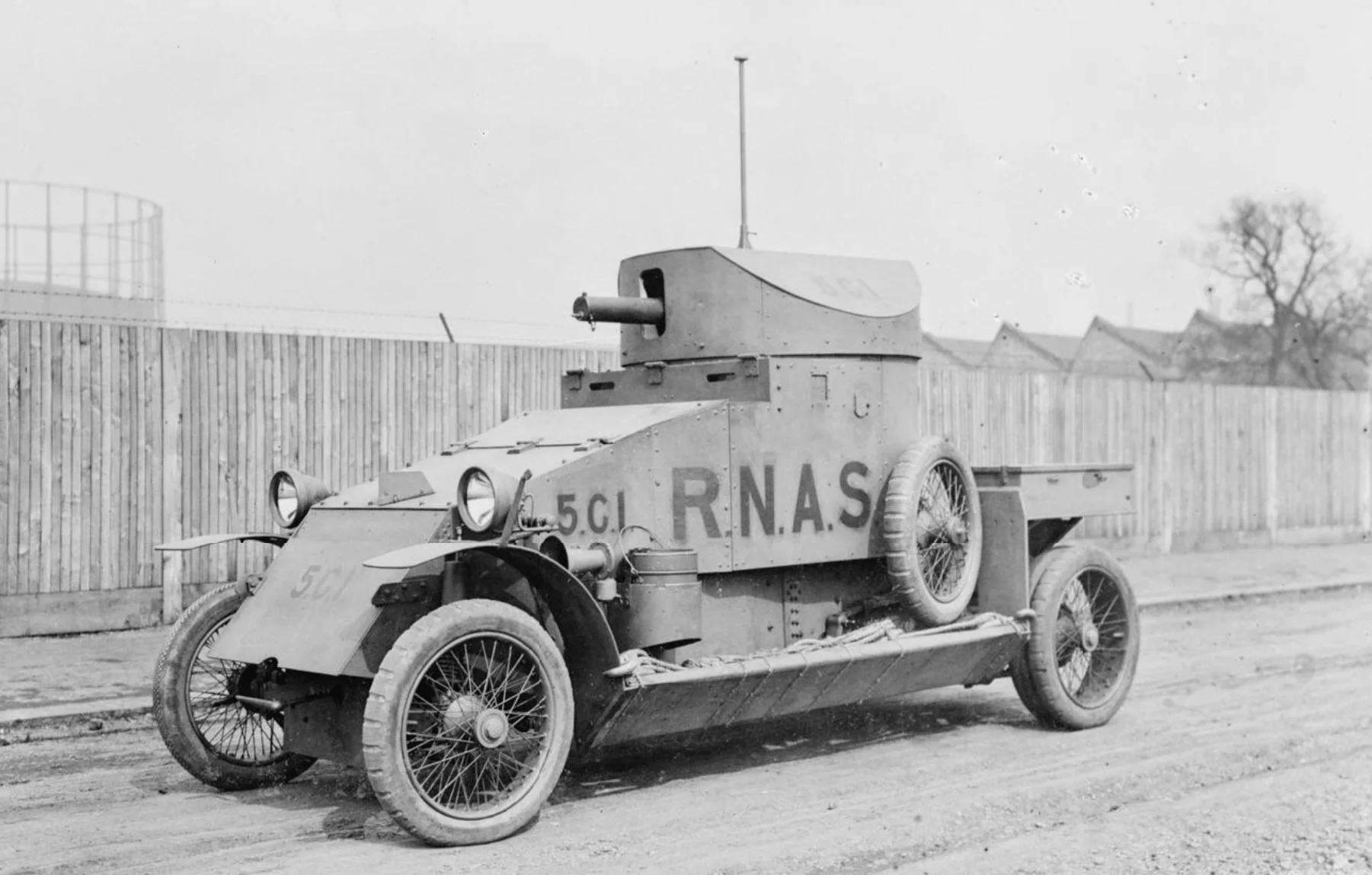
A naval armored car from the Sporting Forty
Naval armored-car operations grew partly from attempts to recover airmen forced down between the armies in France. In October 1914 an organization took shape with a London headquarters and a Wormwood Scrubs depot. Lanchesters formed part of a mixed fleet that also included Rolls-Royce and Seabrook vehicles, with strengthened chassis components, armored bodies, and turreted machine guns. 1
The Lanchester used a Sporting Forty road-car chassis as the basis for its armored body. Production and deployment followed in 1915. 2
Enclosed hull and a road-car chassis
The First World War Lanchester used a front-engine, rear-wheel-drive layout with an enclosed armored body and an upper gun position. The National Archives newsletter reproduces a period photograph labeled as a standard Lanchester armored car, under reference MUN 5/394. It is useful evidence of the visible arrangement. The image is not an engineering drawing and cannot establish plate thickness, internal dimensions or resistance to a particular projectile. 1
Road mobility and difficult ground
On roads and firm surfaces, the Lanchester could exploit the performance of its touring-car chassis to move rapidly between observation points, patrol routes, and threatened sectors. That mobility suited the Royal Naval Air Service’s early-war operations, which often required small detachments to cover broad areas and protect aviation installations. A light armored car could arrive faster than infantry on foot and bring a protected machine gun with it. In mobile warfare, especially before continuous trench systems hardened the Western Front, this was a valuable capability. 2
Rear-wheel drive and narrow tires imposed different terrain limits from the tracks and multi-axle arrangements of later vehicles. Road movement and travel through shell-damaged ground should therefore be described separately. The retained sources do not provide a comparative mobility trial that would justify rating the Lanchester as excellent on one surface or assigning a measured cross-country limit. 2
Protection within a touring-car weight limit
The Lanchester’s armored body enclosed the crew and key mechanical components against the most common small-arms threats of early armored-car operations. This was a major improvement over unprotected cars used for scouting or courier work. Armor also allowed the vehicle to approach hostile positions, escort columns, and patrol contested roads with protection unavailable to ordinary motor transport. As with other early armored cars, however, protection remained light because the chassis could not absorb the weight of tank-like armor without sacrificing the mobility that justified the vehicle. 2
The turreted Vickers machine gun
The principal weapon was a .303-inch Vickers machine gun carried in a rotating turret. The turret gave the crew far greater tactical flexibility than a fixed forward gun, allowing the vehicle to cover road junctions, engage threats to the flanks, or fire while withdrawing without turning the entire car. The water-cooled Vickers provided a means of sustained fire against infantry, cavalry, and unarmored vehicles. 2
France and the Russian expedition
Conditions in Flanders restricted the naval cars' original aircraft-support duties. The units nevertheless took on ground fighting: Number 15 Squadron supported Belgian cavalry in August 1915. Its armament included both machine guns and a three-pounder. The heavier gun belonged to the mixed squadron's equipment, not to the standard machine-gun Lanchester. 1
Late in 1915, Oliver Locker-Lampson offered his squadron for Russian service. Under the resulting arrangement, the Admiralty supplied personnel and equipment while Russia met expenses and pay. The expedition carried several vehicle types. Its history must therefore be distinguished from the movements or mechanical record of any single Lanchester. 1
The archive newsletter also recounts a long-distance record associated with Locker-Lampson’s Rolls-Royce. That example belongs to another car in the expedition and is not evidence for a Lanchester endurance figure. The mixed composition of the force matters whenever a squadron-level account is used to describe one make of vehicle: a unit’s journey, a particular car’s mileage and the standard vehicle’s performance are different claims. 1
Imperial War Museums preserves a 1916 record of the Royal Naval Air Service armoured-car force during the Romanian campaign. That archival photograph and catalog context support the Lanchester family's presence in the wider RNAS/Russian armoured-car story, while leaving vehicle-by-vehicle mileage, mechanical condition, and exact mixed-column composition to more detailed archival research. 4
Place in armored-car development
Lanchester supplied four-wheeled armored cars to the Admiralty in 1915. The company's later six-wheeled car was a separate interwar design, with production beginning in 1928. The Tank Museum's Mark II belongs to a 1931 contract. Its additional axle and later chassis should not be used to describe the First World War 4x2 car, despite the shared manufacturer name. 3
Sources and further reading
References and further reading are listed below. Image identification, credit and reuse terms remain with each photograph.
- The National Archives, Autumn 2014 newsletter, The Czar’s British Squadron (reproduced archival photograph and retrospective context)
- Lanchester armoured car overview, First World War 4x2 design
- The Tank Museum, Armoured Car Lanchester, Mark II (interwar six-wheeled design)
- Imperial War Museums — RNAS Armoured Car Division, Romania, 1916
Visit an Armor Museum
Explore the worldwide museum directory to find armored vehicles, collections, and visitor-planning information.
Browse armor museums