Development
West German development pursued both gun and missile vehicles for specialist antitank units. The Kanonenjagdpanzer was therefore one branch of a broader program, not an isolated revival of a wartime machine. The published development history places trials and procurement in the 1960s. 1
Layout and crew
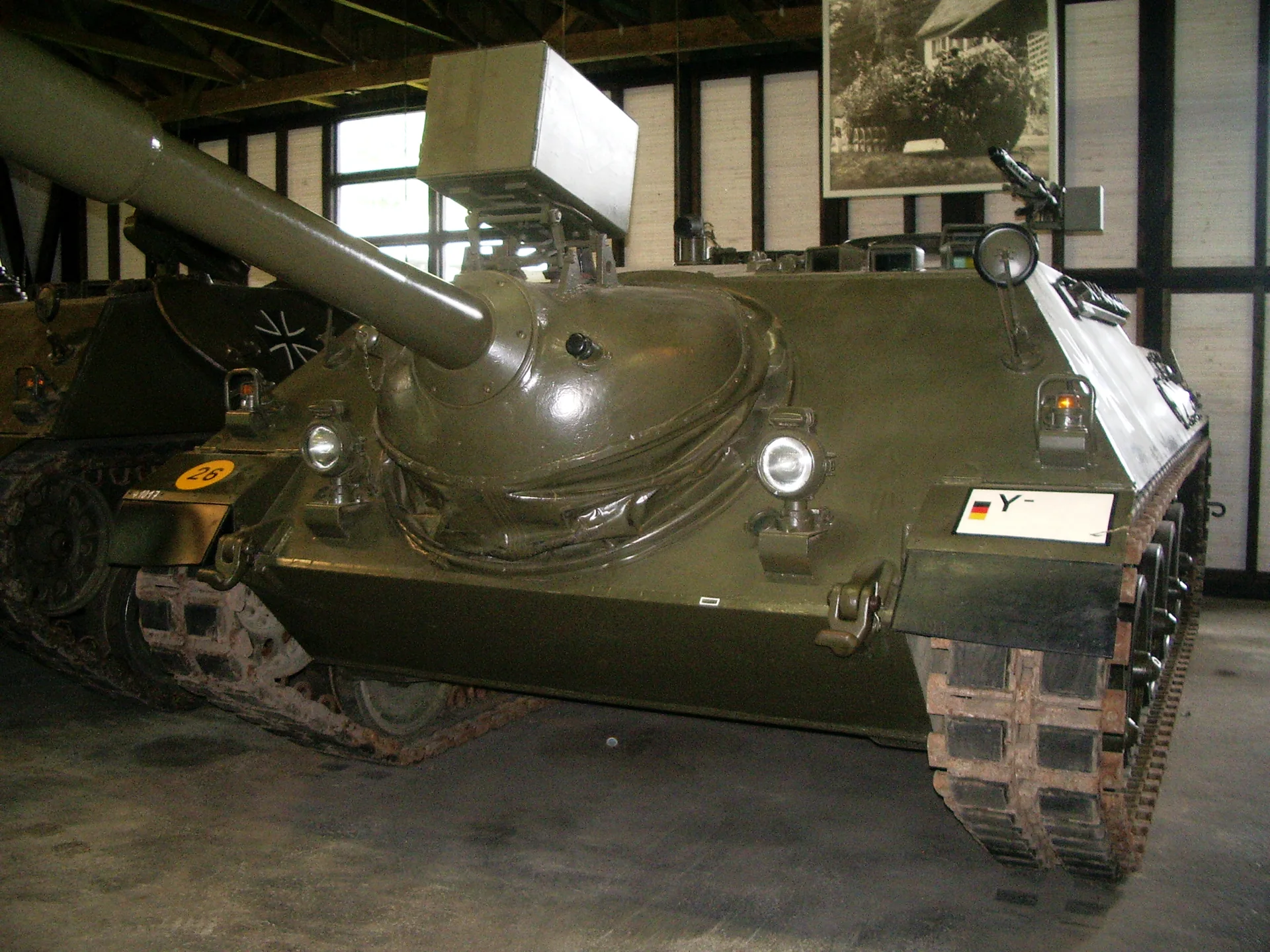
The gun sat in the front of a low, fixed fighting compartment, with the powerplant behind the crew. This gave the vehicle a compact external shape without a large rotating turret. The absence of that turret also meant that the gun’s independent traverse remained limited. 2
The low fighting compartment removed the mass and height of a large gun turret, but the hull now had to supply much of the weapon's change in bearing. Driver and gunner coordination consequently remained part of the design's usefulness. When the same automotive platform later carried a missile or observation installation, the original gun's location and firing arc no longer described the work performed inside the vehicle. 1
Armament
A conventional 90 mm gun offered direct fire with carried ammunition and no missile-guidance interval after a shell had left the weapon. That was a different operating proposition from the parallel guided-missile vehicles. The distinction helps explain why a gun branch and a missile branch could be pursued at the same time. 1, 2
Crew protection
The design emphasized mobility and a low outline rather than the heavy protection associated with a main battle tank. This was a role choice, not proof that armor had become unimportant. The crew’s chances depended on the whole vehicle and its employment, not just on the visibility of the casemate. 2
Mobility and support
A diesel engine and tracked chassis supported the mobile requirement. Reusing that automotive platform after the original gun installation became less attractive offered a different kind of economy from replacing the complete fleet. A conversion could preserve useful hull life while demanding new training for the changed mission. 2, 3
Versions and conversions
The original gun vehicle, Jaguar 2 missile conversion, and gunless observation conversion must be distinguished. A former Kanonenjagdpanzer hull carrying TOW did not become a Jaguar 1. Likewise, a drawing or proposal for a much larger gun does not establish that an up-gunned version entered routine service. 1, 3
The museum's observation-and-command vehicle record describes removal of the 90 mm gun while retaining the mantlet for weight distribution. It dates the conversion of 486 vehicles by Thyssen-Henschel to the period ending in 1988. The retained external shape could therefore conceal a major change in purpose. A front plate resembling the former gun installation was not evidence that the vehicle still carried its original cannon. 5
Service history
The Bundeswehr’s Cold War retrospective includes a period photograph explicitly captioned as a Kanonenjagdpanzer taking part in the field parade during Exercise Schwarzer Löwe. That is direct institutional evidence of the type in the Bundeswehr’s large-exercise environment. It does not establish combat service, and the vehicle’s history should remain framed around deterrence, training, unit issue and later conversion rather than an invented wartime record. 4
The same retrospective emphasizes that West German and NATO forces repeatedly rehearsed national and alliance defense in large maneuvers. In that setting, a specialist antitank vehicle had to function as part of a larger formation, not simply demonstrate gun performance on a range. Exercise imagery therefore adds operational context without supplying unsupported claims about battlefield results. 4
The same account records the later installation of a mast-mounted target-location device in place of the earlier rotating observation arrangement. It dates withdrawal of these observation vehicles to 2003. That year belongs to the converted artillery-support role, not to continued service of every original 90 mm tank destroyer. The hull's career outlasted the gun because the protected tracked space could be reorganized around a different crew task. Reading those careers separately avoids extending the antitank gun's service life by borrowing the retirement date of its successor configuration. 5
Operating constraints
The 90 mm installation had less growth potential than the hull beneath it. Improving protection on potential opposing tanks increased pressure on the original armament concept, while guided missiles provided another route to antitank capability. This does not mean that every later task required an entirely new chassis. 1, 2, 3
Design legacy
The Kanonenjagdpanzer's gun and hull had different service lives. The fixed 90 mm installation belonged to one generation of antitank requirements; the tracked platform could remain useful for missile or observation work after that gun role declined. Jaguar 2 and observation conversions were consequently new roles for existing automotive equipment, not evidence that the original gun design remained unchanged throughout the Cold War. 1, 3
Sources and further reading
- Panzerbaer, “Jagdpanzer (Bw): Kanonenjagdpanzer 90 mm”
- Weaponsystems.net, “Kanonenjagdpanzer”
- Panzerbaer, Raketenjagdpanzer and Jaguar development
- Bundeswehr — Landes- und Bündnisverteidigung im Kalten Krieg
- Zivil- und Wehrtechnik Museum, Kanonenjagdpanzer observation and command conversion
Visit an Armor Museum
Explore the worldwide museum directory to find armored vehicles, collections, and visitor-planning information.
Browse armor museums