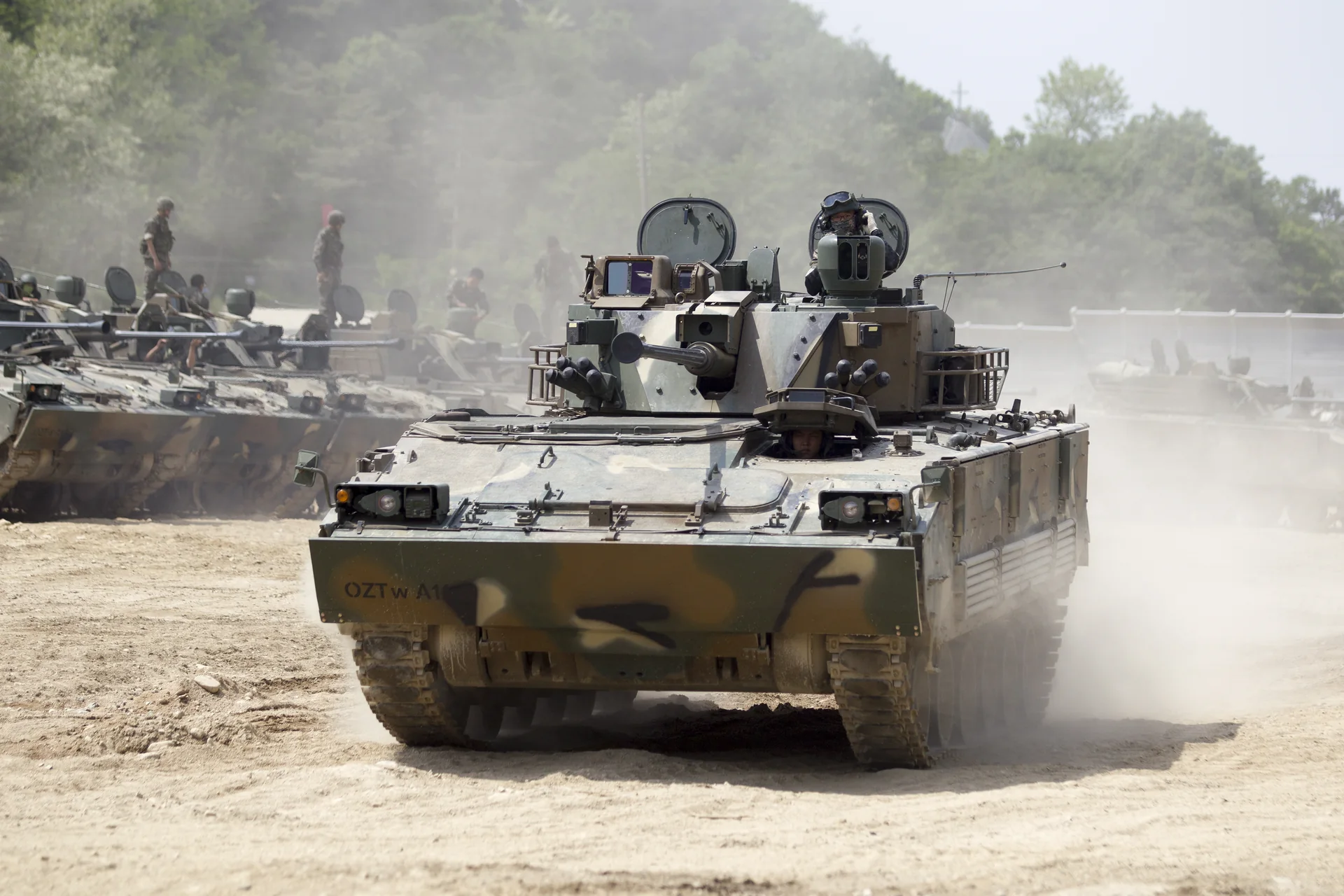
Development and requirement
South Korea developed the K21 as the next-generation replacement for K200-series vehicles and as a domestically designed infantry fighting vehicle able to defeat contemporary light armor. Development emphasized low vehicle weight, substantial cannon firepower, modern sensors, and amphibious movement appropriate to the Korean operating environment. 1, 2
K21 combines a tracked infantry carrier with a 40 mm cannon and an amphibious requirement. Its design therefore has to reconcile a substantial turret weapon with troop space and the weight limits associated with water movement. The vehicle’s role is to move and support infantry alongside armored forces, not to duplicate a tank’s protection and firepower. The relationship to South Korea’s earlier K200 carrier is principally one of changing infantry equipment and capability. It should not be described as proof that the K21 is simply a K200 hull receiving a larger turret. 1, 2
Design, protection, and mobility
The K21 combines a 40 mm cannon with an infantry compartment in a tracked vehicle intended to retain amphibious capability. This creates a balance between turret and ammunition weight, troop accommodation and the hull’s water-mobility requirements. Claims about a particular antitank installation, protective package or changes following water trials need a named configuration and a technical record. The cited corporate overview does not supply that evidence, so no specific trial failure, corrective measure, or universal missile fit is asserted here. 1, 2
Amphibious capability strongly influenced the proportions and weight discipline of the K21 Infantry Fighting Vehicle. A vehicle that must swim cannot simply add armor without consequence: buoyancy, freeboard, water propulsion, sealing, trim, and the location of heavy components all constrain later growth. That capability can be operationally important where rivers, canals, coastal approaches, or destroyed bridges would otherwise halt a mechanized force, but it also forces a different protection balance than a vehicle designed only for land combat. The most meaningful comparison is therefore with other amphibious fighting vehicles serving the same mission rather than with much heavier non-amphibious designs. 1, 2
Protection and internal volume are especially difficult problems in an infantry fighting vehicle because the hull must serve both a vehicle crew and a dismounted fighting element. The troop compartment needs usable space, access routes, ammunition stowage, communications, and enough separation from fuel and mechanical systems to make the vehicle practical in repeated operations. Adding armor improves resistance to fragments and direct fire, but it also increases weight and can reduce mobility, amphibious margin, payload, or growth capacity. As threats change, many IFV modernization programs therefore become exercises in managing accumulated weight and electrical demand as much as in fitting a new gun or sight. 1, 2
Firepower and battlefield role
The vehicle’s principal armament, 40 mm automatic cannon, defines much of how the K21 Infantry Fighting Vehicle can contribute after contact. Cannon and antitank weapons can allow an infantry or reconnaissance vehicle to suppress positions, engage light armor, and threaten heavier vehicles under favorable conditions without depending on a tank for every target. That firepower changes tactics because the carrier can support the infantry before and after dismount, cover movement, and respond quickly to targets that would otherwise require a separate support weapon. At the same time, mounted firepower does not erase the distinction between an IFV and a main battle tank: protection, ammunition, sensors, and survivability remain optimized around different missions. 1, 2
Service, variants, and modernization
Initial production began in 2009 and the K21 became a major Republic of Korea Army mechanized platform. The chassis has also supported proposals for heavier direct-fire vehicles, but the fielded K21 remains principally an infantry fighting vehicle whose purpose is to move troops and provide substantial mounted fire support. 1, 2
K21 configurations and later export-related developments should not be combined into one equipment list. A claim about a new missile installation, protective system or turret needs to identify whether it describes a production vehicle, an upgrade proposal or a different national program. The same applies to amphibious trials and changes made after testing: a brief corporate overview is not a technical trial report. The family history remains clearer when its basic Korean vehicle is described separately from subsequent offers, rather than assembled from the most capable features mentioned across several programs. 1, 2
Hanwha’s company overview names K21 among its South Korean armored products and separately describes the 2023 Australian Redback contract. That is useful evidence for keeping the programs distinct. It is not a technical comparison of their hulls, protection or armament, and it does not establish that an Australian Redback is an unchanged Korean K21. The corporate relationship belongs in the development context; specifications and accepted national configurations still require vehicle-specific records. 3
How the vehicle fits the formation
In combined-arms employment, the K21 Infantry Fighting Vehicle is not an independent substitute for tanks, infantry, artillery, engineers, or air defense. Its purpose is to connect protected mobility with the infantry's ability to seize and hold ground. The mounted crew can observe and engage while the dismounted element deals with terrain and threats that cannot be solved from inside the hull. Effective use therefore depends on coordination: tanks provide heavier direct fire and protection, artillery and mortars suppress or isolate, engineers open routes, and the infantry fighting vehicle moves soldiers while contributing its own sensors and weapons. The platform is most effective when those capabilities overlap rather than when it is sent forward alone. 1, 2
Strengths, limitations, and family boundaries
K21-105 and similar gun-armed derivatives are not counted as ordinary IFVs simply because they share a chassis. They belong in the direct-fire lineage, while the troop-carrying K21 remains the core profile here. 1
The K21’s 40 mm cannon distinguishes its armament from many contemporary infantry fighting vehicles, but caliber is only one part of the design. The turret, ammunition and soldiers all occupy space and impose weight on a hull that is also intended to move in water. That combination requires attention to the exact vehicle configuration before comparing protection or mobility. The infantry still forms an essential part of the system. Mounted fire supports its movement and work on the ground rather than turning the carrier into a substitute for dismounted soldiers. 1, 2
K21 and Redback should not be used as interchangeable names. Their relationship is relevant to the manufacturer’s development history, but an Australian contract or demonstration does not establish the Korean vehicle’s precise armor, weapons or water-crossing configuration. Likewise, a corporate list of tracked vehicles is not a technical statement that their hulls and components are identical. The Korean K21 remains the subject of this profile, with later national programs treated separately until their design relationships and accepted configurations can be established from appropriate records. 1, 2
Sources and further reading
References and further reading are listed below. Image identification, credit and reuse terms remain with each photograph.
- U.S. Army TRADOC ODIN Worldwide Equipment Guide — K21
- U.S. Army TRADOC ODIN Worldwide Equipment Guide — BMP-3 search
- Hanwha, Hanwha Aerospace company overview (corporate/program context only)
Visit an Armor Museum
Explore the worldwide museum directory to find armored vehicles, collections, and visitor-planning information.
Browse armor museums