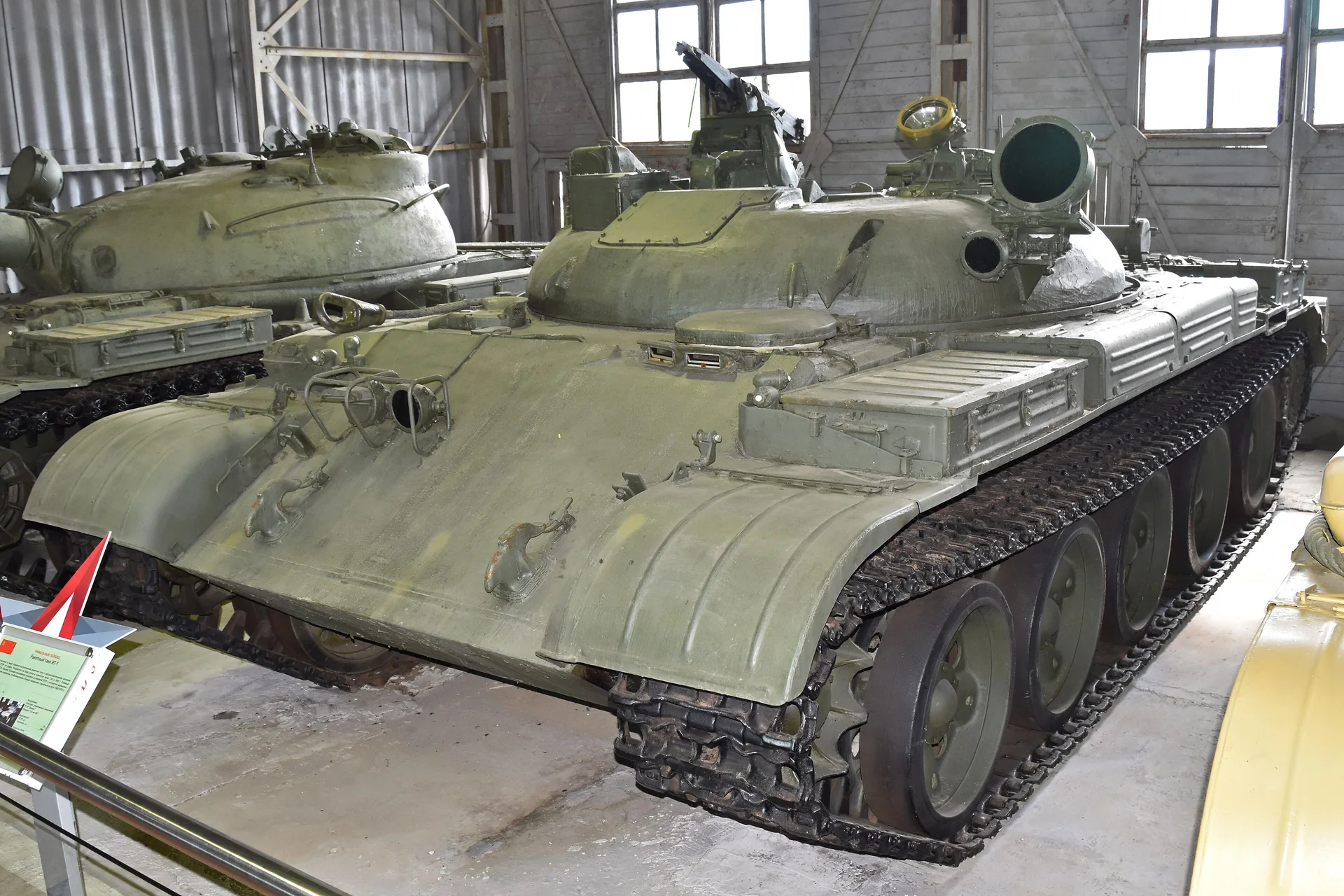
Development
Soviet missile-tank work developed from mid-1950s discussions about replacing or supplementing increasingly powerful tank guns with guided weapons. GlobalSecurity places the beginning of Object 150 work in 1957 and identifies the eventual IT-1 as a T-62-derived vehicle carrying the 2K4 Drakon system. The vehicle was adopted in 1968, so its service identity belongs to a long development program rather than to a sudden late-1960s conversion. 1
The collection places the IT-1 alongside other Ural design projects, including Object 140 and the experimental gas-turbine Object 167T. Its accompanying material covers design work, trials, observation equipment and the biographies of the engineers involved. That setting presents the missile tank as part of a wider experimental program rather than as an isolated curiosity. The inventory identifies useful primary material for further study, but its listing does not disclose the contents of the IT-1 drawings or establish a production total. 3
Layout and crew
The launcher retracted inside the turret for travel and rose when required. Missiles were carried internally, so the external appearance did not show the complete installation. Removing the main gun freed some space, but the launcher, magazine, and guidance equipment then made their own demands on the fighting compartment. 1
The distinctive shape came from housing a guided-weapon installation inside a tank-derived vehicle instead of retaining the main gun. That choice changed both the ammunition carried and the equipment needing protected space. A conventional barrel no longer projected from the turret, but the turret still had to accommodate a magazine, launcher movement and guidance apparatus. Removing the gun did not leave an otherwise empty or mechanically simple fighting compartment. 1
Armament
The 3M7 used radio-command guidance. It was not a gun-launched missile and did not leave through an ordinary tank barrel. This distinction matters when comparing IT-1 with later gun tanks that could carry guided ammunition while retaining the ability to fire conventional shells. 1
Crew protection
Tank-derived armor distinguished the IT-1 from a light tracked missile carrier. It did not, however, protect every part of the weapon system equally or eliminate the problem of a target inside the missile’s minimum engagement distance. Physical armor and the coverage supplied by the main weapon are separate aspects of survivability. 1
Mobility and support
Reusing a tank chassis provided a familiar automotive starting point. It did not eliminate specialized support for the missile and guidance installation. A unit needed both a serviceable tracked vehicle and a functioning weapon system; readiness in one part could not substitute for readiness in the other. 1
Versions and conversions
Object 150 was the development designation, IT-1 the vehicle identity, 2K4 the Drakon system and 3M7 the missile. These names describe different levels of the same installation rather than four separate tank types. The vehicle was manufactured in a limited series. Conflicting published totals do not support a precise production figure, but the type's construction and operational fielding distinguish it from a demonstrator that never left trials. 1
Service history
IT-1 passed beyond trials and into limited operational fielding, but it did not replace conventional gun tanks generally. The Patriot museum complex lists an IT-1 in its equipment catalog, providing a surviving institutional reference to the type. Its short career contrasts with the much longer life of vehicles that combined conventional gun ammunition with guided weapons rather than making the missile the sole principal armament. 1, 2
The same secondary account describes only limited operational organization, with separate missile-tank battalions formed in the Belarusian and Carpathian military districts. That evidence supports a short fielding history without implying widespread replacement of gun tanks. It also reinforces the distinction between a vehicle that reached units and a concept that proved durable enough to reshape the entire tank force. 1
The Uralvagonzavod museum preserves evidence from several stages of the IT-1 story. Nizhny Tagil's municipal description lists an actual tank, a model associated with the presentation of its technical project and dated 1968, and an album of drawings dated 1970. These are different kinds of surviving material: a model records how a proposal was represented, drawings record design information, and a vehicle preserves an assembled configuration. The date on the drawing album is not, by itself, a production or withdrawal date. 3
Operating constraints
Minimum range, finite missile stowage, and specialized equipment made the vehicle less flexible than its main weapon alone suggested. Replacing a gun also removed access to the wider set of ordinary shell types that a gun tank could carry. The relevant comparison is therefore between complete vehicle capabilities, not two isolated weapons. 1
Design legacy
IT-1 shows why successful integration and broad operational usefulness are different tests. The later coexistence of guns and guided missiles makes more sense when viewed against an experiment in replacement rather than supplementation. Its historical value lies in being a fielded attempt whose limits could be encountered in service. 1
Sources and further reading
- GlobalSecurity — IT-1 + 3M7 / 2K4 Drakon (secondary source; not primary certification)
- Patriot museum complex, “Raketnyy tank IT-1” equipment entry
- Nizhny Tagil tourism center, Uralvagonzavod exhibition complex
Visit an Armor Museum
Explore the worldwide museum directory to find armored vehicles, collections, and visitor-planning information.
Browse armor museums