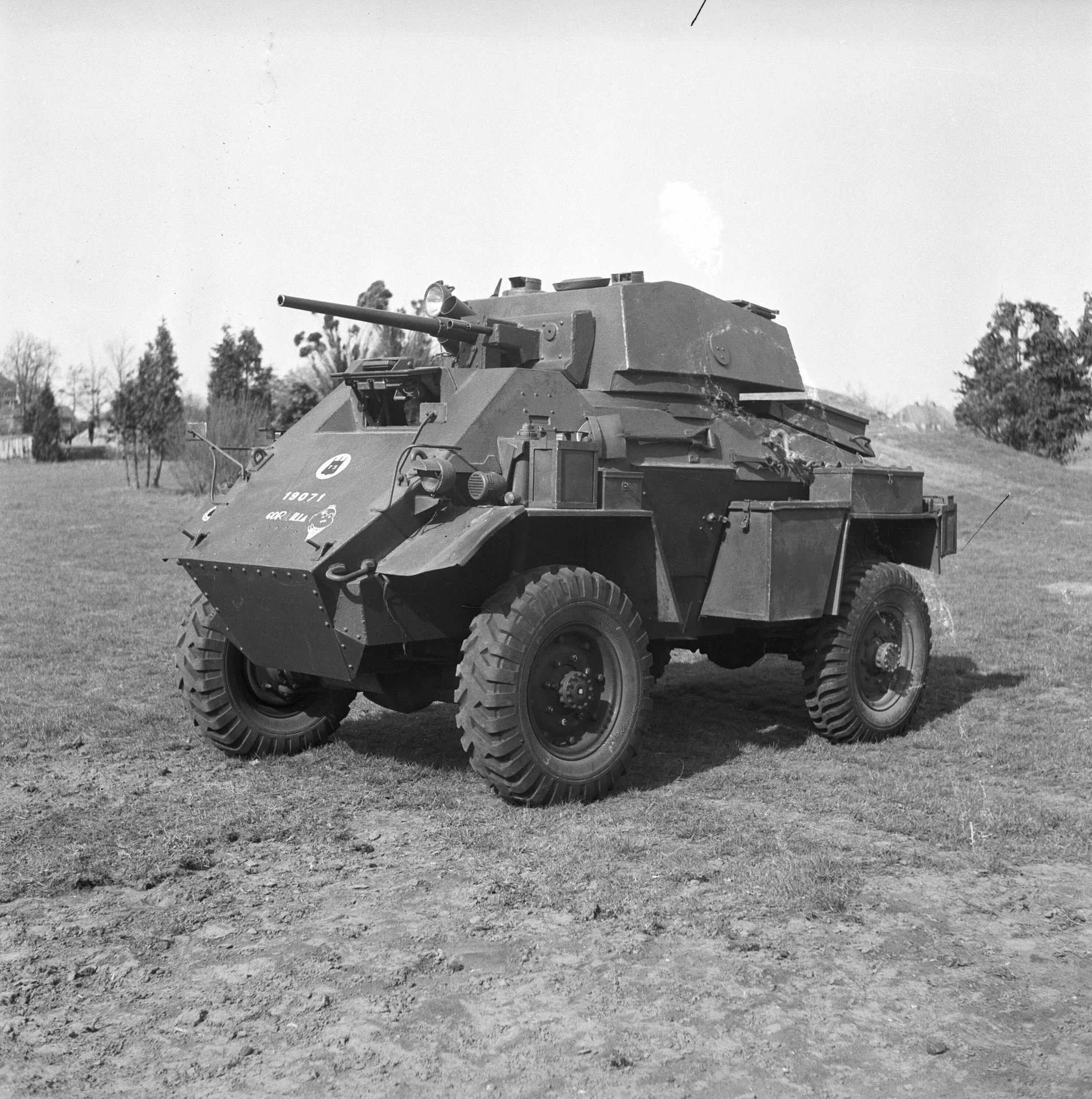
Guy, Karrier and the Rootes production network
The Humber emerged from an urgent British need to expand armored-car production after the outbreak of the Second World War. Guy Motors had developed a capable armored car but lacked capacity for the numbers required, so the Rootes Group adapted the concept to components it could manufacture at scale. Karrier used its KT4 artillery-tractor chassis and Guy supplied important armored-body design work, producing a vehicle that entered service under the Humber name to avoid confusion with the Universal Carrier. Because it combined an existing industrial base with a proven layout, the Humber reached quantity production quickly. The Rootes production network allowed the design to equip reconnaissance forces in substantial numbers. 1, 2
A changing turret on the Humber chassis
The Humber was a conventional-looking 4x4 armored car with the engine at the rear, driver forward, and a rotating turret above the central fighting compartment. The Mk I closely reflected the Guy Armoured Car, while subsequent marks altered armor, turret design, crew arrangement, and weapons. The Mk III adopted a larger three-man turret, improving division of labor inside the fighting compartment. The Mk IV changed again to accommodate the American 37 mm gun, reducing crew count in the turret arrangement. The automotive layout remained recognizable while the combat compartment changed through successive marks. 1, 2
Wheeled movement with mechanized formations
The Humber used a Rootes six-cylinder gasoline engine and selectable four-wheel drive. The family was intended to keep pace with mechanized formations and move efficiently over the extensive road networks encountered in North Africa, Italy, and northwest Europe. It was heavier and larger than a scout car but retained wheeled road mobility. Cross-country performance was adequate for reconnaissance but naturally depended on soil and terrain. The simple rugged chassis and large production base were often more valuable operationally than maximum speed because reconnaissance units needed vehicles that could remain available over long marches. 1, 2
Protection for patrols and reconnaissance
Humber armor provided protection against small arms and shell fragments rather than heavy antitank fire. The hull and turret used angled plate where practical, and later marks incorporated lessons from early production. Keeping weight in the six-to-seven-ton class preserved mobility and allowed the Rootes automotive components to remain practical. This balance was fundamental to the vehicle's role. Reconnaissance regiments were expected to use observation, maneuver, and radio reporting rather than engage enemy tanks frontally. The Mk IV's larger gun did not give the car the protection needed for prolonged combat against heavier armored vehicles. 1, 2
From the Besa to the 37 mm gun
Early Humber marks carried Besa machine guns, including a 15 mm heavy machine gun that gave more punch than the rifle-caliber armament of many scout cars. The Mk IV introduced an American 37 mm gun while retaining a machine gun, increasing the car's direct-fire capability. This was a substantial change from the machine-gun armament of the earlier marks. Radios were equally important mission equipment because an armored car that found the enemy had to report quickly to higher headquarters. The armament supported self-protection and limited combat, while the radio allowed the crew to pass observations to headquarters. 1, 2
Four main marks and the separate Fox
Four main Humber armored-car marks are retained in the family account, with changes to the hull, turret, crew arrangement and gun installation requiring mark-specific description. The Canadian Fox is a related but separate vehicle. The June 1945 transcription also treats Humber Scout Cars and Humber Light Reconnaissance Cars as separate categories from the gun-armed Humber IV. Their names and shared manufacturer associations do not justify merging their production figures into this family. 4, 5
British and Commonwealth reconnaissance
The June 1944 entitlement and holdings table lists 224 Humber IVs across eight British reconnaissance regiments and 56 across two Canadian reconnaissance regiments. These are grouped totals, not vehicles per regiment. The table separates 37 mm Humber IVs from Humber Scout Cars, so the two should not be combined when describing the gun-armed family’s service. 5
Humbers also appear in the 61st Reconnaissance Regiment's own visual record. A painting by Trooper Sandford Handley, described by The Tank Museum, places Humber armored cars alongside Universal Carriers and the regiment's fox mascot, Sam. The museum relates that the fox accompanied the regiment to Normandy. 3
The headings of the June 1944 table distinguish entitlement from holdings. A listed allocation is not a daily readiness return, and the report’s date should remain attached to any total extracted from it. The transcription also separates the Humber IV gun car from the smaller Humber scout, so counts need both a date and a vehicle category before they can be compared. 5
Completed Mark IV orders
By 31 May 1945, the Royal Armoured Corps reported the existing Humber IV order complete, with 2,000 ordered and produced. The cars remained allocated to reconnaissance regiments in infantry divisions not equipped with Daimlers. This figure belongs to Mark IV at the report’s cutoff, not to the combined production of every Humber mark. 4
Sources and further reading
References and further reading are listed below. Image identification, credit and reuse terms remain with each photograph.
- Imperial War Museums, Humber Armoured Car collection records
- Humber armoured car overview
- The Tank Museum, Sam and the 61st Recce Regiment, 6 November 2025
- RAC June 1945 report, quoted extracts transcribed by Peter Brown (published transcription)
- 21st Army Group June 1944 entitlement and holdings, tables transcribed by Peter Brown (published transcription)
Visit an Armor Museum
Explore the worldwide museum directory to find armored vehicles, collections, and visitor-planning information.
Browse armor museums