Requirement and development
The Museum of American Armor traces Fox development to 1965, a Daimler prototype contract to 1966 and prototype construction from 1967 to 1969. It records acceptance in 1970, production beginning in 1972 and the first completed production vehicle in May 1973. These stages precede issue to an operational unit. The chronology helps explain why references can give different dates without describing the same event: a requirement, acceptance, a factory completion and service entry are not interchangeable. 1
Layout, crew, and architecture
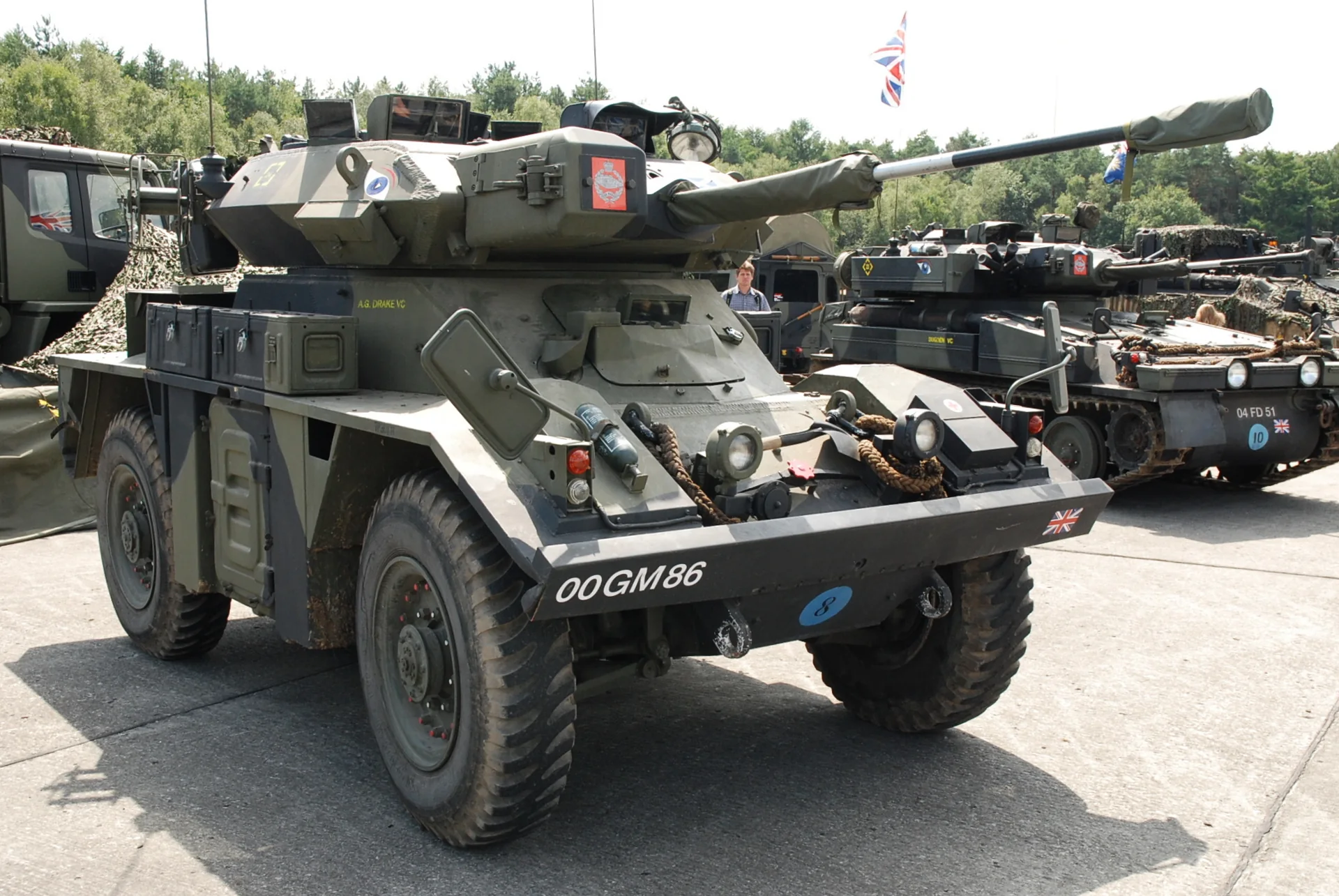
The FV721 used a compact 4×4 hull with the driver forward and a two-man turret above the center of the vehicle. The small hull and relatively powerful automotive package produced a reconnaissance vehicle that was quick on roads and easy to conceal compared with larger gun cars. Aluminum armor helped control weight, while the turret gave commander and gunner an enclosed position for observation and weapon use. The design shared conceptual and equipment links with the tracked CVR(T) family rather than simply continuing the earlier Ferret mechanically. Fox therefore represented a new reconnaissance generation built around common weapons and tactical ideas across wheeled and tracked scouts. 1, 2
Mobility and operational reach
Museum data lists a road speed of 64.6 mph and a 190-horsepower Jaguar J.60 engine, figures that underline how strongly Fox prioritized rapid wheeled movement. The 4×4 arrangement was simpler and smaller than the six- or eight-wheel layouts used by many heavier reconnaissance cars, and its compact dimensions made it useful on roads, lanes, and built-up terrain. That same layout imposed limits in very soft ground compared with tracked CVR(T) vehicles. British reconnaissance organizations could exploit the difference by choosing vehicles according to terrain and task rather than demanding that every scout have identical mobility characteristics. 1, 2
Protection and survivability
Fox used light armor to keep weight down and preserve the speed expected of a reconnaissance vehicle. Its protection philosophy assumed that the vehicle would use observation, concealment, and movement instead of fighting through opposition. The enclosed turret offered better overhead and frontal protection than an open scout car, but the vehicle remained vulnerable to weapons that would also threaten other light reconnaissance systems of its era. Its later service coincided with growing concern over mines and more capable automatic cannon, threats that highlighted the limits of a very light wheeled platform when reconnaissance missions required crews to remain close to hostile forces for extended periods. 1, 2
Weapons, sensors, and reconnaissance task
The 30 mm RARDEN cannon gave Fox substantially more firepower than machine-gun-armed scouts and aligned it with Scimitar. That weapon could deal with light armored vehicles and provide useful direct fire during security missions, but the Fox was still fundamentally a reconnaissance platform. Its small crew needed to observe, navigate, maintain radio contact, and manage the gun without losing the ability to move quickly. The weapon therefore supported the scout’s ability to survive contact and influence light opposition rather than transforming the vehicle into an infantry fighting vehicle or tank substitute. 1, 2
Variants and configuration changes
The Fox turret also had a service life on a different carrier. Sabre combined a Fox 30 mm turret with a Scorpion chassis and remained a distinct tracked reconnaissance vehicle, not another FV721 configuration. The Ministry of Defence answer of 4 July 2006 records Sabre’s withdrawal in 2004. That statement does not date the withdrawal of the wheeled Fox; the Fox chronology rests on the separate retained museum account. 1, 2, 3
Operational service and employment
The retained Museum of American Armor account places Fox entry into British service with B Squadron, 1st Royal Tank Regiment in 1975 and withdrawal in 1993–94. These dates concern the wheeled carrier, not the later Sabre conversion. Fox and tracked CVR(T) vehicles occupied related reconnaissance roles, but their coexistence is not evidence that they had identical unit allocations or equipment. The museum chronology does not, by itself, establish why Fox was withdrawn. 1, 2
Limitations and tradeoffs
Fox’s strengths, small size, speed, and a hard-hitting autocannon, created corresponding constraints. A compact 4×4 has less protected volume for crew endurance, radios, sensors, ammunition, and future growth than a larger vehicle. Its light protection limited how aggressively it could exploit the RARDEN cannon, while wheeled mobility was most effective where road and soil conditions favored it. These tradeoffs became more important as reconnaissance increasingly demanded sophisticated observation systems and as mine protection expectations rose. The vehicle could be excellent at rapid scouting without offering the growth margin later forces wanted from a long-lived platform. 1, 2
Historical place
Fox is historically important as the wheeled counterpart to Britain’s better-known CVR(T) family. It shows that the British Army did not view reconnaissance as a simple wheel-versus-track choice; instead it sought complementary vehicles that could share weapons and doctrine while exploiting different mobility strengths. The vehicle also marks the end of a line of very small British gun-armed armored cars. Later reconnaissance designs such as Fennek emphasized sensors and information management more strongly, while larger wheeled platforms provided greater protected volume. Fox therefore captures a distinct 1970s answer to the perennial problem of how much firepower a scout should carry. 1, 2
Sources and further reading
References and further reading are listed below. Image identification, credit and reuse terms remain with each photograph.
- Museum of American Armor, FV721 Fox exhibit account
- Fox armoured reconnaissance vehicle overview
- UK Ministry of Defence, Military Vehicles written answer, 4 July 2006, continuation
Visit an Armor Museum
Explore the worldwide museum directory to find armored vehicles, collections, and visitor-planning information.
Browse armor museums