A postwar scout-car requirement
The Ferret followed a 1947 War Office requirement for a new armored scout car. Production ran from 1952 to 1972, but its service life continued long after the assembly lines stopped. It remained in British use through the 1990–91 Gulf War, and the RAF Regiment employed it for airfield protection. A small reconnaissance vehicle had therefore found a place beyond the armored regiment as well as within it. 1
The Tank Museum dates the requirement for a new armored scout car to a 1947 War Office policy statement and production from 1952 through 1972. Its 2026 history notes British Army service through the 1990-91 Gulf War and broader armed-forces use until 1996. That long span explains why Ferret marks and user-specific equipment cannot be described as one unchanged standard configuration. 1
Inside the welded hull
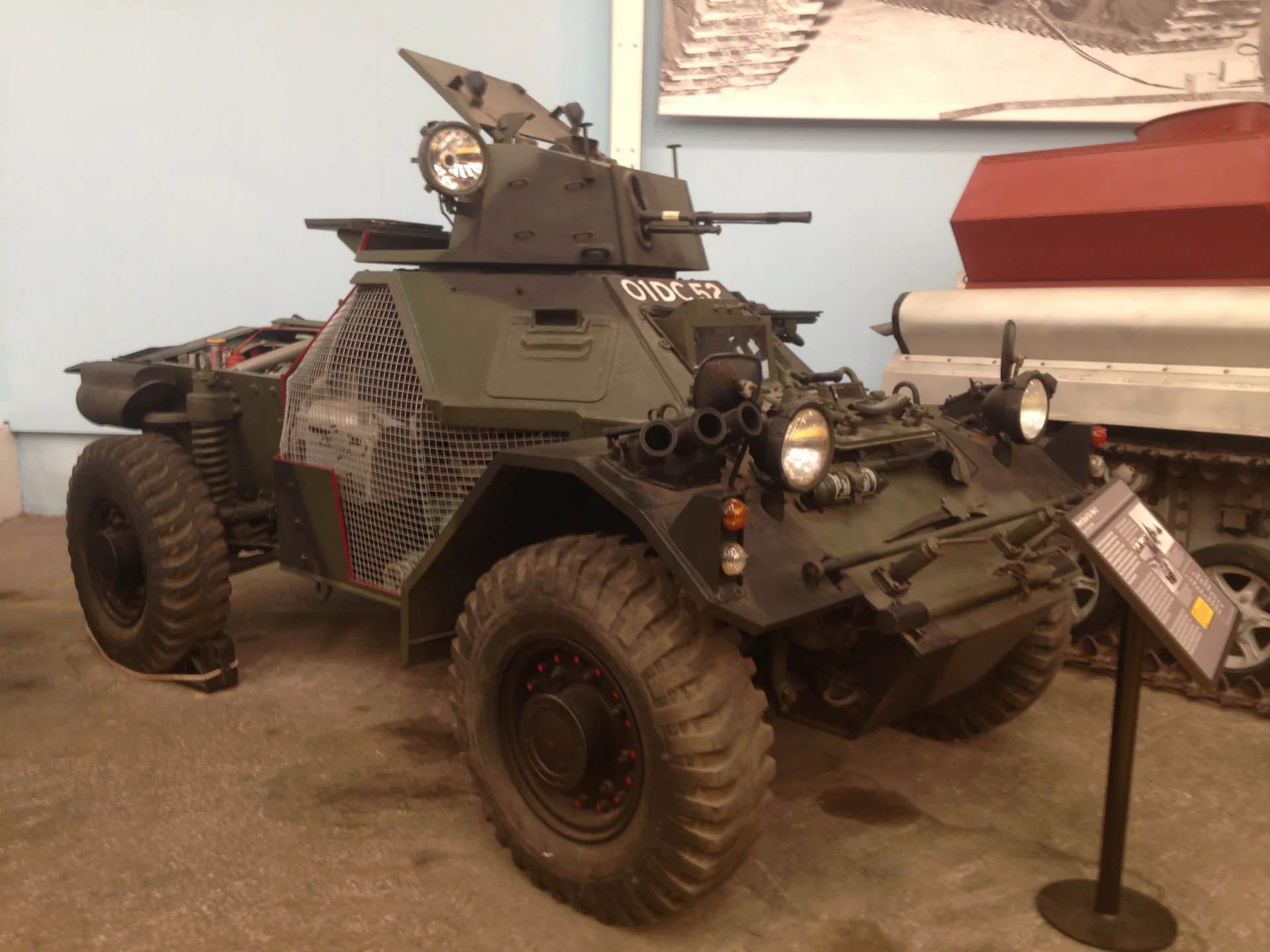
The surviving Mk 2/3 described by its owner, Jeremy Sanderson, places the driver low in the front of a welded hull, with the engine at the rear. Drive shafts run along the inside of the hull, while vision hatches give the driver a view ahead and to either side. The arrangement makes the occupied space part of the mechanical layout: the crew does not sit in an isolated cabin above a conventional truck chassis. 2
Above and behind the driver, the commander occupies the small manually turned turret with its .30-inch Browning machine gun. A folding seat, intercom and roof hatch fit into the limited space. The vehicle’s four-wheel drive, fluid coupling and preselector transmission support its mobility, but its armament remains that of a scout car. The turret protects a machine-gun position; it does not supply a tank gun or room for a separate loader. 2
Liaison, turreted and guided-weapon versions
The British Army’s 1969 handbook distinguishes the original Mark 1 liaison car from the Mark 2 reconnaissance car with a rotating turret. The Mark 1/2 instead had a fixed upper structure with a hinged roof opening and a Bren gun. Such distinctions change how the vehicle looks and how its crew works. A roofed Ferret is not automatically a Mark 2, and a gun visible above the hull need not be mounted in a rotating turret. 3
The same handbook separates thicker armor fitted during manufacture on the Mark 2/3 from the added plates of the Mark 2/4. It identifies the Mark 2/6 as a Vigilant missile conversion and the Mark 2/7 as that arrangement with its missile equipment removed. The Mark 5 used a different turret for missile launching. These were role and configuration changes within a family, not interchangeable names for one standard machine-gun car. 3
Canadian scouts and other operators
Canada obtained 124 Mark 1 Ferrets in 1954. Colin Stevens’s vehicle register follows them through official registration numbers, photographs and disposal records. A Department of National Defence photograph reproduced there shows a Royal Canadian Dragoons Ferret on a United Nations Emergency Force desert patrol around 1958–59, with a Bren gun rather than the small Browning turret familiar from British Mark 2 photographs. The national purchase and the pictured configuration need to be considered together. 4
The Canadian records also illustrate the transition from military equipment to preserved vehicles. A 22 May 1981 disposition document allocated cars to disposal, museums, monuments and target use. Stevens records cases in which the intended disposal route did not become the final outcome. A surviving hull may consequently have later fittings or markings that differ from its Canadian service appearance; its registration and physical history are more reliable identifiers than its present paint scheme. 4
The Sri Lanka Army’s pictorial history includes Ferrets on parade alongside motorcycles. Wheeled reconnaissance involved combinations of vehicles, not only a single model. The photograph documents an operator and an activity without establishing that every car shared the same mark or armament. 5
A long service life with different jobs
The Ferret’s career joined liaison, reconnaissance and airfield defense rather than following a single pattern of tank combat. Its longevity should not obscure that distinction. A vehicle still useful for local protection or patrolling need not be capable of confronting an opposing tank. The RAF Regiment’s employment and the late British service date show continued utility, not an unchanged tactical role across four decades. 1
Seen beside the Canadian open-topped cars, a preserved turreted Mk 2/3 makes the family’s central choice clear: how much enclosure and armament to provide for a very small crew. The name alone is insufficient to identify that choice. The hull, roof arrangement and service record explain which Ferret is actually being described. 2, 4
Sources and further reading
References and further reading are listed below. Image identification, credit and reuse terms remain with each photograph.
- The Tank Museum, new guide to Daimler Ferret
- Jeremy Sanderson, Daimler Ferret Mk 2/3: physical description
- British Army, Ferret User Handbook, Army Code 12174 (1969), page 17: list of marks
- Colin Stevens, Ferret Scout Car: Canadian vehicles and original records
- Sri Lanka Army Armoured Corps, Pictorial History
See Armor in Person
This vehicle family is connected to 1 verified museum through 1 documented display record.