Requirement and development
Fennek was designed for German and Dutch reconnaissance forces seeking a modern scout centered on observation and target location rather than a large turret. The Bundeswehr has used Fennek since 2003 and describes it as the main weapon system of Army reconnaissance troops for vehicle-based scouting. KNDS likewise presents reconnaissance as the mission around which the family was created. This requirement favored a very low silhouette, quiet operation, long range, a three-person crew, advanced day/night sensors, and communications. In doctrinal terms, Fennek represents a clear move away from gun-armed armored-car tradition toward a platform whose principal weapon is the quality and speed of the information it produces. 1, 2, 3
Layout, crew, and architecture
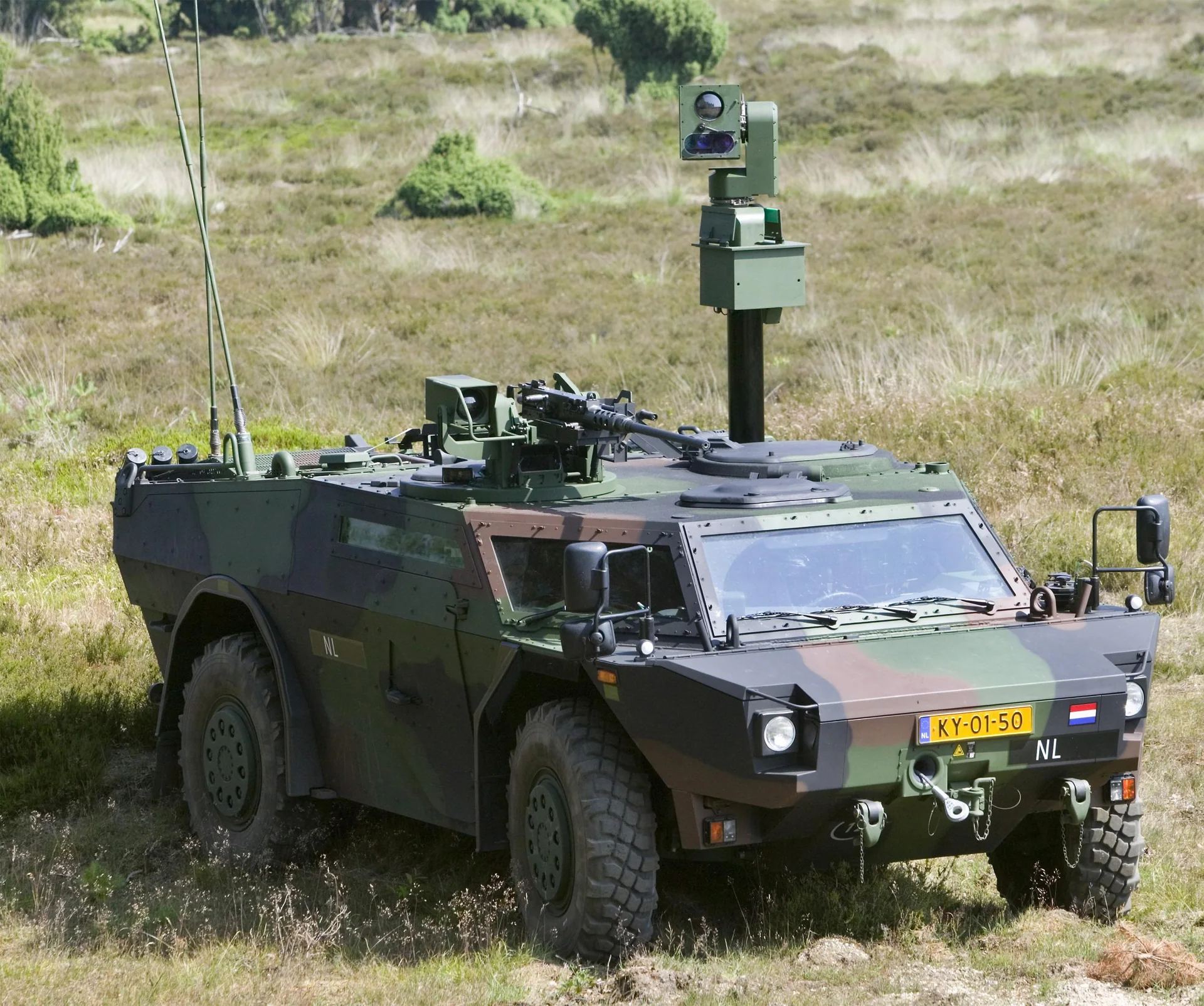
Fennek carries a driver, commander and system operator in a low four-wheel hull. Its observation head combines a thermal imager, daylight camera and laser rangefinder and can be raised above the roof on a mast. The Bundeswehr also describes dismounted operation of the sensor assembly on a tripod. That separation of vehicle position from observation height is central to the design: the crew can obtain a view without placing the whole vehicle on an exposed crest. 1
The Bundeswehr states that the observation head can be raised more than three metres and can also be removed from the vehicle for use on a tripod connected by cable. That lets the crew keep the hull below cover while moving the sensor to a better line of sight. The same official page identifies thermal imaging, daylight optics, and a laser rangefinder in the sensor head, so the mast is not merely a periscope extension but the core of the reconnaissance system. 1
Mobility and operational reach
Bundeswehr and KNDS data emphasize long-range wheeled mobility. German published figures give a 177 kW engine and roughly 1,000 km range, while KNDS lists road speed above 100 km/h and describes an H-drive arrangement, central tire inflation, and strong gradient performance. These features make Fennek well suited to dispersed reconnaissance patrols that must move far between support points. Its 4×4 layout keeps the vehicle compact, although it does not make the platform equivalent to a tracked scout in every terrain. The design instead seeks a balance among strategic deployability, road endurance, off-road maneuverability, low profile, and a small logistical footprint. 1, 2, 3
Protection and survivability
Fennek is lightly armored relative to infantry fighting vehicles and tanks, but its survivability concept extends beyond passive armor. Bundeswehr and KNDS material describe ballistic, mine, IED, and fragment protection in broad terms while also emphasizing low silhouette, quiet running, signature reduction, and the ability to observe from concealment. Later German variants added improved IED protection and electronic countermeasures. Those upgrades reflect experience in expeditionary operations where mines and improvised explosives became major threats. The vehicle is still not intended to fight through heavy direct fire; survivability depends on avoiding detection, using terrain, and exploiting sensors before an opponent can locate the scout. 1, 2, 3
Weapons, sensors, and reconnaissance task
Fennek’s defining equipment is its observation and reconnaissance suite. Bundeswehr material identifies thermal and daylight cameras plus a laser rangefinder on an elevating mast, integrated with navigation and operator displays. A roof weapon station can carry a machine gun or automatic grenade launcher, giving the crew self-defense and limited direct-fire capability without making the vehicle gun-centric. KNDS stresses target-location accuracy and reconnaissance performance. This arrangement allows a patrol to detect, identify, locate, and report targets while remaining behind cover, a mission concept far closer to modern intelligence collection than to the older practice of using an armored car’s cannon to fight for information. 1, 2, 3
Variants and configuration changes
German service material distinguishes several Fennek configurations instead of presenting one family-wide equipment fit. The Bundeswehr describes 1A1 and 1A2 reconnaissance vehicles, with the later standard incorporating improved protection against mines and improvised explosive devices plus electronic countermeasures. Joint Fire Support and engineer forms use the same basic vehicle for different tasks, and their mission equipment is not interchangeable with the reconnaissance fit. Configuration therefore has to be stated with the variant rather than inferred from the Fennek name alone. 1
Operational service and employment
The Bundeswehr states that it has operated Fennek since 2003 and has used the vehicle in missions including Afghanistan and Mali. Those deployments put the design into environments very different from the Central European reconnaissance problem faced by earlier Luchs crews. Fennek also serves outside pure reconnaissance in German Joint Fire Support and engineer roles, showing how a sensor-rich small vehicle can support multiple information-intensive tasks without needing the protected volume of a larger infantry carrier. 1, 2, 3
Limitations and tradeoffs
Fennek’s emphasis on sensors and concealment creates a different set of constraints from a gun-armed scout. A three-person crew has limited manpower for security, maintenance, and dismounted observation, and a compact 4×4 hull restricts internal volume despite the sophisticated electronics carried. The mast and sensor suite are valuable but make the vehicle dependent on electrical power, trained operators, and communications networks. Its self-defense weapons cannot substitute for the firepower of an IFV. Wheeled mobility and low silhouette work especially well on suitable routes and observation positions, but planners still have to match the vehicle to terrain and threat rather than treating technology as a replacement for tactical judgment. 1, 2, 3
Assessment and related development
Fennek puts observation equipment at the center of the reconnaissance vehicle. The mast, three-person crew and communications fit serve a different balance from a turreted cannon scout. Its specialist versions extend that arrangement to other information-gathering and fire-support tasks. The mission equipment, rather than the shared body shape alone, identifies which Fennek is being described. 1, 2, 3
Sources and further reading
References and further reading are listed below. Image identification, credit and reuse terms remain with each photograph.
Visit an Armor Museum
Explore the worldwide museum directory to find armored vehicles, collections, and visitor-planning information.
Browse armor museums