Requirement and development
Arquus’s indexed heritage account dates privately funded VCR work to 1975 and the gun-armed ERC development to 1976, followed by French Army acceptance of ERC-90 F4 in September 1981. The chronology helps distinguish the private family development from later Army adoption. The indexed heritage account supports these development stages but not a complete specification or a claim that the Sagaie and Lynx turrets used identical weapons. 4
Layout, crew, and automotive architecture
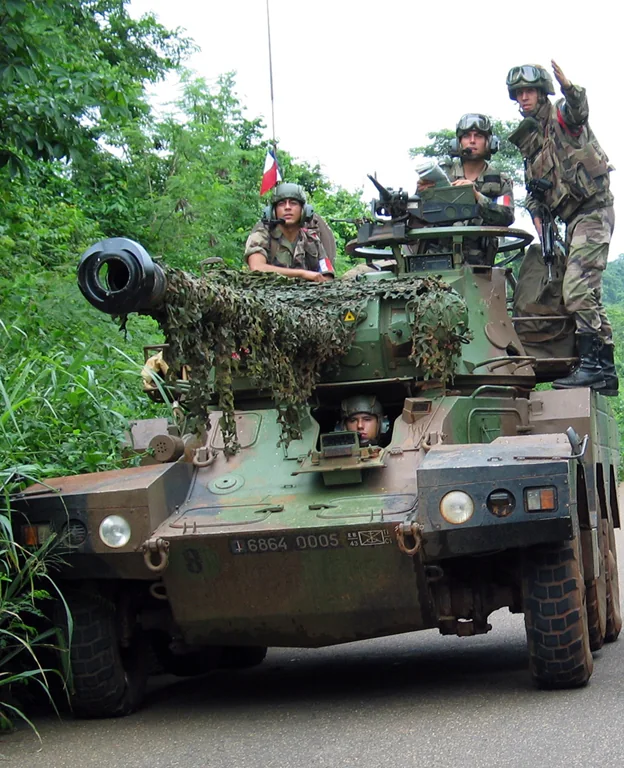
The Sagaie used a low 6×6 hull derived from Panhard's VCR family, with the driver forward, a compact turret in the center, and the powerpack toward the rear. The middle road wheels could be raised in some conditions, reflecting Panhard's continued interest in reducing drag and adapting wheeled geometry to different terrain. Amphibious capability and NBC protection were part of the original concept, although later modifications and service configurations could affect those capabilities. The turret carried a three-man crew overall and was designed around the 90 mm F4 gun. Compared with the four-man AMX-10RC, the Sagaie was smaller and lighter, easing air transport but reducing internal volume and growth margin. 1, 2, 3
Mobility and terrain behavior
Strategic deployability was a central design requirement. Arquus explicitly ties the Sagaie's mass ceiling to C-160 transport, and French operational history repeatedly linked the vehicle with rapid-deployment formations and African basing. On roads and tracks the 6×6 chassis provided useful speed and range, while amphibious equipment widened route options under suitable conditions. The light weight also helped on bridges and infrastructure that could not support heavier armored vehicles. These strengths came with tradeoffs: the original power-to-weight ratio was modest enough to motivate engine upgrades, and the small chassis could not absorb the same payload growth as larger reconnaissance vehicles. The Sagaie's mobility story is therefore as much about getting to a theater as about movement inside it. 1, 2, 3
Protection and survivability
The Sagaie's protection was appropriate to a light expeditionary armored car rather than a main battle vehicle. The welded hull and turret provided protection from small-arms fire and fragments, while low mass preserved air transportability and mobility over weaker roads and bridges. French doctrine relied on reconnaissance methods, dispersion, and movement to reduce exposure to heavier weapons. Later upgrades improved observation and automotive reliability more than they transformed the basic protection category. As with other light armored cars, the presence of a powerful gun could create a misleading impression of survivability: the Sagaie could deliver serious direct fire, but it remained vulnerable to cannon, mines, improvised explosive devices, and dedicated anti-armor systems. 1, 2, 3
Armament, observation, and communications
The French Sagaie configuration is associated in the retained references with the 90 mm F4 gun and its turret installation. The broader ERC family also includes other gun and turret arrangements. Caliber alone does not make their ammunition, sights or armor-piercing performance interchangeable. The gun supported reconnaissance and direct-fire tasks, but the choice of weapon does not by itself establish the detailed threat assessment behind every French or export purchase. 1, 2, 3
Variants and production evolution
The wider ERC family included earlier Lynx and export configurations with different turrets and guns, while the French F4 Sagaie became the best-known model. Panhard also developed engine and automotive improvements; later French vehicles received diesel-related modernization and revised observation equipment, and export users fielded their own standards. A small Sagaie 2 branch used a lengthened hull and twin-engine arrangement for Gabon. These variants should not be merged into one specification. The French service vehicle, export Sagaies, and earlier ERC models shared a family resemblance and chassis heritage, but differences in engines, turrets, amphibious equipment, and electronics changed performance and maintenance requirements. 1, 2, 3
Operational service
ERC-90 Sagaie served French expeditionary cavalry and export users on different schedules. Retained accounts describe employment in overseas operations and later redistribution or withdrawal from French front-line units as other vehicles became available. A unit’s transition does not establish a universal retirement date for every training vehicle or foreign operator. The history is therefore organized around the French expeditionary role and dated modernization, without treating a photograph or an undated operator list as a current force census. 1, 2, 3
Historical place
Sagaie occupied the lighter end of France’s gun-armed wheeled reconnaissance force. Its 6×6 carrier and 90 mm turret addressed a different transport and infrastructure problem from the heavier AMX-10RC. The comparison explains why both could serve at the same time without one being a scaled copy of the other. Later replacement programs changed the balance of protection and sensing, but their complete execution is not assumed here from the existence of a successor design. 1, 2, 3
Different French units, training establishments and export operators need separately dated transition records. A successor becoming available does not establish a completed one-for-one exchange, and a surviving photograph does not establish the status of an entire fleet. The retained accounts do not justify a precise universal sequence from Sagaie through an interim vehicle to Jaguar. Unit-level transfers and retirement dates remain subject to their own delivery and establishment evidence. 1, 2, 3
Sources and further reading
References and further reading are listed below. Image identification, credit and reuse terms remain with each photograph.
- Arquus Heritage , presentation of the ERC 90 Sagaie at Satory
- ERC-90 Sagaie overview and French service history
- Operation Daguet historical profile , ERC-90 Sagaie
- Arquus Heritage, presentation of ERC-90 Sagaie at Satory, indexed excerpt (indexed excerpt)
Visit an Armor Museum
Explore the worldwide museum directory to find armored vehicles, collections, and visitor-planning information.
Browse armor museums