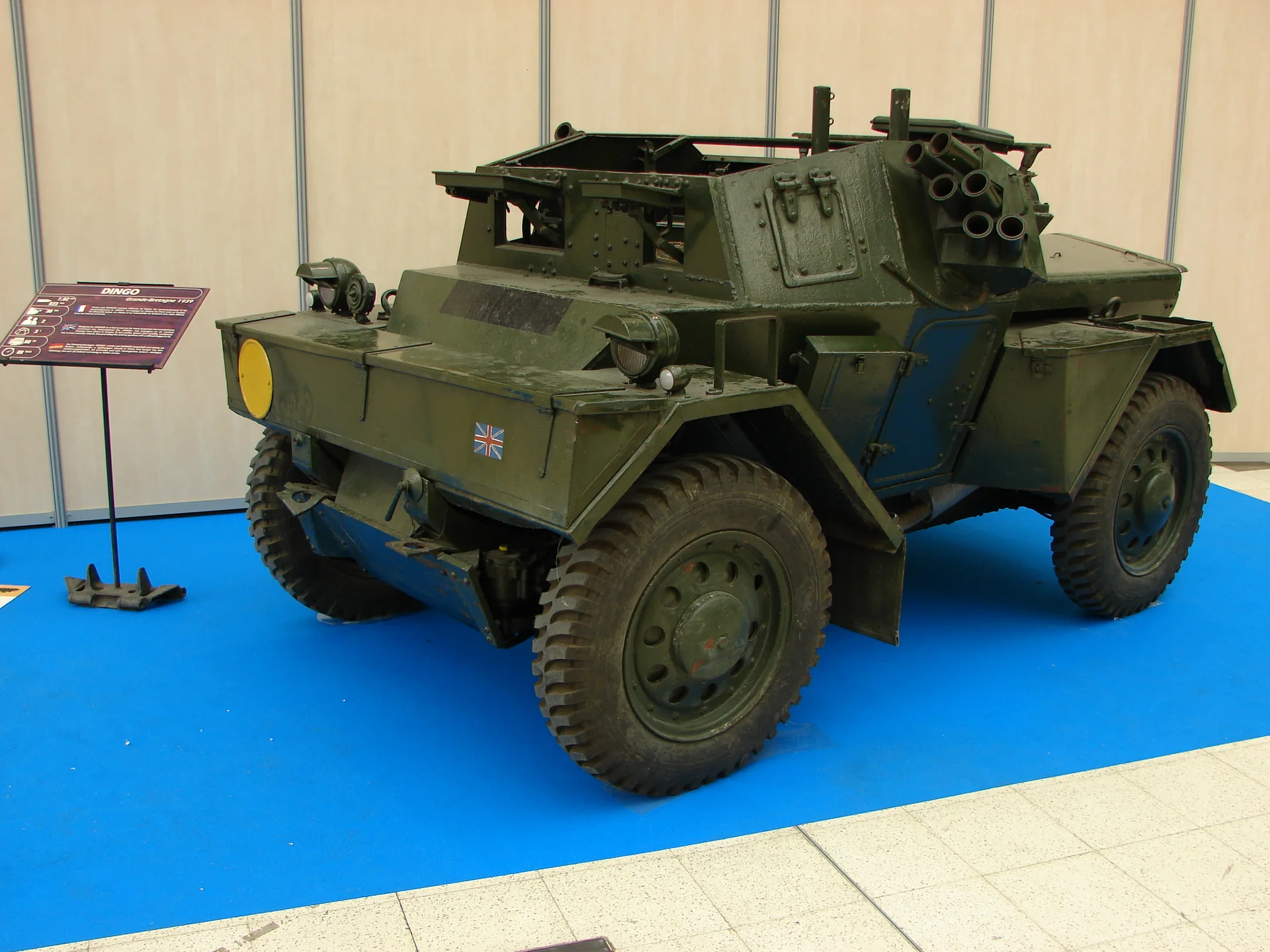
A small car built for reconnaissance
The Dingo was a prewar BSA design manufactured by Daimler and entered British service in 1939. It put a two-person crew into a compact armored vehicle rather than supplying a gun turret or a troop compartment. Reconnaissance for infantry and armored divisions was its original work. The combination of small size and maneuverability also made it useful for other tasks requiring a protected vehicle close to the fighting. 1
The driver, the wireless and the Bren
The second crew member sat beside the driver. A swiveling seat let him turn toward the No. 19 wireless set or face forward to use the Bren gun. The engine was behind the crew. Front armor reached 30 mm; the smooth underside helped the car cross uneven ground but left it vulnerable to mines. 2
A fluid flywheel and five-speed preselector transmission gave the Dingo the same choice of ratios in forward and reverse. Independent suspension served all four wheels. This arrangement made reversing a more useful part of its mobility than it would be in a vehicle with only one slow reverse gear. It did not require the crew to turn the whole car around before withdrawing along the route by which it had approached. 1
The tires were another distinctive feature. The museum’s D-Day account describes solid rubber tires and the absence of a spare wheel, with the independent suspension cushioning the ride. The Dingo therefore combined puncture-resistant running gear with mechanical attention to crew comfort. That relationship between tires and suspension is more revealing than treating a quoted road speed as a measure of how comfortably a crew could scout across broken ground. 2
Reconnaissance and battlefield errands
Medical officers used Dingos to look for casualties, and one regimental padre received a car. Later, Daimlers tended to remain with infantry divisions while armored divisions received Humbers. Service continued into the 1960s. The museum’s Coventry-built Mark III, F206073, has no established wartime service record. 1
An earlier museum display carried 12th Lancers markings in desert colors. Its D-Day feature identified it as the same type used by the Inns of Court on D-Day. Those display markings and that equipment comparison do not establish a personal wartime history for the restored car. 2
An Imperial War Museums catalog caption places a Dingo of the 2nd Polish Corps at the River Esino in July 1944, during the advance beyond Ancona. The catalog describes the scout car fording the river about ten miles beyond the city. That is a specific Italian-campaign connection for the type, distinct from the British unit histories and surviving museum vehicles discussed here. The caption does not identify an individual chassis history or turn one crossing into a general statement of safe fording depth. 5
Daimler Dingo, Australian Dingo and Ford Lynx
Australia also built a vehicle called Dingo, but it was not the British Daimler car. The Australian War Memorial’s example used a shortened Ford truck chassis, Marmon-Herrington four-wheel-drive equipment and a Ford V8 engine. Leaf springs, a conventional four-forward-speed gearbox and a front-mounted engine gave it a different mechanical layout. Its similar name and reconnaissance purpose are not evidence of identical construction. 3
The Australian program answered a local wartime requirement when overseas supply was difficult. The resulting cars equipped Australian armored formations for training; unsatisfactory performance contributed to the end of production and their replacement by Canadian Lynx vehicles. That sequence belongs to Australian procurement history, rather than to a progression of Daimler production marks. 3
The Canadian Ford Lynx is another identification trap. A National Library of New Zealand photograph taken by George Kaye near Atina and Belmonte on 30 May 1944 is cataloged as a Lynx with New Zealand Divisional Cavalry. It has circulated through Dingo-related references, but the corrected identification should govern its use. A photograph of a related-looking scout car cannot establish the presence of a Daimler merely because an older link describes it that way. 4
Reconnaissance without a fighting turret
The two-person layout concentrated driving, observation, wireless reporting and the Bren in a small car. Its mobility served reconnaissance rather than the duties of a miniature tank. 1, 2
Sources and further reading
- The Tank Museum, Dingo Scout Car
- The Tank Museum, The Daimler Dingo, D-Day collection feature (archived)
- Australian War Memorial, Australian Dingo scout car, REL23826
- National Library of New Zealand, Ford Lynx scout car in Italy, 30 May 1944
- Imperial War Museums, Polish Army in the Italian Campaign: Dingo at the Esino (indexed evidence only)
See Armor in Person
This vehicle family is connected to 1 verified museum through 1 documented display record.