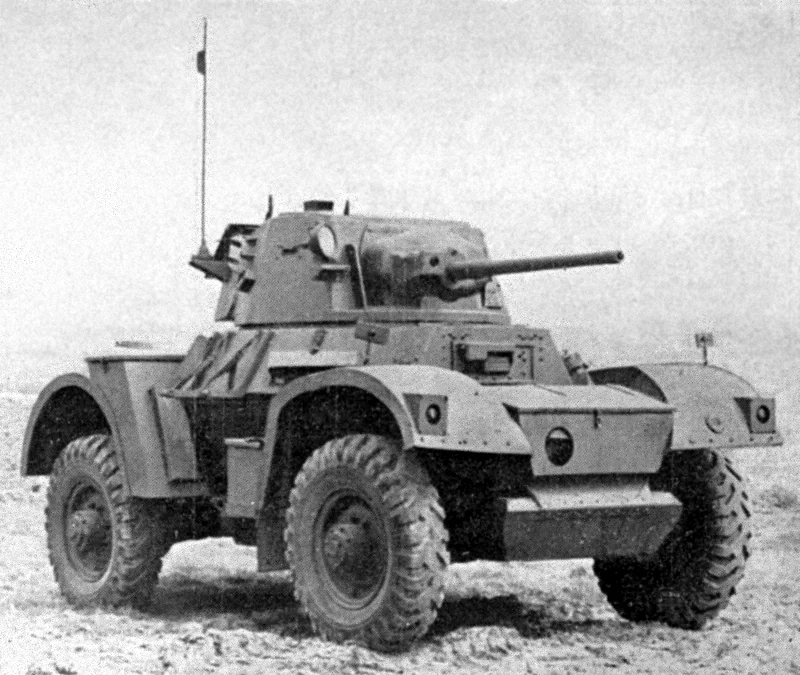
Daimler in British reconnaissance
The Daimler Armoured Car was a gun-armed reconnaissance vehicle, with a rear engine, four-wheel drive and a crew of three. It served both reconnaissance regiments and reconnaissance troops within armoured regiments. Its turreted 2-pounder gave the three-man crew a gun rather than relying on the machine-gun armament of a smaller scout car. 1
Crew positions and reversing controls
The arrangement for reversing depended on cooperation between two crew members. Coventry Transport Museum describes a conventional steering wheel for the driver and a second wheel inside the turret. A crew member used the latter to steer while reversing, but the driver retained the other driving controls. It was therefore not a separate rear driving station with an independently operated set of controls. 2
Suspension and transmission
Each wheel was independently suspended, with permanent four-wheel drive transmitted through a pre-selector gearbox and fluid flywheel. Coventry’s Mark I has a modified four-litre Daimler car engine. 2
The underside was unusually smooth. The regimental museum describes this as allowing the car to slide across small obstacles rather than catching on them. Alongside the independent suspension, that detail belongs to the practical design of a wheeled reconnaissance vehicle: ground clearance alone does not describe how the underside meets an obstruction. 1
Observation under armor
With the turret hatch closed for action, the crew observed through a periscope. Turret rotation was manual, using an internal handle. The crew therefore depended on optical observation and hand traverse when fighting with the hatch shut. 2
The 2-pounder installation
The June 1945 Royal Armoured Corps report described both principal Daimler marks with a 2-pounder gun and a coaxial 7.92 mm Besa. It also recorded that some carried a Little-John adaptor. This was a selected equipment fit, not the defining armament of every Daimler. 3
Two production marks and a field conversion
Mark I and Mark II remained in service together. The same report said that Mark II incorporated improvements not introduced into Mark I production. Its production position to 31 May 1945 listed 1,900 Mark I and 418 Mark II vehicles against orders for 1,900 and 1,100 respectively. Those figures describe the report's cutoff, not the final output of both marks. 3
A different alteration appears in a dated operational record. The Imperial War Museums catalogue for Army Film and Photographic Unit film A70 113-12 identifies an Inns of Court Regiment sawn-off Daimler among traffic near St Martin des Besaces on 1 August 1944. The catalogue places this altered vehicle in the movement of reinforcements behind the advancing front, alongside transport and other reconnaissance vehicles. 5
Mixed reconnaissance regiments
The June 1944 21st Army Group table lists 45 Daimler gun cars and 14 Staghounds for each of the 2nd Household Cavalry, Inns of Court, Royal Dragoons and 11th Hussars. AEC cars or 75 mm half-tracks appear in their support columns, with scout cars recorded separately. These are dated administrative holdings, not proof that every vehicle was present and serviceable on a particular day of battle. 4
By June 1945, the RAC report gave an issue scale of 45 Daimlers per armoured-car regiment and noted that some infantry-division reconnaissance regiments were receiving them instead of Humber IVs. The scale placed the Daimler within a mixed establishment containing headquarters, support, antiaircraft and scout vehicles, rather than an all-Daimler unit. 3
The Ceylonese unit's equipment history began before its Daimler gun cars arrived. Army headquarters authorized the regiment in October 1955, initially at squadron strength, and its early fleet combined scout cars with machine-gun-equipped motorcycle sidecars. The twelve Daimlers inducted in 1959 belonged to the transition toward a larger regiment. They therefore entered an organization still building its own reconnaissance structure and training system, rather than merely replacing twelve identical vehicles. The unit history establishes that institutional setting without identifying the later service career of each individual Daimler. 6
Postwar service and a preserved Mark I
The Sri Lanka Armoured Corps’ 1st Reconnaissance Regiment history records the induction of twelve Daimler Armoured Cars in 1959, during its expansion from a squadron into a regiment. It separately lists four Mark I scout cars acquired initially and eight Mark II scout cars added by February 1956. The distinction prevents the earlier scout-car purchases from being miscounted as gun-armed Daimlers. 6
Coventry Transport Museum dates its Mark I to 1943 and records purchasing it in 1977 with a Science Museum grant. This gives one survivor a documented post-service history. 2
Sources and further reading
- Museum of The Queen's Royal Hussars, Daimler Armoured Car
- Coventry Transport Museum, Daimler Armoured Car: 1943 Mark I collection record
- Royal Armoured Corps half-yearly report, June 1945, production position to 31 May 1945; quoted extracts transcribed by Peter Brown
- 21st Army Group vehicle holdings, June and December 1944; RAC report tables transcribed by Peter Brown
- Imperial War Museums, A70 113-12: Reinforcements move up to 8th Corps' front south of Caumont, 1 August 1944, catalogue description
- Sri Lanka Armoured Corps, 1st Reconnaissance Regiment history
Visit an Armor Museum
Explore the worldwide museum directory to find armored vehicles, collections, and visitor-planning information.
Browse armor museums