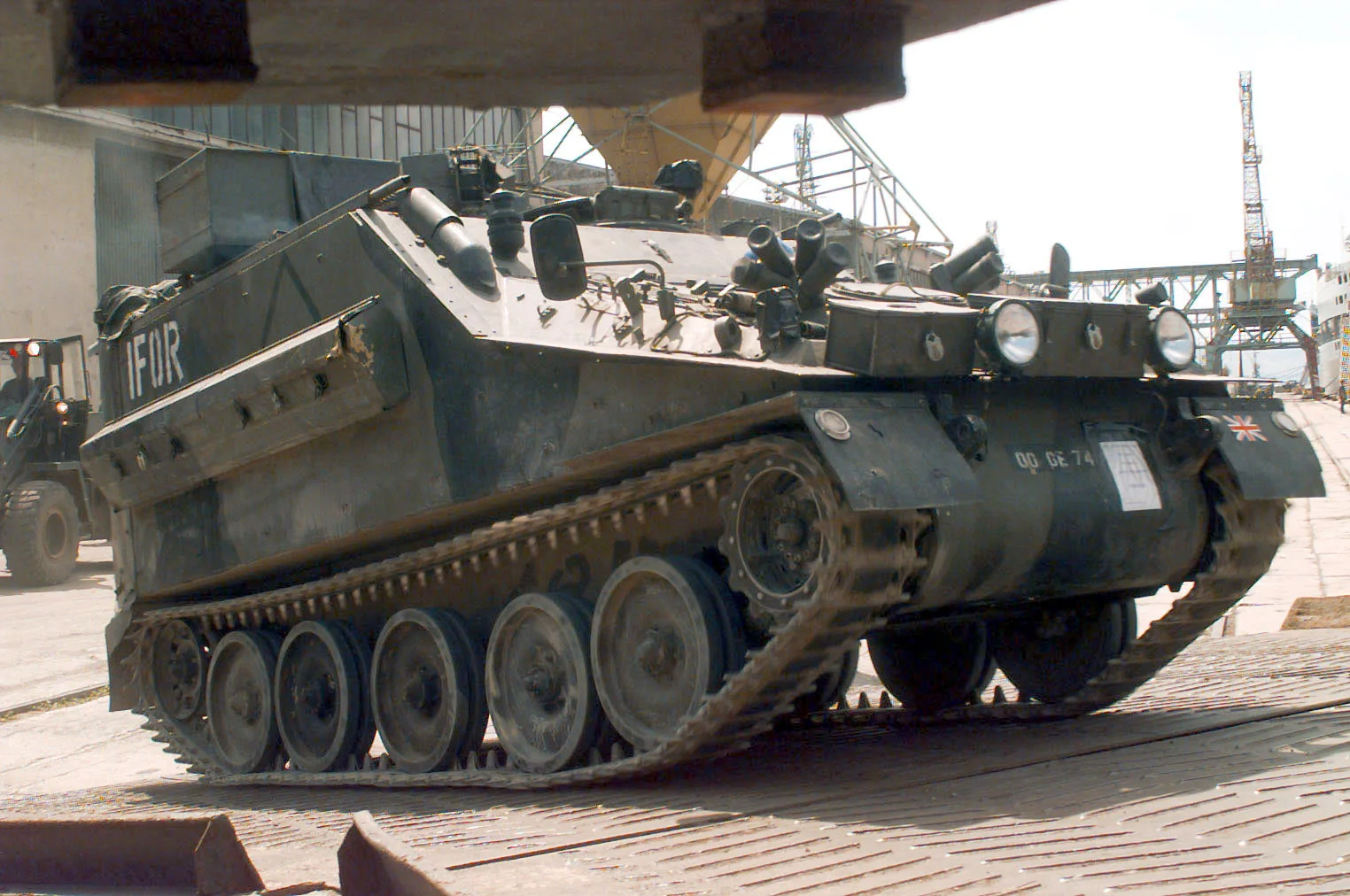
Requirement and development
CVR(T) grew from a British requirement for a small, fast, air-portable tracked reconnaissance family that could replace older scouts while operating across difficult ground. Rather than build one vehicle and force it into every cavalry task, the program created a common automotive base for specialized variants. Scimitar provided the best-known reconnaissance combat configuration, while Spartan carried small teams, Sultan served command posts, Samson supported recovery, and Striker carried antitank missiles. This family approach allowed reconnaissance formations to preserve similar mobility and maintenance characteristics across vehicles whose battlefield functions were very different. 1
Layout, crew, and architecture
The CVR(T) chassis was intentionally compact, with low weight and dimensions that reflected transport as well as tactical requirements. Different superstructures and turrets changed the internal volume and crew arrangements, but the family retained recognizable automotive commonality. Scimitar’s turret and 30 mm RARDEN cannon created a fighting scout; Spartan traded the turret for protected passenger space; Sultan raised the roof for command work; Samson carried recovery equipment; and Striker reorganized the vehicle around missiles. The common chassis let these specialists accompany one another instead of forcing command, support, and antitank elements onto slower or larger platforms. 1
Mobility and operational reach
Tracks gave CVR(T) useful cross-country performance for a vehicle that remained much lighter than contemporary tanks and infantry fighting vehicles. Low mass aided transport and allowed the family to use routes and bridges that could be restrictive for heavier armor. At the same time, the compact running gear and high mobility imposed ride, noise, maintenance, and crew-space penalties familiar to very small tracked vehicles. The crucial point is that every variant could broadly keep pace with the reconnaissance force it supported. A Sultan command post or Samson recovery vehicle that could not follow Scimitar across the same ground would have undermined the family concept. 1
Protection and survivability
CVR(T) protection was deliberately light because the program prioritized compactness, mobility, and transportability. Crews were protected from the kinds of small-arms and fragmentation threats associated with reconnaissance but were not meant to exchange sustained fire with tanks or heavier fighting vehicles. Later upgrades improved survivability, yet the small basic hull restricted how much additional armor and equipment could be added without eroding the original advantages. The family’s long life meant it eventually operated in threat environments far more demanding than those envisioned at design, increasing reliance on tactics, concealment, and careful mission selection. 1
Weapons, sensors, and reconnaissance task
Mission equipment differed more than any other feature across CVR(T). Scimitar combined optics and the 30 mm RARDEN gun for armed reconnaissance. Spartan moved small specialist teams under armor. Sultan provided space for radios, maps, and command personnel. Samson carried recovery equipment needed to keep the light tracked fleet moving, and Striker added guided antitank firepower to reconnaissance organizations. Taken together, these variants show that reconnaissance is an ecosystem rather than a single scout vehicle. Observation has to be supported by command and control, protected movement, recovery, and sometimes the ability to impose delay or defeat armor encountered during security operations. 1
Variants and configuration changes
Each named CVR(T) variant should be identified by its function rather than treated as one interchangeable scout. Scimitar carried the 30 mm turret; Spartan carried small specialist teams; Sultan provided command space; Samson supplied recovery equipment; and Striker carried antitank missiles. Scorpion and later Sabre conversions belong to the wider lineage, while the larger Stormer is a related development. Equipment changes across a long service life require individual configuration records rather than a universal late-model specification. 1
Operational service and employment
A Ministry of Defence answer published on 4 July 2006 lists Spartan, Scimitar, Striker, Samson, Samaritan and Sultan separately, using a fleet snapshot dated 21 April. It distinguishes fleet size from operationally deployable numbers, and its continuation explains that these categories include vehicles undergoing several kinds of repair or upgrade. The same answer records earlier withdrawal of Sabre and Scorpion. This is a useful dated view of the family’s different service paths, not evidence that all variants remained in service together indefinitely. 2, 3
The answer’s definitions are important: fleet stock includes vehicles undergoing repair or modification, as well as training, trials and storage vehicles. Even the operationally deployable category can include vehicles in specified repair or conversion processes. Neither column should be renamed immediately available for combat. The dated administrative definitions belong alongside any figure taken from the table. 3
Limitations and tradeoffs
A common automotive family does not give every member the same payload, internal layout or growth margin. A command vehicle, an ambulance, a recovery vehicle and a gun-armed scout place different demands on a small hull. The retained evidence does not provide a common comparative noise or maintenance trial against wheeled scouts. Nor should the needs of one late upgrade become the measured limit of every original CVR(T) configuration. 1
Historical place
CVR(T) is one of the clearest examples of a successful reconnaissance family rather than a single successful vehicle. Its significance lies in the way Scimitar, Spartan, Sultan, Samson, Striker, and other variants collectively supported the information-gathering mission. The program demonstrated the value of automotive commonality while preserving specialized battlefield functions, a principle repeated in later modular armored fleets. It also illustrates the limits of extreme compactness as electronics and protection demands grow. The family’s multi-decade career links Cold War visual scouting to the networked reconnaissance era and remains central to understanding British cavalry organization after the 1960s. 1
Sources and further reading
References and further reading are listed below. Image identification, credit and reuse terms remain with each photograph.
- Combat Vehicle Reconnaissance (Tracked) overview
- UK Ministry of Defence, Military Vehicles written answer,4 July 2006, fleet table
- UK Ministry of Defence, Military Vehicles written answer, 4 July 2006, continuation
Visit an Armor Museum
Explore the worldwide museum directory to find armored vehicles, collections, and visitor-planning information.
Browse armor museums