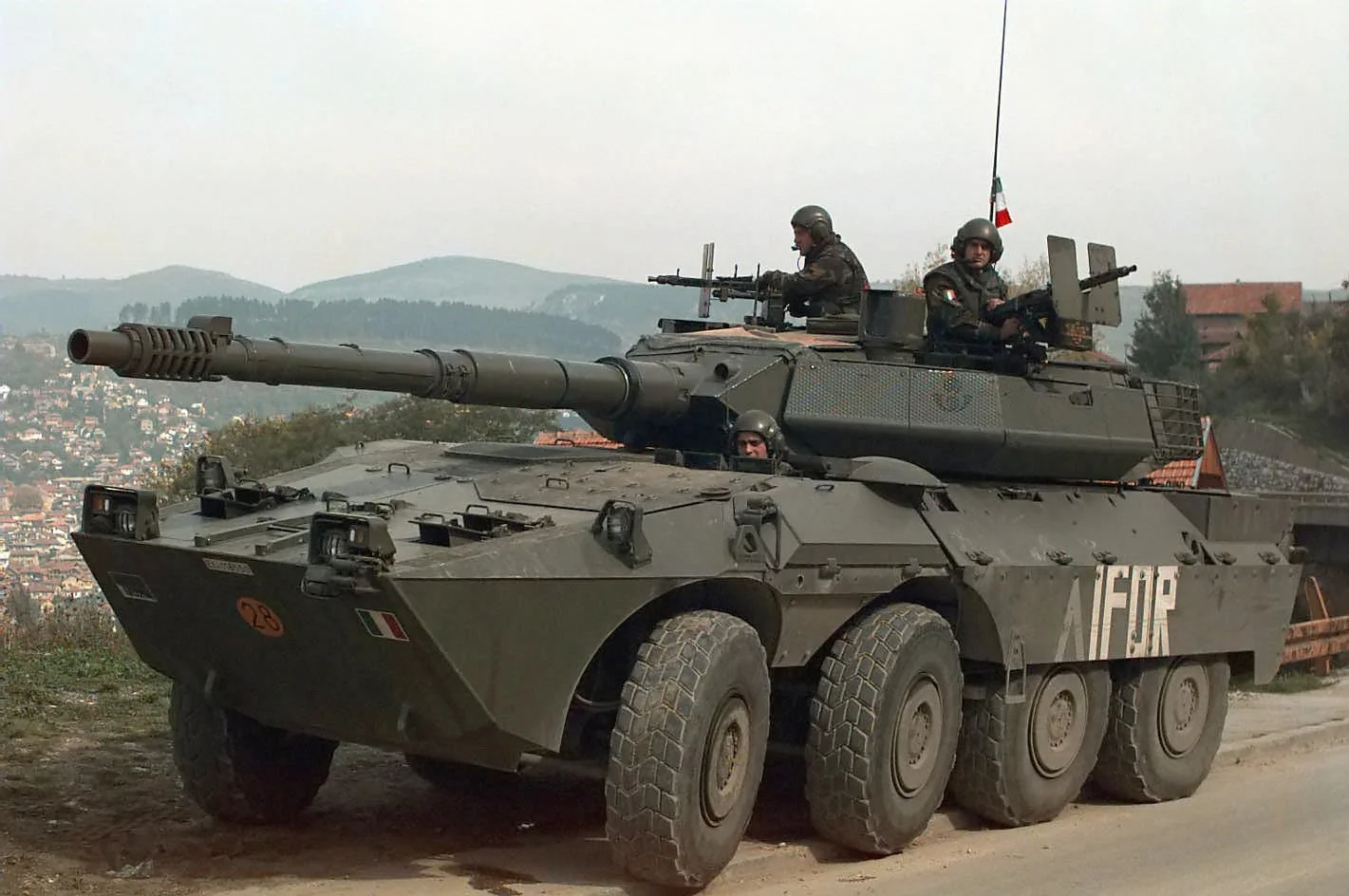
Development
The manufacturer presents Centauro II as an evolution of Centauro I rather than as a simple gun upgrade. Its current product description combines a 120 mm L/45 main installation, automatic loading, a four-person crew and a 525 kW powerplant on a roughly 30-tonne reference vehicle. Those figures belong to the second generation and should not be projected backward onto the original B1. 1
Layout and crew
An eight-wheel chassis and a large gun turret distinguish the family from troop-carrying armored vehicles. Centauro II combined a revised powerpack and transmission with new control, braking and digital systems. Accommodating its weapon and protection involved the complete vehicle: hull structure, balance, suspension and crew space changed together. The second generation was therefore a redesign of the wheeled gun-vehicle concept, not merely a larger barrel fitted to the original B1. 1
Armament
The baseline Italian B1’s 105 mm gun and the principal Centauro II 120 mm smoothbore installation remain distinct configurations. However, the maker’s Centauro I description also lists 105 mm and 120 mm gun installations, while IDV advertises a 105 mm option for Centauro II. A barrel’s caliber alone therefore cannot reliably identify the generation. The Centauro I product description lists a turret commander, gunner and loader; automatic loading on the later vehicle should not be applied retrospectively to every earlier Centauro. 1, 4, 5
IDV describes the Centauro II's automatic loading system with a manual backup and lists thirty-one rounds for the vehicle. The backup is an important qualification to the word automatic: the published configuration retains an alternative means of serving the gun rather than making the normal loading mechanism the only stated option. This description belongs to the Centauro II installation and should not be projected backward onto the original Centauro simply because both vehicles carry the family name. 1
Crew protection
For Centauro II, the manufacturer describes modular protection, separation of ammunition from crew space, and fire-suppression provisions. These are manufacturer statements about design features, not independent proof of immunity to a named battlefield threat. Protection is also not reducible to one armor-thickness number: internal arrangement and the handling of damage are different questions from whether a projectile can penetrate the outer structure. 1
Mobility and support
Wheels make the family’s emphasis on road movement immediately visible, but road speed is not a complete measure of military mobility. Ground conditions, route access, maintenance, recovery, and transport all influence whether a force can move as required. As an engineering comparison, a heavier second-generation vehicle must be judged in its own configuration; published B1 figures cannot simply be combined with Centauro II armament and protection. 1, 2
The manufacturer's chassis description includes an H-shaped driveline with a single differential, independent hydropneumatic suspension, and steering on the first, second and, when required, fourth axles. It also lists run-flat tires and central tire-pressure control. These are distinct solutions to maneuvering and sustaining an eight-wheeled vehicle; road speed alone does not describe their function. They remain published configuration features, not independent evidence that every terrain or damage condition can be overcome. 1
Versions and conversions
The B1 and Centauro II are distinct generations of wheeled gun vehicle. Related infantry carriers and support designs require their own identification, even where they share components or industrial ancestry. Export installations also differ. Gun caliber, hull design, electronics and customer requirements did not all change at the same time, so a 120 mm barrel alone is not sufficient evidence that a vehicle belongs to the Centauro II generation. 1, 2
Service history
The consortium dates the start of original Centauro deliveries to early 1992 and its Somalia deployment to early 1993. It also records later employment in Lebanon, Bosnia-Herzegovina, Kosovo and Iraq. These are historical milestones in a manufacturer account, not a present-day fleet census. 4
For Centauro II, a dated manufacturer announcement on 1 September 2026 identified a Brazilian serial-production contract for seven vehicles within a 98-vehicle program, following two evaluation vehicles. The same release cited Italian orders for 150. These are distinct program milestones, not interchangeable delivered-fleet totals. 3
Operating constraints
The combination of tank-caliber armament and wheels invites misleading shorthand. A vehicle may provide heavy direct fire without reproducing a main battle tank’s protection, internal volume, or cross-country characteristics. Conversely, describing it only as an armored car understates the specialization of its gun system. The useful question is how the chosen balance serves a force’s intended movements and missions, not whether the vehicle wins an abstract wheels-versus-tracks comparison. 1, 2
Design legacy
Centauro provides a long-running example of the wheeled gun vehicle as a distinct armored category. Its two generations show continuity in the desire for mobile direct fire while also demonstrating that increasing armament and protection can demand a substantial redesign. The family is best understood through those linked requirements and changing configurations, rather than through a single headline specification or an assumption that every later model simply replaces every earlier role. 1, 3
Sources and further reading
- IDV, Centauro II product description
- GlobalSecurity: B1 Centauro tank destroyer / VBC 8x8 APC
- Leonardo, 1 September 2026: First serial production contract for the Centauro II signed for the Brazilian Army
- IDV–OTO Melara Consortium: company history, original Centauro chronology
- IDV–OTO Melara Consortium: Centauro I
Visit an Armor Museum
Explore the worldwide museum directory to find armored vehicles, collections, and visitor-planning information.
Browse armor museums