Requirement and development
Buk was designed as the successor to Kub, retaining mobility with ground formations while increasing engagement capacity, resistance to countermeasures, and the ability to deal with a broader target set. Development overlapped the transition from Kub, and early Buk-1 arrangements even added new launcher-radar vehicles to existing Kub batteries before the complete Buk system matured. 1, 2, 3
Vehicle architecture and crew arrangement
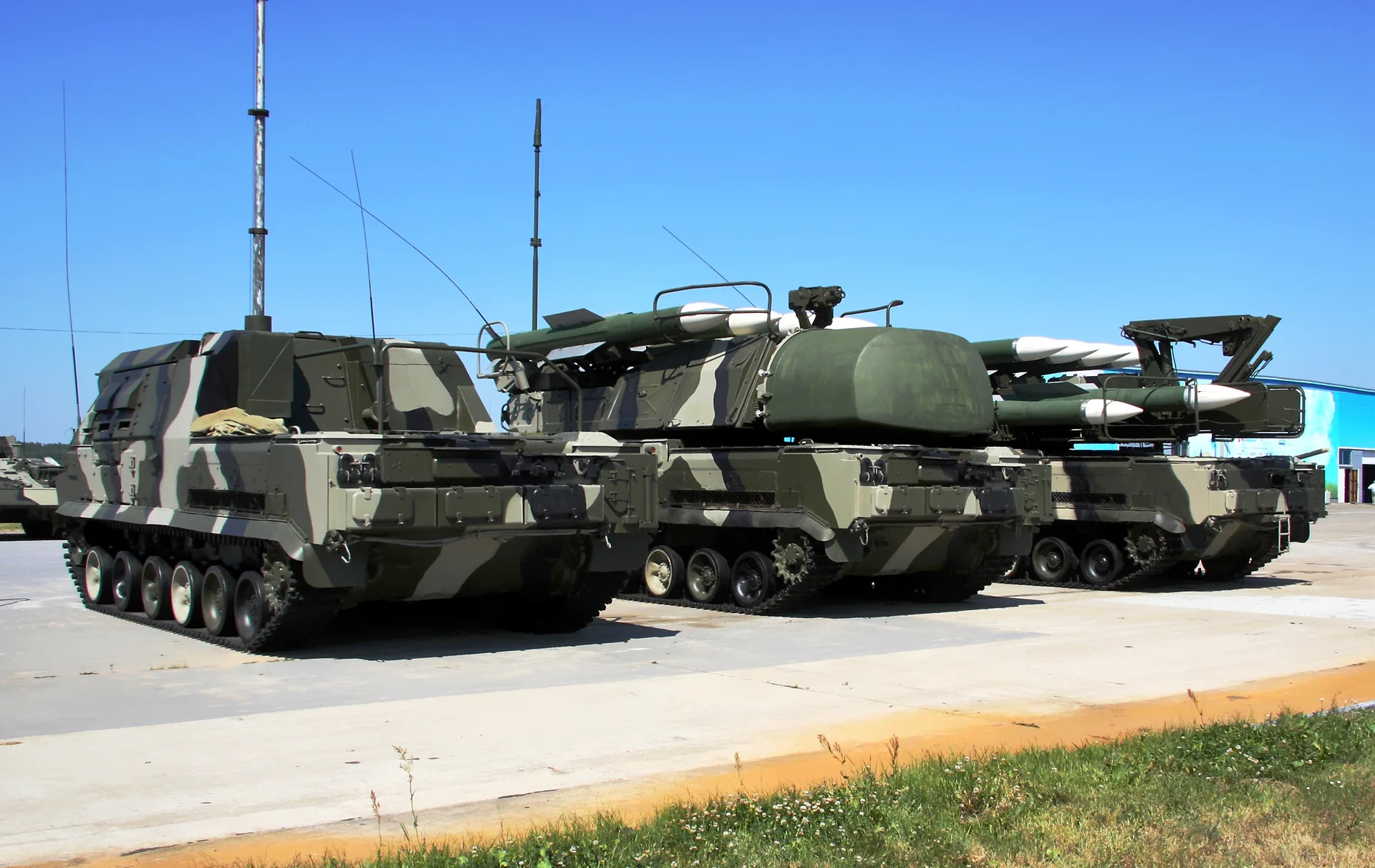
Buk is a multi-vehicle system rather than one self-contained gun vehicle. A tracked formation combines command and acquisition-radar vehicles with transporter-erector-launcher-and-radar vehicles, abbreviated TELARs, and supporting launcher-loaders. A TELAR carries engagement radar and missiles; a launcher-loader is not automatically another radar-equipped firing vehicle. Their different jobs explain why identifying one launcher does not identify a complete battery. 1, 2, 3
For the Buk-M1 generation, the study identifies the 9A310M1 as the radar-equipped firing vehicle and the 9A39M1 as the accompanying launcher-loader. The latter carries missiles and loading machinery but is not simply a second example of the former. That division of labor is central to reading photographs of a Buk unit: visible missiles may belong to different vehicles with different sensor arrangements. Counting launcher rails alone cannot establish how many independently radar-equipped firing vehicles are present. 4
Weapons and engagement concept
Baseline Buk used 9M38-family missiles, with later versions adopting improved 9M317-series weapons. The launch vehicles carried several ready missiles externally; later Buk-M3 equipment increased ready-round density through new canister arrangements. Because missile, radar, and launcher changes occurred together, maximum range and target-set claims belong to specific Buk versions rather than to the family name as a whole. 1, 2, 3
Sensors, fire control, and target information
The family combines broad-area acquisition radar with the radar carried by each TELAR, a distributed architecture that gives batteries multiple engagement channels and some resilience if one sensor is lost. Later Buk versions improved phased-array technology, digital processing, and target capacity. The separate command and search elements also allow the system to receive information from higher-echelon air-defense networks instead of relying only on the sensors mounted with one firing battery. 1, 2, 3
Mobility, protection, and sustainment
Buk uses tracked GM-series vehicles so the complete battery can leave roads and reposition with operational ground forces. The price of this mobility is a large logistical footprint: several specialized armored vehicles, missile reloads, maintenance assets, and trained radar and missile crews are required. Individual vehicles are protected against battlefield fragments and small-arms effects, but survivability depends heavily on movement, dispersion, and networked operation rather than heavy armor. 1, 2, 3
Place in the air-defense system
Buk normally operates above the very-short-range layer occupied by systems such as Shilka, Strela-10, Tunguska, or Tor. Its medium-range missiles extend coverage over maneuver areas while shorter-range weapons protect the formation against threats that leak through or approach below the useful horizon of longer-range sensors. This layered relationship is central to understanding why Buk includes both relatively autonomous TELARs and centralized search and command assets. 1, 2, 3
Variants and modernization
The line progressed through 9K37 Buk, Buk-M1, Buk-M1-2, Buk-M2, and Buk-M3, with export and national upgrade packages adding further names. Each step changed some combination of missile, radar, digital processing, target capacity, and launcher design. Buk-M3 is visually and technically different enough from early SA-11 vehicles that treating all Buk specifications as interchangeable obscures the family’s four decades of development. 1, 2, 3
The technical account also separates the 9S18 acquisition radar and 9S470 command vehicle from the radars associated with individual firing elements. Its discussion of later Buk-M2 equipment includes the elevated 9S36 radar installation. The family consequently changed in more than missile caliber, length or ready-round count. Search, command and engagement equipment evolved together, and a specification for one component must be attached to its particular generation. The study is an illustrated technical analysis, not an acceptance test or a measured record of wartime performance. 4
Service history and operators
Buk entered Soviet service and subsequently appeared with successor-state forces and export operators. Those users did not all operate the same missile, launcher and radar generation. The vehicle family can be traced through its development and equipment relationships without making a current inventory, assigning unverified engagements or converting combat photographs into a complete performance record. 1, 2, 3
Constraints and changing threat environment
A distributed system gains coverage and resilience but is harder to move and sustain than a single combat vehicle. Buk batteries need functioning communications, trained crews, missile resupply, and several specialized chassis. Radar emissions can also reveal operating positions, while terrain can reduce low-altitude detection. Modern precision attack and unmanned systems therefore put as much pressure on command discipline and displacement as on the nominal range of the missile. 1, 2, 3
Historical place
Buk is a major example of the Soviet approach to mobile medium-range air defense: tracked vehicles, radar-equipped launchers, and a network designed to move with land forces rather than defend only fixed sites. Its long sequence of upgrades shows the durability of that architecture. The family also demonstrates how armored air defense extends beyond individual gun tanks into complete mobile systems whose combat power is distributed across several vehicle types. 1, 2, 3
Sources and further reading
- U.S. Army ODIN — 9K37 Buk-M1 / SA-11
- GlobalSecurity — Buk-M2 / SA-17 family reference
- GlobalSecurity — Buk-M3 overview
- Air Power Australia, Buk technical study, TELAR and launcher-loader distinctions
Visit an Armor Museum
Explore the worldwide museum directory to find armored vehicles, collections, and visitor-planning information.
Browse armor museums