Requirement and development
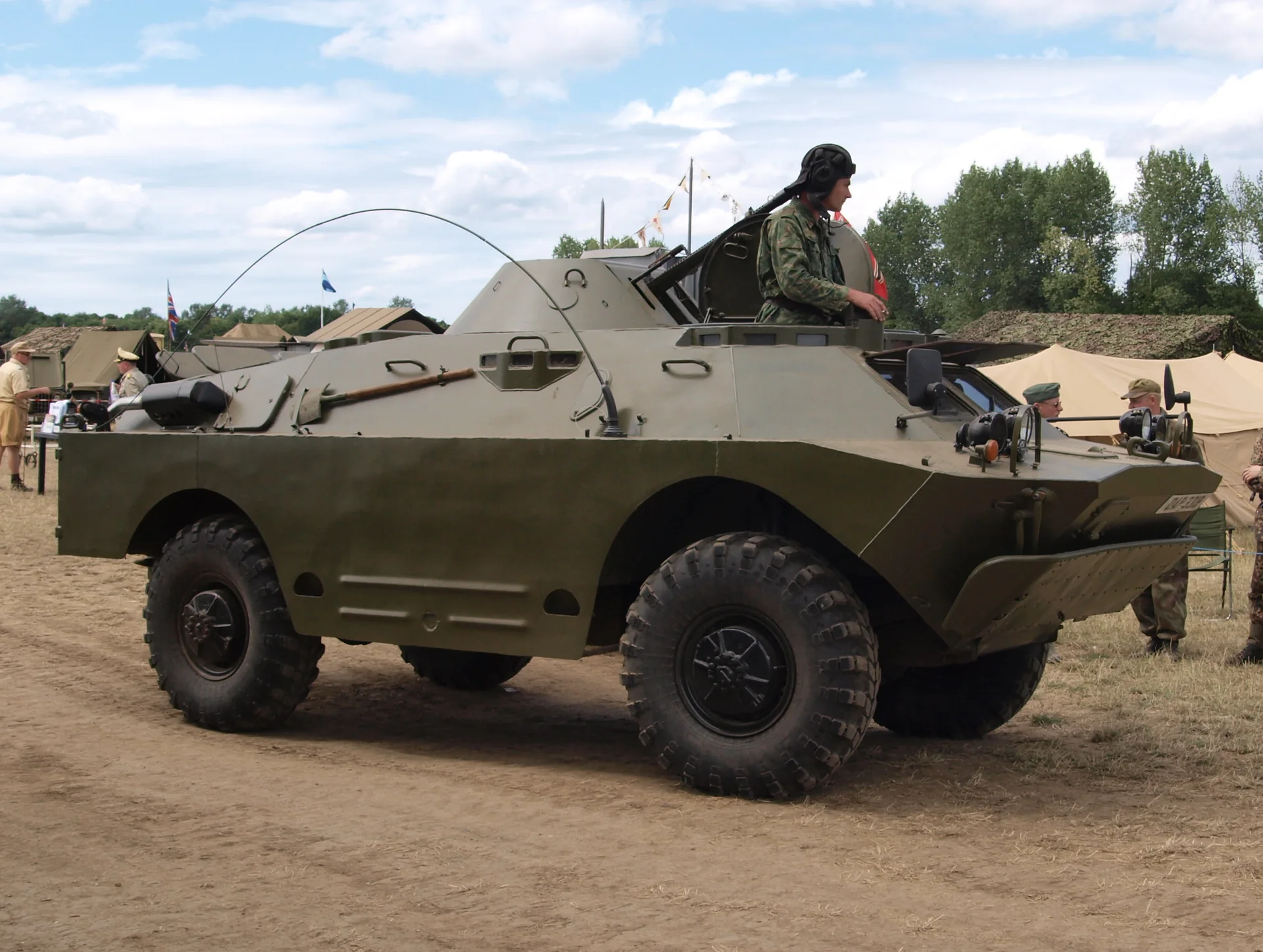
The BRDM-2 retained the amphibious reconnaissance mission of the first BRDM but rearranged the hull around a rear engine and a turreted weapon installation. Four large road wheels, retractable auxiliary wheels and centralized tire-pressure adjustment remained central features. The new arrangement placed the driver and commander at the front rather than behind the engine. Development and introduction belong to the early 1960s; an exact acceptance date is not needed to distinguish this second-generation vehicle from its predecessor. 4
Layout, crew, and automotive architecture
The standard four-person crew comprised the driver, commander, gunner and observer. The driver sat at the front left and the commander at the front right. Moving the engine aft freed the forward part of the hull for the crew, while a small turret carried the 14.5 mm KPVT and coaxial 7.62 mm PKT. The four smaller belly wheels were obstacle-crossing aids rather than an extra pair of normal road axles. Roof access and the boat-shaped hull remained characteristic of the original vehicle. 4
Mobility and terrain behavior
Those features gave the BRDM-2 unusual route flexibility for a light wheeled vehicle: crews could alter tire pressure for changing ground and cross some water obstacles without external bridging. The 4×4 chassis still had the limitations of any light scout in deep mud, steep banks, or heavily cratered terrain, and the belly wheels were an aid rather than a substitute for tracks. Road mobility, however, was excellent for long reconnaissance movements, and the amphibious hull reduced dependence on bridges, important in Soviet doctrine, which expected formations to maintain momentum through river-rich European terrain. 1, 2, 3
Protection and survivability
Protection remained deliberately light. The welded steel hull and turret could shield the crew from many small-arms threats and fragments, but the BRDM-2 was not intended to absorb direct fire from cannon or anti-armor weapons. Its low silhouette and speed were part of the survivability concept, as was the ability to choose routes unavailable to ordinary trucks. Tires, vision blocks, the water-propulsion system, and roof hatches remained vulnerable, while internal fuel and ammunition imposed hazards common to compact armored vehicles. Later national rebuilds sometimes added armor, diesel engines, doors, or other changes, but those should be treated as modernization packages rather than retroactively applied to the Soviet baseline. 1, 2, 3
Armament, observation, and communications
The standard turret mounted a 14.5 mm KPVT heavy machine gun with a coaxial 7.62 mm PKT. Compared with the BRDM-1's light flexible weapon, this gave the scout a much stronger ability to engage soft vehicles, firing points, and light armored targets. It did not make the BRDM-2 a tank hunter in the conventional sense, and specialist anti-tank versions carried missile systems precisely because the basic turret was designed around reconnaissance self-defense and support. Radios and observation equipment were fundamental to the mission. 1, 2, 3
Variants and production evolution
Few Cold War wheeled chassis generated as many recognizable specialist variants. The BRDM-2U command vehicle replaced the turret with additional radios and antennas; RKh versions performed chemical reconnaissance; 9K31 Strela-1 air-defense launchers and several 9P-series anti-tank missile carriers used the same automotive base. Because those changes span decades, it is misleading to describe a single 'BRDM-2 specification.' The historically sound approach is to identify the baseline scout first and then treat command, missile, reconnaissance, and national rebuilds as separate configurations. 1, 2, 3
Operational service
BRDM-2s served throughout the Soviet Army and across a large network of export users. The scout appeared in conventional reconnaissance units, internal-security forces, command elements, chemical-defense units, and missile batteries, and it saw combat in numerous regional wars after the 1960s. Its long service owed much to mechanical simplicity and the usefulness of a small amphibious hull, but modern battlefields also exposed the vulnerability of light armor and gasoline-powered legacy vehicles. Many countries consequently retired, rebuilt, or reassigned the type while others continued to operate specialized derivatives. 1, 2, 3
Assessment and related development
The original BRDM-2 is identified by its rear engine, four-person crew, small machine-gun turret and auxiliary wheels. Later diesel conversions, side-door modifications and replacement turrets should be described as rebuilds rather than read back into that baseline. The long history of the name includes different national equipment fits, not one unchanging vehicle. 1, 2, 3, 4
The ODIN entry remains useful as a configuration check rather than as a complete operational history. The baseline BRDM-2 is a four-person amphibious scout with a turreted heavy-machine-gun installation, auxiliary belly wheels and central tire-pressure adjustment. Later command vehicles, antitank missile carriers, diesel rebuilds and national conversions changed those features. The archive therefore treats the original Soviet scout as the reference configuration and keeps later rebuilds explicit. 1
Sources and further reading
References and further reading are listed below. Image identification, credit and reuse terms remain with each photograph.
- U.S. Army ODIN, BRDM-2 Russian 4x4 Amphibious Armored Scout Car (indexed asset-page evidence only)
- WarWheels — BRDM-2 Scout Car Index
- BRDM-2 overview
- Museum of National Military History, Padikovo: BRDM-2
See Armor in Person
This vehicle family is connected to 4 verified museums through 4 documented display records.