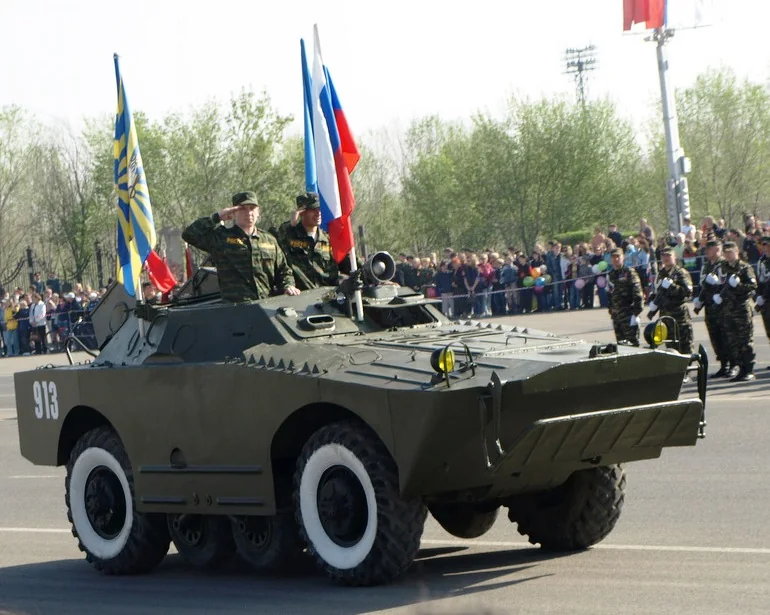
Requirement and development
The first BRDM grew out of work on an amphibious development of the BTR-40. The early designation BTR-40P reflected that starting point, but the watertight hull and new running gear produced a substantially different reconnaissance vehicle. Padikovo dates a prototype to 1956 and formal acceptance to January 1958. The name BRDM-1 is useful for distinguishing this first generation from the later BRDM-2; the original service designation was simply BRDM. 4
Layout, crew, and automotive architecture
The engine occupied the front of the hull, with the occupants behind it. Four large road wheels provided normal travel. Four smaller, powered auxiliary wheels beneath the middle of the hull could be lowered to assist with obstacles and reduce the chance of becoming grounded. They were not four additional road wheels used continuously. A rear water jet propelled the vehicle afloat. The museum lists two crew members and room for three additional occupants, so crew and passenger figures should not be combined into an unexplained single number. 4
Mobility and terrain behavior
It could cross water obstacles without a bridge under suitable conditions and negotiate trenches that might hang up an ordinary light vehicle. At the same time, it remained a wheeled machine with modest power and limited suspension travel compared with tracked reconnaissance vehicles. Soft banks, steep exits, deep mud, and damaged terrain could still restrict it. The vehicle's importance was therefore not that it could go anywhere, but that it expanded the routes available to a reconnaissance patrol while remaining relatively small and road-mobile. 1, 2, 3
Protection and survivability
BRDM-1 armor protected the crew against small-arms fire and fragments while keeping weight low enough for amphibious operation. The compact hull reduced the target area compared with larger APCs, but the scout was not intended to withstand heavy machine-gun fire from all aspects or any dedicated anti-armor weapon. Early open or partially covered configurations were particularly exposed from above, while later enclosed roofs improved environmental and ballistic protection. Tires, suspension, water-propulsion components, and vision devices remained vulnerable parts of any light wheeled scout. Soviet doctrine compensated by emphasizing reconnaissance, route choice, concealment, and mobility rather than using the BRDM-1 as a direct-fire fighting vehicle. 1, 3
Armament, observation, and communications
The basic BRDM-1 generally carried a light machine gun on a flexible mount rather than a turreted heavy weapon. That modest armament suited a vehicle whose primary task was to observe, report, patrol, and provide limited self-defense. The family became more heavily equipped in specialist branches: WarWheels lists command, chemical-reconnaissance, and several anti-tank missile carriers built on the chassis. Those versions changed the mission and crew workload substantially and should not be treated as evidence that every BRDM-1 possessed the same weapon fit. Radios were central to the reconnaissance role, especially on command variants, because the value of finding an enemy position depended on transmitting that information to the supported formation. 1, 2, 3
Variants and production evolution
The BRDM-1 chassis supported a broad family. The BRDM-1U added command communications, the RKh series supported chemical reconnaissance, and multiple 2P- and 9P-series vehicles carried early Soviet anti-tank guided missiles. Some references also divide baseline production by changes in roof arrangement and weapon mount. This proliferation made sense because a small amphibious chassis could accompany reconnaissance and anti-tank elements across the same obstacles. It also makes retrospective identification difficult: a missile carrier with a large launcher housing may share the BRDM-1 automotive base while differing radically in crew, internal layout, and mission. 1, 2, 3
Operational service
The BRDM-1 served the Soviet Union and was exported widely across Warsaw Pact and partner states. WarWheels describes it as one of the common Soviet-bloc reconnaissance vehicles of the 1960s and early 1970s, with variants remaining in use longer. It filled reconnaissance, patrol, command, chemical-survey, and missile-carrier roles and could appear in units far removed from classic cavalry scouting. As the BRDM-2 entered service, the older vehicle was gradually displaced rather than instantly removed, so both generations overlapped. Export users often kept BRDM-1 variants longer because the chassis was simple, familiar, and already integrated into their support systems, extending the design's service life beyond its period as the Soviet front-line standard. 1, 2, 3
Assessment and related development
The first BRDM combined a small armored hull with water propulsion and auxiliary obstacle-crossing wheels. Its successor retained those broad mobility choices while moving the engine and changing the weapon installation. Their shared mission does not erase the different internal layouts. Preserved vehicles and specialist carriers are most useful when their actual configuration is identified. 1, 2, 3, 4
Sources and further reading
References and further reading are listed below. Image identification, credit and reuse terms remain with each photograph.
- WarWheels — BRDM-1 Scout Car Index
- WarWheels — Armored Cars of Russia / BRDM-1 historical notes
- BRDM-1 overview
- Museum of National Military History, Padikovo: BRDM
See Armor in Person
This vehicle family is connected to 2 verified museums through 2 documented display records.