Requirement and development
The BA-64 was a small Soviet armored scout built around GAZ utility-vehicle components rather than a heavy cannon-armed armored-car chassis. Work began during 1941, and the Red Army accepted the design in March 1942. The GAZ-64 supplied the original automotive base. Its successor, the BA-64B, used wider running gear associated with the GAZ-67 to address stability problems. These were related production forms, not interchangeable specifications for a single unchanged car. 4
The Padikovo museum distinguishes the intended production changeover from its realization. It dates the planned start of BA-64B manufacture to May 1943 but says air raids on the plant delayed the transition until August. That account places the widened car within the disruption of wartime manufacturing, not just a tidy sequence of model names. It should be checked against factory records before being used to divide monthly production totals between the original and revised versions. 4
Layout, crew, and automotive architecture
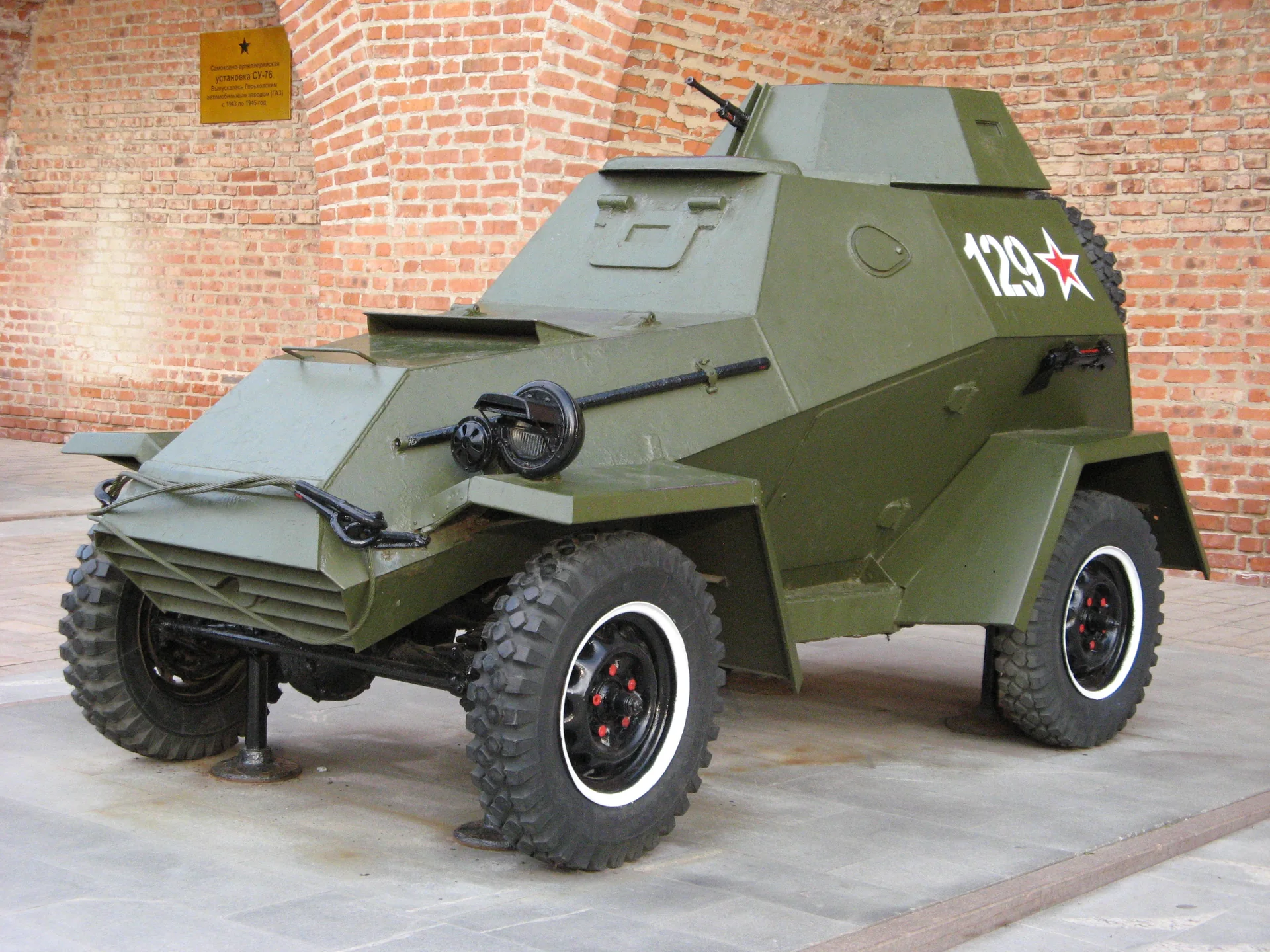
The BA-64 wrapped sloped welded armor around a very small automotive package. The driver sat low in the hull while the commander/gunner occupied the open-topped polygonal turret, which kept weight down and allowed wide observation at the expense of overhead protection. The engine remained in front, and the compact wheelbase made the vehicle notably shorter and more maneuverable than the earlier 6×4 heavy cars. The initial GAZ-64 chassis was narrow enough to create stability concerns, leading to the BA-64B on the broader GAZ-67-based running gear. The tiny interior limited radios, ammunition, and crew comfort, but the same compactness reduced production demands and made the scout easier to conceal and transport. 1, 3
Mobility and terrain behavior
All-wheel drive distinguished the BA-64 from the earlier 6×4 heavy armored cars. The four driven wheels, short wheelbase, low mass, and utility-vehicle suspension gave crews much more freedom on poor roads, tracks, snow, and broken ground. Early vehicles could be narrow and top-heavy, especially on side slopes, which contributed to the wider BA-64B chassis and suspension refinements. That made it a better match for reconnaissance in the fluid, damaged landscape of the Eastern Front. 1, 2, 3
The museum associates the wider BA-64B with strengthened front suspension, four hydraulic shock absorbers and improved engine ventilation. Those changes addressed the vehicle as a working chassis, rather than merely increasing the distance between its wheels. Its exhibited car carries markings representing reconnaissance troops of the 1st Guards Mechanized Corps around Vienna in April–May 1945. Those markings describe the chosen display identity; the museum text does not establish that its surviving chassis followed that wartime route. 4
Protection and survivability
The welded sloped hull used relatively thin armor and depended on shape, low size, and mobility rather than mass. It offered meaningful protection from small-arms fire and fragments compared with an open jeep or motorcycle, but the open turret exposed the commander from above and the vehicle remained vulnerable to heavier machine guns, anti-armor weapons, mines, and artillery effects. The two-man crew also meant that any casualty or mechanical problem had immediate consequences for both observation and movement. Wartime field modifications sometimes added equipment or improvised weapons, yet the core design remained intentionally light. It was an armored scout first, not a miniature tank, and it survived by avoiding the kinds of fights its silhouette could tempt observers to imagine. 1, 3
Armament, observation, and communications
Most production BA-64s carried a 7.62 mm DT machine gun on a high-angle open mounting in the turret. That was far less destructive than the 45 mm guns of BA-6 and BA-10 cars, but it was sufficient for local defense, suppressing exposed infantry, and discouraging unarmored pursuers while keeping the vehicle light. The open mounting also gave the commander a broad field of observation, important for a scout, although it increased exposure. Experimental wartime vehicles tested heavier weapons and specialist roles, but they did not redefine the standard car. The BA-64's communication fit varied, and the tiny interior constrained radio installation, reinforcing the fact that Soviet reconnaissance still depended on a mix of vehicle types and unit-level communications rather than one universal scout configuration. 1, 3
Variants and production evolution
The distinction between BA-64 and BA-64B is principally automotive. The broader track and suspension changes of the B model addressed the tendency of the narrow original vehicle to overturn. The basic machine-gun scout layout remained. Experimental railway, transport and heavier-weapon projects were separate branches rather than the standard equipment of the production cars. 4
Operational service
The Red Army used these small cars for reconnaissance, liaison, artillery observation and convoy escort. Their machine-gun armament was suitable for local protection, while their compact size allowed movement along routes crowded with larger vehicles. Padikovo's account also describes BA-64B employment in urban fighting during the final campaigns in Europe. Those support duties did not turn the vehicle into a substitute for a cannon-armed tank or an infantry carrier. 4
Assessment and related development
The BA-64 and BA-64B were compact machine-gun scouts. Their two-man arrangement concentrated driving, observation and weapon handling in very few hands. The wider B model addressed an important automotive defect without turning the car into a larger troop carrier. Later amphibious BRDM vehicles belong to the continuation of the reconnaissance mission, not to a direct BA-64 chassis family. 1, 2, 3, 4
Sources and further reading
- Tank Encyclopedia — BA-64 in North Korean Service and design history
- Tank Encyclopedia — Soviet Union WW2 armored vehicles overview
- BA-64 overview
- Museum of National Military History, BA-64B exhibit
Visit an Armor Museum
Explore the worldwide museum directory to find armored vehicles, collections, and visitor-planning information.
Browse armor museums