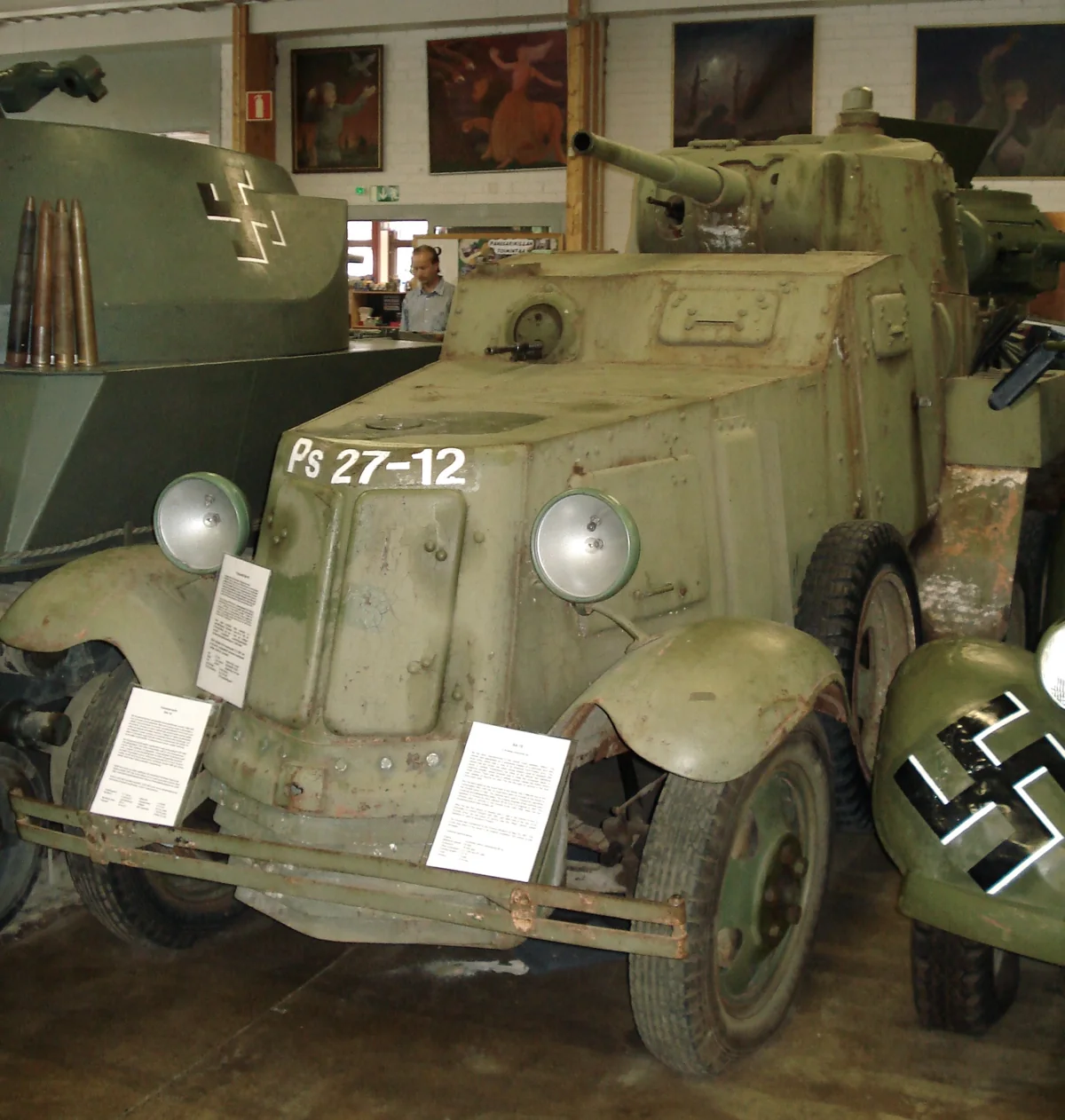
Requirement and development
The BA-10 grew from efforts to improve the BA-6 family without abandoning the economical GAZ three-axle chassis concept. WarWheels describes the BA-6M as the immediate engineering bridge, after which the BA-10A entered production in 1938 on a slightly shortened GAZ-AAA-based chassis with revised suspension and updated 45 mm armament. The BA-10M followed in 1939 with further detail changes, including improved fuel arrangements and radio fit on equipped vehicles. 1, 2, 3
Layout, crew, and automotive architecture
The BA-10 had a conical turret and a shortened chassis frame. Compared with the BA-6, its front axle was strengthened and fitted with hydraulic shock absorbers. The museum specification lists a four-man crew and a combat weight of about 5,140 kg. 4
Mobility and terrain behavior
The underlying GAZ-AAA arrangement drove the two rear axles, not all three. Detachable Overall bands around the rear driving wheels provided an additional traction aid. They did not place a powered track beneath the front axle or replace the wheeled suspension with a tank running gear. 5
Freely rotating spare wheels mounted on each side provided a further aid over uneven ground. The BA-10 used a gasoline M-1 engine rated at 50 horsepower. 4
Protection and survivability
The BA-10 armored body provided bullet-resistant protection. The museum specification lists armor plates up to 10 mm thick. 4
Armament, observation, and communications
A 45 mm gun in the turret formed the main armament. Two 7.62 mm DT machine guns supplemented it. 4
Radio equipment should not be assumed on every BA-10 solely because the type served reconnaissance formations. The museum describes radio fit as partial, while separately identifying the later BA-10M’s 71-TK-3 set. A unit role and an equipment fit are different kinds of evidence. Identifying a particular vehicle’s communications arrangement requires its configuration or a suitably dated photograph, not just the family name. 4
Variants and production evolution
The BA-10M placed its fuel tanks outside the hull on the fender shelves and strengthened the front machine-gun mounting. It also used the 71-TK-3 radio. The railway-adapted BA-10ZhD used interchangeable rail wheels on the front and rear axles. 4
Operational service
The Museum of Russian Military History describes BA-10 employment in reconnaissance and liaison within tank formations and in separate armored or motorized formations. It associates the type with Khalkhin Gol and wartime service. This identifies roles and campaigns in a museum account, not a vehicle-by-vehicle operational register. It does not establish that losses in every formation had the same mechanical cause, or that a later captured vehicle retained its original equipment. 4
Preservation and museum interpretation
Both Parola Tank Museum in Finland and the Museum of Russian Military History in Padikovo list a BA-10 in their collections. 4, 6
Sources and further reading
References and further reading are listed below. Image identification, credit and reuse terms remain with each photograph.
- WarWheels, BA-6M, BA-10A & BA-10M Heavy Armored Car Index
- Tank Encyclopedia, Soviet Union WW2 armored vehicles overview
- BA-10 overview
- Museum of Russian Military History, BA-10 collection record
- Museum of Russian Military History, GAZ-AAA collection record (Russian)
- Parola Tank Museum, collection and mission description (Finnish)
Visit an Armor Museum
Explore the worldwide museum directory to find armored vehicles, collections, and visitor-planning information.
Browse armor museums