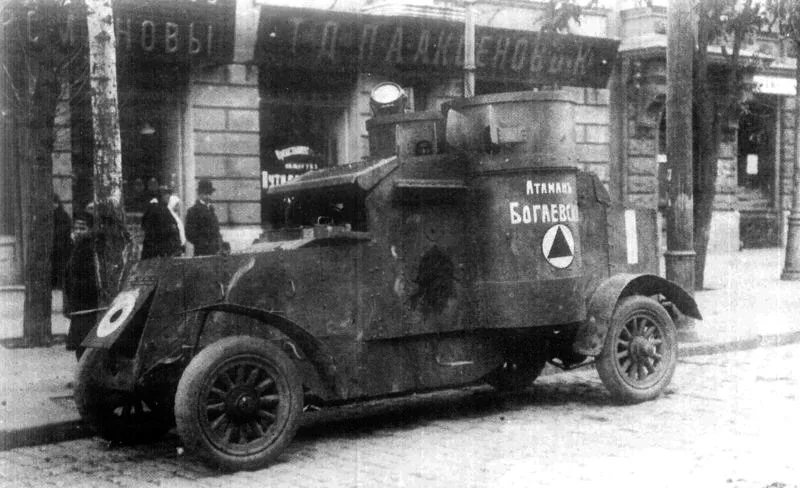
A British car for Russian requirements
Russia sought armored cars abroad during the First World War, and Austin supplied vehicles built for Russian requirements. The retained accounts distinguish First, Second and Third Series cars rather than a single unchanged British design. Later Russian bodies used imported chassis to produce a further branch. Orders, chassis shipment, armored-body completion and acceptance are separate manufacturing stages, so a count or date attached to one should not silently become the delivery record of another. 1, 2
Two turrets behind the driver
The characteristic Austin arrangement placed two separate machine-gun turrets behind the driver instead of one larger central turret. This gave the crew overlapping fields of fire while keeping each weapon installation relatively compact. British-built series differed in chassis, armor, hull details, and turret placement. Russian engineers later redesigned the body for the Austin-Putilov, most visibly staggering the two turrets diagonally and adding features intended to improve firing arcs and crew access. That Russian-built hull retained the recognizable Austin concept while showing how local experience could transform an imported automotive platform into a distinct national variant. 1, 2, 3
Rear-wheel drive and the Kégresse branch
British-built Austins were road-oriented vehicles with rear-wheel drive, narrow tires, and the advantages and weaknesses of early motor-car technology. On firm roads they could move machine guns and protected crews far faster than infantry, but mud, deep snow, shell damage, and soft ground imposed severe limits. Added armor also increased stress on chassis components, a recurring problem in early armored-car development. Russian efforts to improve mobility included the Austin-Kégresse, which combined an Austin-Putilov-type armored body with Adolphe Kégresse's flexible rear-track system. The half-track remained a specialist derivative rather than the standard Austin configuration. 1, 2, 3
Rearmoring and chassis loads
The earliest Austin armor proved inadequate in Russian service and vehicles were rearmored after arrival, increasing protection but also adding weight to an already heavily loaded chassis. Later British series and the Russian-built cars incorporated stronger or better-arranged plate from the outset. Even so, the family remained lightly armored by later standards. Its armor was intended to reduce vulnerability to rifle fire and fragments during reconnaissance, convoy security, raids, and support missions rather than to endure direct hits from artillery. Thicker plate imposed additional loads on the suspension, tires, engine, and driveline. Protection and automotive performance could not be increased independently on the same chassis. 1, 2, 3
Independent machine-gun turrets
The family was defined by twin machine-gun turrets, normally carrying Maxim guns in Russian service. Two independently traversed weapons could cover separate sectors, useful when an armored car was operating on a road, passing through a village, or withdrawing from contact. The arrangement also increased crew demands and internal complexity compared with a single turret. The Austin-Putilov's diagonally staggered turrets improved the relationship between the two firing arcs without changing the vehicle into a gun-armed armored car. 1, 2, 3
British series and Russian-built bodies
The Austin lineage developed through several British production series before the Russian-built branch appeared. First, Second, and Third Series cars differed in chassis and armored-body details; a later 1918 pattern was produced for British requirements after the Russian political collapse disrupted the original market. In Russia, Putilov and Izhorski work produced the Austin-Putilov design from chassis already ordered from Britain. A smaller number of related armored bodies were paired with Kégresse half-track running gear. Each series and derivative had its own weight, armor and hull arrangement; the name Austin did not identify a single unchanging vehicle. 1, 2, 3
Eastern Front and civil-war service
Austins served the Imperial Russian Army on the Eastern Front, where road networks and long operational distances created both opportunities and constraints for armored cars. After the revolutions of 1917, surviving vehicles passed into a fragmented political landscape and were used by Bolshevik, White, Polish, Baltic, Finnish, German, and other forces during civil wars and border conflicts. The Austin-Putilov became especially associated with the Red Army, although individual vehicles changed hands repeatedly. Surviving vehicles could acquire new markings, equipment and crews as they passed from one force to another. 1, 2
A recent Oxford Academic study of the Royal Naval Armoured Car Division in Russia draws on archival records for the British armored-car expedition. It strengthens the broader organizational and campaign context used for this family, but it does not justify turning every RNACD episode into an Austin-specific event or assigning Austin-Putilov engineering details to the British-built series without separate evidence. 4
An international manufacturing program
The Austin program linked British chassis supply with Russian armored-body construction and subsequent local modifications. The twin-turret arrangement provides a recognizable family feature, but it is not enough to identify the series, builder or history of an individual car. British-built cars, Austin-Putilov bodies and Kégresse conversions need separate configuration and production records. Their shared name does not demonstrate uninterrupted service by the same vehicles or organizations. 1, 2, 3
Sources and further reading
References and further reading are listed below. Image identification, credit and reuse terms remain with each photograph.
- Austin armoured car overview
- 365 Oldtimer Museum, Austin Armoured Car newsletter article (retrospective newsletter; not technical certification)
- Modelism Archive, Austin Putilov
- Oxford Academic — Royal Naval Armoured Car Division in Russia, archival study
Visit an Armor Museum
Explore the worldwide museum directory to find armored vehicles, collections, and visitor-planning information.
Browse armor museums