Development
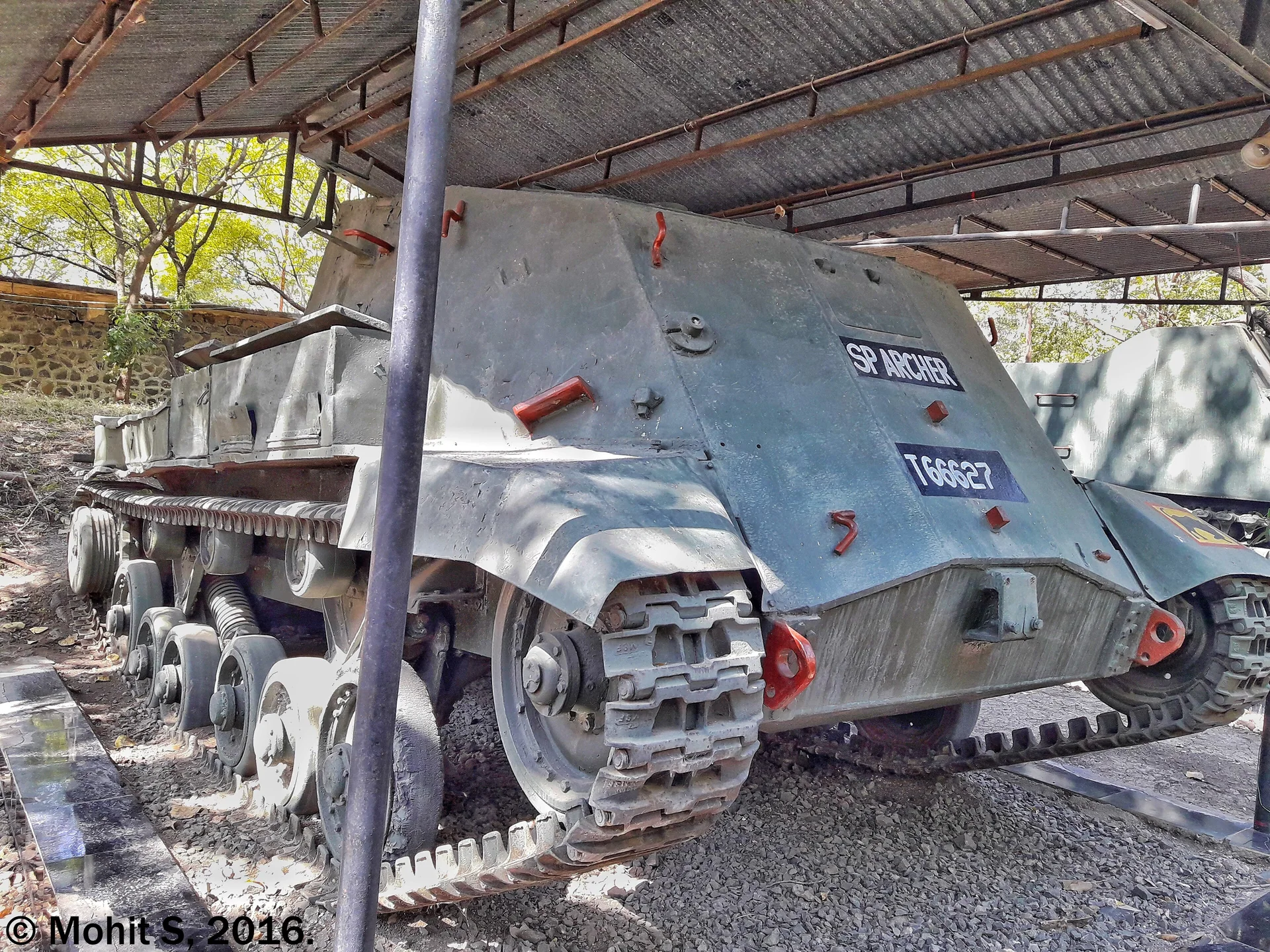
Vickers developed Archer by combining the 17-pounder with the Valentine automotive foundation. The long gun and compact chassis created a packaging problem that the rear-facing arrangement helped resolve. A prototype was undergoing development in 1943, before the type’s later wartime service. 1
The Tank Museum identifies its Archer as the 421st of 665 full-production vehicles and dates its delivery to early-to-mid 1945. That surviving example shows the program had moved well beyond prototype work, but the museum also records that the individual vehicle’s wartime service history is unknown. Production sequence and a museum paint scheme therefore cannot be substituted for a documented unit history. 2
Layout and crew
The gun faced across the rear engine area, while the vehicle retained its normal driving orientation. This reduced the problem of a long barrel projecting far beyond the front of a small hull. The fighting compartment was open rather than a fully enclosed rotating turret. 1
Armament
The 17-pounder supplied the antitank capability for which Archer was built. The vehicle was a means of making that weapon self-propelled, with a mounting constrained by the size of the available chassis. 1
Self-propulsion brought the gun and its means of movement into one vehicle. A separate towing tractor was no longer needed to move that particular weapon. The change did not provide a tank turret's flexibility: the gun remained restricted by its mounting, and the crew's working space was shaped by the breech and the available hull volume. 1
Crew protection
Archer did not simply retain the Valentine’s original armor protection around its new fighting compartment. Its gun enclosure used substantially lighter protection and remained open above. Describing it as a heavily armored infantry tank with a replacement weapon would therefore be wrong. 1
The armored hull and the open gun compartment offered different degrees of shelter. Inherited running gear could simplify maintenance without carrying the parent tank's protection into the new superstructure. Archer's crew therefore worked in a vehicle with recognizable Valentine ancestry but a different arrangement of armor around the weapon and its operators. 1
Mobility and support
The Valentine foundation connected Archer to an established British infantry-tank production and maintenance system. Its tracks, suspension and power train were familiar technologies, even though the new fighting compartment changed the vehicle's purpose. This was an adaptation of a supported chassis, not an attempt to build a fast cruiser tank around the 17-pounder. The gun installation and automotive arrangements had to be judged together. 2
The complete installation was a compromise between the gun that was wanted and the chassis available to carry it. Modest automotive performance could still answer the need to move a heavy antitank weapon under its own power. The rear-facing mounting solved a packaging difficulty while leaving the driver with a different orientation from the direction in which the gun pointed. 2
Versions and conversions
The designation SP 17pdr Valentine identifies the combination more precisely than the name Archer alone. It should not be confused with a conventional Valentine gun-tank mark or with another self-propelled weapon merely because the same parent chassis appears in its description. 1, 2
Service history
Archer reached wartime service in the later part of the European campaign. Its antitank role and artillery organization distinguish it from a cruiser or infantry tank even though it used a tank-derived chassis. 1
The Tank Museum's Archer is serial S280017, recorded as the 421st full-production vehicle and delivered in early or mid-1945. Its earlier service is unknown. Its Canadian markings represent a vehicle in Italy in 1944 rather than that individual hull's documented career. The example illustrates the distinction between a preserved machine and the unit identity chosen for its later display. 2
The museum’s Archer is painted to represent a Canadian vehicle associated with the Italian campaign, but the institution explicitly separates that presentation from the unknown history of the surviving hull itself. That distinction is valuable for the archive: restoration markings can illustrate a type’s service context without proving where one particular preserved vehicle served. 2
Operating constraints
The restricted mounting, open fighting compartment, and different gun and travel orientations imposed compromises. They do not by themselves establish that the vehicle was a failure. The design was an answer to a particular integration problem, and judging it against the capabilities of a completely different class of tank creates a false standard. 1
Design legacy
Archer kept the Valentine automotive family useful after its original gun-tank role had narrowed. The rear-facing weapon was the visible result of fitting a long 17-pounder to a compact chassis, while the open compartment and restricted mounting showed what the conversion could not provide. It gave antitank artillery a tracked mount without requiring another turreted tank design and production line. 1
Sources and further reading
References and further reading are listed below. Image identification, credit and reuse terms remain with each photograph.
See Armor in Person
This vehicle family is connected to 1 verified museum through 1 documented display record.