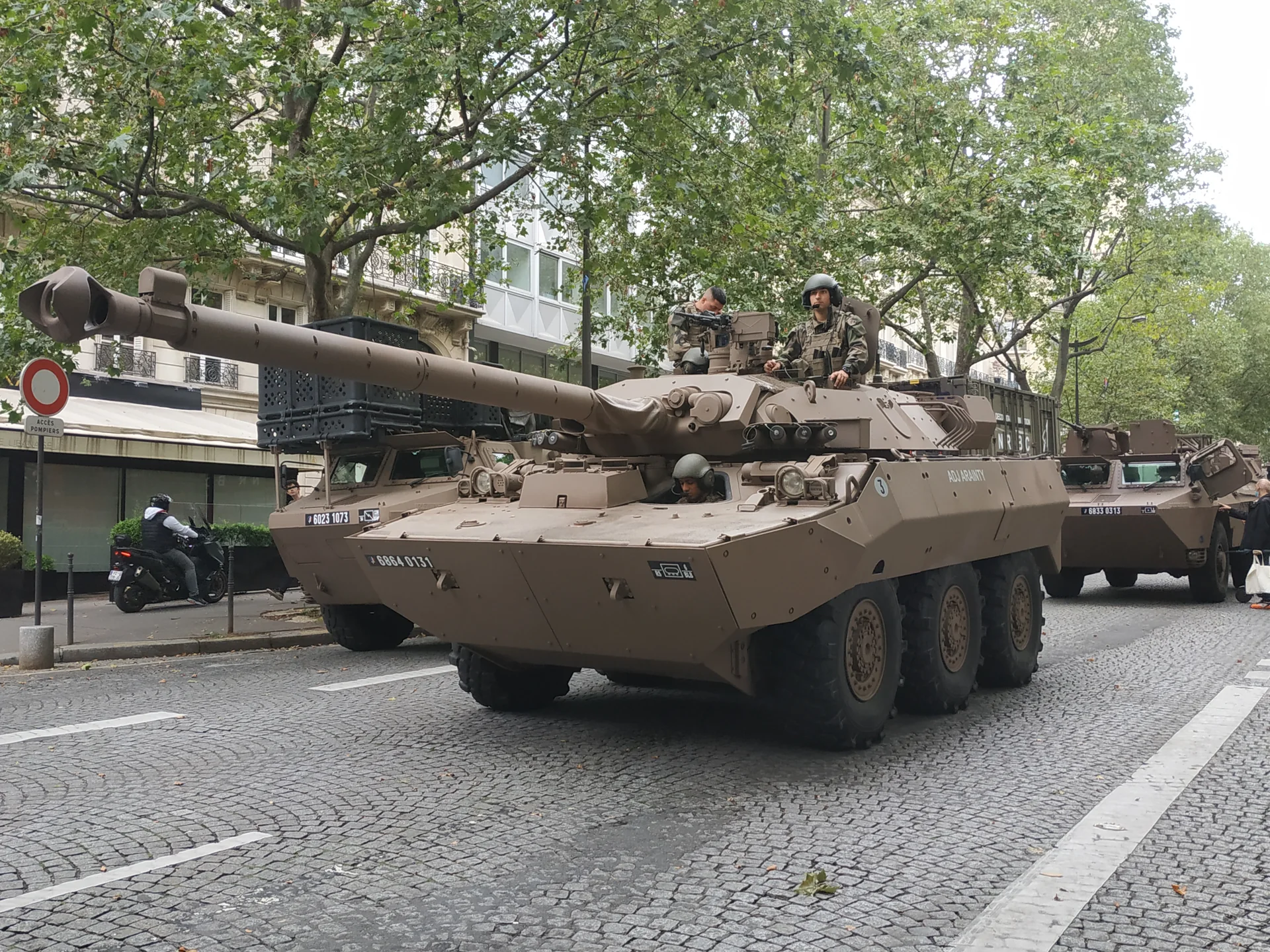
Requirement and development
France developed the AMX-10RC during the 1970s to replace older EBR-era cavalry vehicles with a modern wheeled reconnaissance system combining speed, long range, amphibious capability, and a 105 mm gun. It shared a program name with the tracked AMX-10P but was a distinct 6×6 vehicle designed around cavalry rather than infantry transport. The four-man crew and large turret gave it more fighting capacity than light armored cars, while the wheeled chassis supported long road marches. Later RCR renovation added protection, electronics, and automotive improvements. A French Army article published 6 March 2022 described the SCORPION transition explicitly: Jaguar would progressively take over from AMX-10RCR while crews continued training on the older vehicle during the transition. 1, 2, 3
Layout, crew, and automotive architecture
The AMX-10RC used a large three-axle hull with the driver forward, a three-man turret, and the powerpack to the rear. Instead of steering only the front wheels, the original vehicle used skid steering, turning by varying wheel speeds on the two sides. Hydropneumatic suspension allowed substantial control of ride height and hull attitude, an unusual feature for a wheeled reconnaissance vehicle. The four-person crew, commander, gunner, loader, and driver, gave the turret greater endurance and task separation than three-man light armored cars. RCR modernization added protection and electronic changes that increased mass, demonstrating the tension between the original relatively light amphibious concept and later requirements for survivability and digital integration. 1, 3
Mobility and terrain behavior
French official data describes the AMX-10RCR as a road- and cross-country reconnaissance vehicle with long range and a 6×6 chassis. The original AMX-10RC was amphibious after preparation, while later over-armor packages affected that capability. Hydropneumatic suspension supported cross-country movement and could adjust hull height, but skid steering increased tire wear and made the vehicle behave differently from conventionally steered armored cars. Strategic mobility was less effortless than with the ERC-90 because the AMX-10RC was substantially larger and heavier, yet it still offered faster long-distance movement than tracked cavalry vehicles on roads. The RCR standard accepted more weight in exchange for protection and electronics as operational priorities changed. 1, 2, 3
Protection and survivability
Original AMX-10RC protection reflected the weight limits of a wheeled reconnaissance vehicle, while later RCR work and additional SEPAR equipment changed the balance. Added protection cannot be discussed independently of mass, mobility and the configuration in which amphibious capability was available. The article therefore does not combine an early light vehicle’s mobility claims with a later protected vehicle’s armor fit. The gun provided substantial direct fire, but the vehicle’s cavalry role did not make it equivalent to a main battle tank. 1, 3
Armament, observation, and communications
A 105 mm gun in a three-man turret gave the AMX-10RC unusually heavy direct-fire power for a reconnaissance vehicle. French official data lists a 105 mm main armament with coaxial and roof machine guns and a four-person crew. The gun allowed cavalry units to defeat light and medium armored threats and provide direct fire without waiting for tanks, but it also contributed to the persistent popular label 'wheeled tank.' French doctrine and official descriptions instead emphasize armored reconnaissance. The distinction matters because sensors, radios, mobility, and reporting were central to the mission. RCR modernization and CONTACT radio integration strengthened the vehicle's ability to operate in a digitizing force even as Jaguar began replacing it. 1, 2, 3
Variants and production evolution
The principal historical distinction is between the original AMX-10RC and the renovated AMX-10RCR, with SEPAR protection packages representing later operational configuration. Renovation introduced a new transmission, suspension and protection improvements, digital systems, and other changes across the fleet rather than creating an entirely new chassis. Additional theater-specific equipment could further alter weight and external appearance. French training and integration articles from the SCORPION period show that upgraded AMX-10RCRs remained relevant while units learned Jaguar and new communications systems. Export transfers in the 2020s created another service chapter, but those vehicles should be identified by recipient configuration and date rather than assumed to represent the entire French RCR standard. 1, 2, 3
Operational service
AMX-10RCs became central to French cavalry and deployed in numerous overseas operations from the late Cold War onward, including Africa, the Gulf, the Balkans, and later expeditionary missions. Long road range and the 105 mm gun made them useful where France needed rapidly moving cavalry with more firepower than a light scout. Renovation extended that service into the 2010s and 2020s. French Ministry pages describe Jaguar as the progressive replacement and document overlapping training on old and new equipment, so the transition should be understood as phased. Some AMX-10RC-family vehicles were transferred abroad during that period, giving the type a new combat history separate from its original French reconnaissance doctrine. 1, 2, 3
Historical place
The AMX-10RC is one of the clearest examples of the French preference for heavily armed wheeled cavalry vehicles. It carried forward the EBR idea of fast road movement and serious firepower but used a more conventional six-wheel hull, a 105 mm gun, and later increasingly sophisticated protection and communications. The RCR modernization demonstrated how a Cold War platform could be adapted for expeditionary threats and digital networks, though at the cost of additional weight and complexity. Jaguar's arrival marks another shift toward stronger protection, sensors, network integration, and a different weapon mix. The AMX-10RC therefore links three generations of French reconnaissance doctrine: EBR, AMX-10RC, and SCORPION-era Jaguar. 1, 2, 3
The AMX-10RC's long modernization path shows the value and cost of a generous original design. The four-man crew, sizable turret, and 6×6 hull provided enough margin for new radios, protection packages, and electronics, extending service far beyond the original Cold War requirement. At the same time, added mass reduced some original capabilities and pushed the vehicle closer to the limits of its chassis. The RCR story is thus as much about managing growth as about adding equipment, a recurring challenge in long-lived armored fleets. 1, 2, 3
Sources and further reading
References and further reading are listed below. Image identification, credit and reuse terms remain with each photograph.
- French Ministry of Armed Forces , AMX 10 RCR SEPAR
- French Army , AMX-10RCR training during SCORPION transition
- French Ministry , CONTACT radio integration on AMX-10RCR
Visit an Armor Museum
Explore the worldwide museum directory to find armored vehicles, collections, and visitor-planning information.
Browse armor museums