Development
Alecto grew from an April 1942 British requirement for a light, air-portable self-propelled gun. The History of War account describes Vickers using the Harry Hopkins light-tank chassis, removing the turret and mounting a 95 mm howitzer low in the front of the vehicle. The requirement explains the emphasis on compact dimensions, but it does not by itself prove that a complete operational Alecto force was ever certified for airborne deployment. 2
Built vehicles gave the project a physical existence beyond drawings and weapon proposals. Its limited scale nevertheless left a much narrower record than the standardized British artillery carriers. Later appearances with units show that some machines remained useful for trials or local employment after the European war, without establishing a large production program. 1, 2
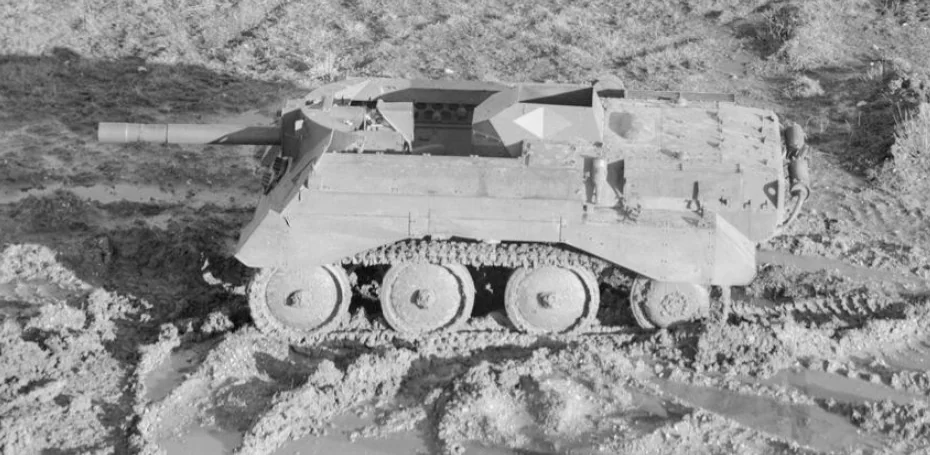
An Imperial War Museums photograph cataloged as STT 7228 records an Alecto self-propelled gun on 5 December 1944. The image is useful evidence that physical prototype hardware existed by that date; it does not establish series production, operational issue, or the final status of every proposed armament variant. 3
Layout and crew
The recognizable howitzer version combined a low hull with an open fighting position. Its Harry Hopkins ancestry did not mean that it was an unchanged tank with the turret removed. Hull shape, weapon mounting and crew accommodation were reorganized around artillery work. The exposed compartment also separated it from the enclosed British assault-gun layouts, despite the superficial similarity of a gun mounted directly in the hull. 1
Lister's comparison of the development material separates the Harry Hopkins-derived hull from the steering and suspension ideas also associated with Tetrarch. That is a more precise relationship than describing all three vehicles as the same tank. Small alterations in hull shape and fighting-compartment arrangement become especially important when a compact chassis must accommodate a crew, gun breech and recoil movement in the space formerly assigned to a turret. 1
Armament
The established version carried a 95 mm howitzer. That was a support weapon whose shell effect was more important to its intended role than high-velocity antitank performance. Its installation must be distinguished from the different guns proposed during the project's development. A proposed mark number does not demonstrate that the matching weapon was actually fitted to a completed vehicle. 1
The howitzer installation also helps distinguish the recognizable vehicles from the more uncertain branches of the project. The 95 mm version occupies a firmer place in the surviving photographic and developmental record than the often-repeated heavier-gun proposals. Those proposals reflected the search for uses for a compact hull, rather than a succession of established production models. 1
Crew protection
The open, compact arrangement is evidence of a design that accepted substantial limits on protected crew space. It should not be presented as an enclosed assault gun scaled down without any corresponding compromises. 1
The weight and volume available for additional armor were limited by the small hull. Overhead protection would have required a different arrangement around the breech and gun crew. Leaving the compartment open provided working access but made the crew's shelter incomplete, particularly while handling ammunition and serving the weapon rather than simply moving the vehicle. 1
Mobility and support
Alecto's compact tracked hull offered a small footprint and a close relationship to British light-tank automotive development. Neither characteristic eliminated the need for trials and a support organization. Nor did small dimensions alone establish that the complete vehicle had been approved for airborne delivery. Transport by an aircraft, ground movement under its own power and useful field endurance were separate requirements. 1
Its light-tank ancestry placed Alecto within a closely related group of British compact tracked designs. That relationship supplied automotive ideas, not a complete operational organization. Unit use still required vehicles that could be maintained, spare parts that could be supplied and crews able to combine driving and gun duties on a small platform. 1
Versions and conversions
The surviving development record distinguishes the recognizable 95 mm vehicles from proposals for other armament. David Lister's study of drawings and photographs questions the commonly repeated story of a completed 32-pounder version. The study also discusses a photographed vehicle with a longer gun. These uncertain branches should not be counted as a fully produced family alongside the howitzer vehicles. 1
Service history
David Lister’s research identifies Alectos with the 11th Hussars in Berlin in 1945 and a small number with the King’s Dragoon Guards in Libya in 1947. These are postwar appearances and use, not evidence of wartime combat. 1
Operating constraints
Alecto's small hull constrained both the crew's workplace and the room available for ammunition. Its open compartment provided access around the howitzer but little overhead shelter. Those compromises suited an experimental lightweight support vehicle more closely than a protected assault gun. A small postwar record of use does not establish how the design would have performed during sustained combat with a complete formation. 1
Design legacy
Alecto occupied the space between an experimental vehicle and a widely issued weapon. Built examples appeared with British troops after the European war, yet that limited use did not turn the project into a significant wartime combat system. The distinction is important to its history: a vehicle can be constructed, tried by units and retained briefly without ever becoming standard equipment for a major operational role. 1
The air-portability requirement helps explain why the program tolerated a very small chassis and an exposed fighting arrangement. It also sets a boundary on what the surviving development record proves: Alecto was built around a transportability objective, yet the limited postwar appearances of completed vehicles are not evidence of a wartime airborne artillery capability. 2
Sources and further reading
References and further reading are listed below. Image identification, credit and reuse terms remain with each photograph.
- David Lister — The Tiny Erinyes
- History of War — Alecto self-propelled gun (secondary source; not primary certification)
- Imperial War Museums photograph STT 7228 — Alecto self-propelled gun, 5 December 1944 (via Commons catalog record)
Visit an Armor Museum
Explore the worldwide museum directory to find armored vehicles, collections, and visitor-planning information.
Browse armor museums