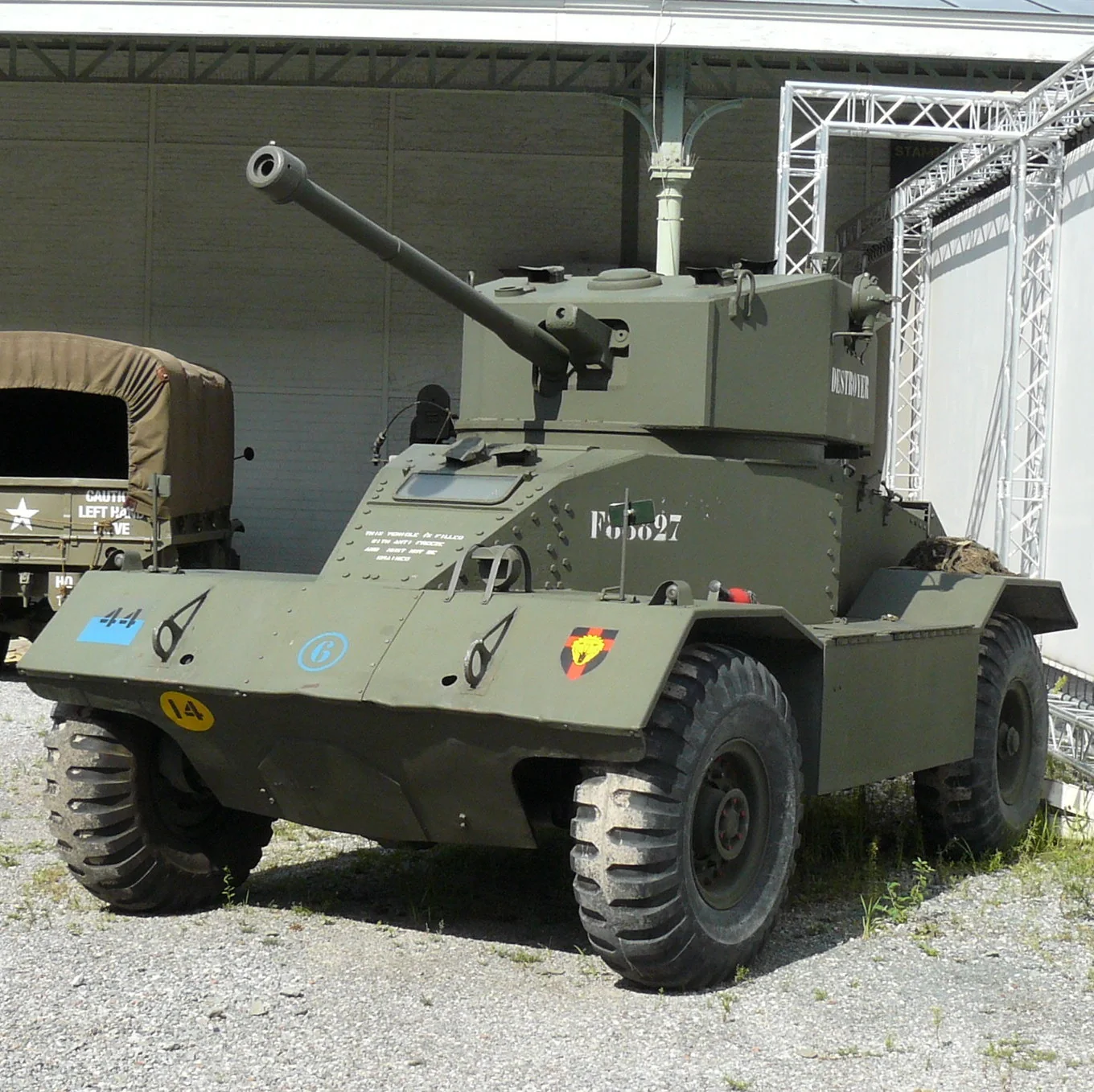
AEC’s heavy reconnaissance proposal
Associated Equipment Company was best known for heavy commercial vehicles and the Matador artillery tractor when it pursued an armored car largely as a private venture. British experience in the Western Desert had exposed the limits of lightly armed reconnaissance cars when they met enemy armored vehicles. AEC's answer was deliberately ambitious: a wheeled vehicle with armor and firepower closer to a contemporary tank. A mock-up attracted official attention in 1941 and production followed. The concept did not replace lighter scout and armored cars; instead it gave reconnaissance regiments a heavier element able to provide more powerful direct fire while sharing the road mobility of wheeled formations. 1, 2, 3
Valentine turret and the later fighting compartment
The Mk I used a chassis derived from AEC heavy-vehicle engineering and mounted a Valentine tank turret with a 2-pounder gun. The Mk II redesigned the hull and introduced a larger three-man turret, while the Mk III adapted the same general vehicle to the British 75 mm gun. The driver sat in the forward hull with the engine at the rear, and later versions carried a four-man crew. Compared with most wartime armored cars the AEC was tall, broad, and heavy. Those dimensions bought internal volume, armor, and weapon capacity but reduced the stealth and agility normally associated with reconnaissance. The vehicle was therefore a specialized heavy component rather than the universal scout car of a regiment. 1, 2
Diesel power and a heavy wheeled chassis
Despite its weight, the AEC retained 4x4 wheeled mobility and could travel efficiently on roads over the long distances demanded of reconnaissance formations. Later Mk II and III cars used a more powerful diesel engine than the Mk I, helping offset increased weight. The design's commercial-vehicle ancestry helped with robust driveline components, but the mass that enabled heavy armor and guns also increased ground pressure and made difficult terrain more challenging than for lighter cars. Its size and weight made it a different vehicle to handle from a light scout car. 1, 2
More armor for the heavy reconnaissance element
AEC explicitly sought protection closer to a cruiser tank than to a typical armored car. Armor thickness varied by mark and location, and later vehicles remained vulnerable to dedicated antitank weapons, but the crew enjoyed a substantially more protected fighting compartment than in light reconnaissance cars. That survivability supported a role in the heavier troops of armored-car regiments, where the vehicle could back up forward scouts and engage targets that machine-gun cars could not handle. The cost was weight: every increase in armor reduced the margin available for mobility and automotive reliability. The design emphasized fighting power rather than the small size and concealment of a light scout car. 1, 2
2-pounder, 6-pounder and 75 mm
Armament grew with the family. The Mk I used the 2-pounder in a Valentine-derived turret, the Mk II received the 6-pounder, and the Mk III carried the dual-purpose British 75 mm gun. A coaxial Besa machine gun supplemented the main weapon. The changing guns increased the direct-fire support available within reconnaissance units. The 75 mm version was particularly useful for high-explosive support, but that did not make the vehicle a substitute for a tank regiment. Its guns supported reconnaissance troops whose primary tasks remained screening, information gathering, and maintaining contact with enemy formations. 1, 2
Three marks and specialist adaptations
The three principal marks were not simple gun swaps. The Mk II introduced major hull and automotive changes together with its 6-pounder turret, while the Mk III built on that later configuration with the 75 mm gun. A twin-20 mm anti-aircraft prototype was also developed but did not enter production. Foreign users later modified or reused AEC components, and some Lebanese Staghounds received AEC turrets, but those hybrid vehicles belong to separate postwar stories. Crew size, engine power, mass, turret arrangement, and armament changed across the three marks. 1, 2
The quoted 1945 entry applies to AEC III: its four crew and three-man turret should not be turned into a specification for the earlier marks. The same entry names Staghound III or Alecto as intended replacements. That statement records policy at the time of the report, not completion of a fleet-wide exchange. 4
Fire support in reconnaissance regiments
The June 1945 Royal Armoured Corps report describes the AEC III with a 75 mm gun, coaxial 7.92 mm Besa and four crew, three in the turret. It records 200 ordered and produced, with eight cars per armored-car regiment pending replacement by Staghound III or Alecto. That replacement wording states an intention, not evidence that every unit had already changed equipment. 4
The June 1944 holdings table gives eight AEC IIIs to the 2nd Household Cavalry Regiment and eight to the Inns of Court Regiment. In the same table, the Royal Dragoons and 11th Hussars instead have eight 75 mm M3 half-tracks each. These dated returns show different support equipment within armored-car regiments; they do not establish every vehicle’s readiness or daily movements. 5
A heavy complement to lighter scouts
The AEC III combined a 75 mm gun with a heavy wheeled carrier in the support element of reconnaissance formations. The dated RAC return places it alongside lighter gun cars and scouts, rather than identifying it as their universal replacement. This is a distinction of roles within a formation, not proof that all AEC marks had the same crew, turret or equipment. Nor does the return establish a comparative road-speed, armor or cross-country advantage over every other armored car. 4, 5
Sources and further reading
References and further reading are listed below. Image identification, credit and reuse terms remain with each photograph.
- The Tank Museum, Tank Chats #141 AEC Armoured Car
- AEC armoured car overview
- The Tank Museum, December 2021 video archive (AEC Tank Chat listing)
- RAC June 1945 report, quoted extracts transcribed by Peter Brown (published transcription)
- 21st Army Group June 1944 entitlement and holdings, tables transcribed by Peter Brown (published transcription)
Visit an Armor Museum
Explore the worldwide museum directory to find armored vehicles, collections, and visitor-planning information.
Browse armor museums