Development
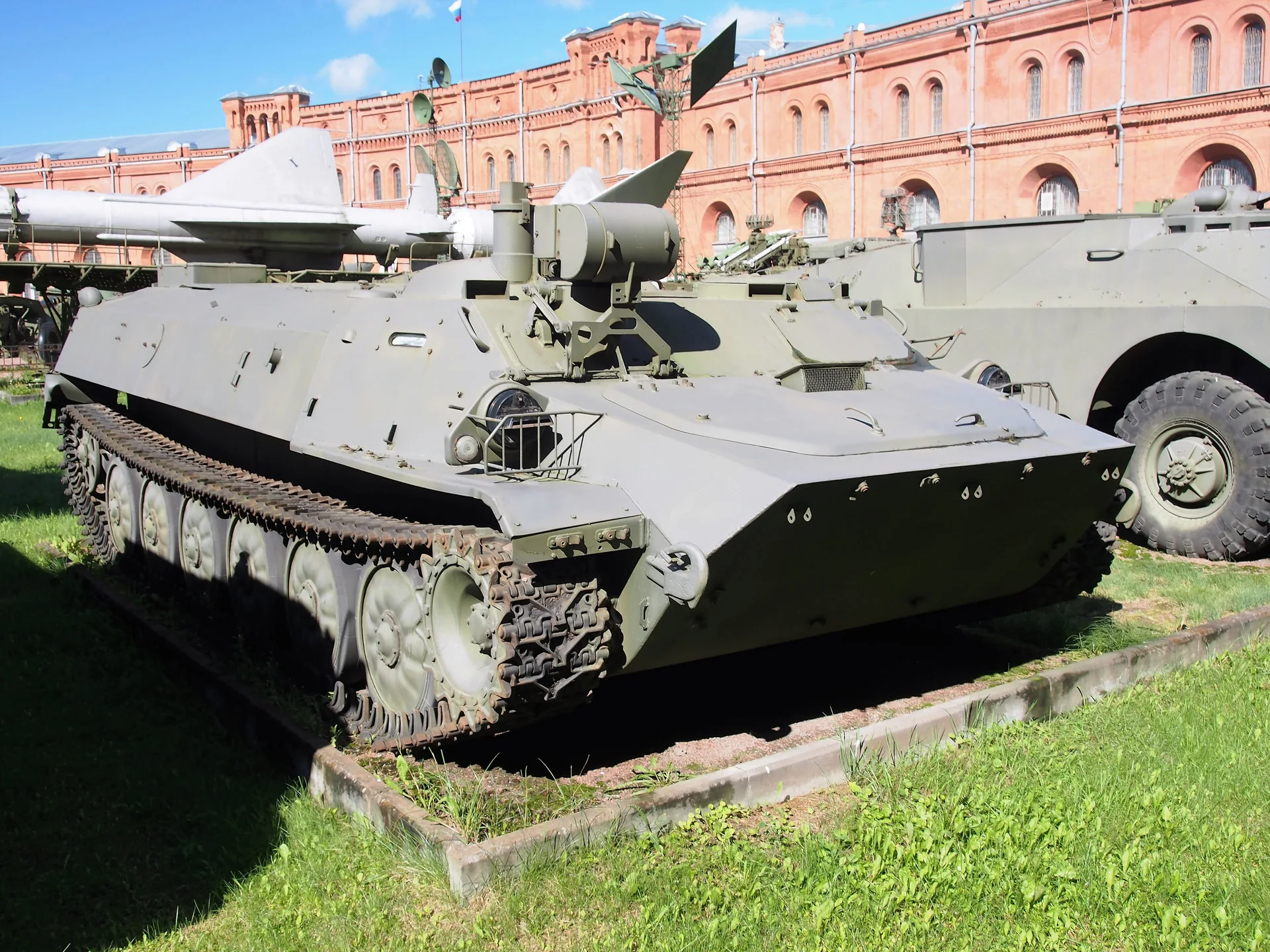
The 9P149 was a dedicated antitank carrier built around the MT-LB automotive platform rather than a missile tank intended to replace the main battle tank. The current Warspec record, which cites U.S. Army ODIN, places Shturm-S in service from 1979 and describes a two-person crew. That combination of a light carrier, small crew and internal loading machinery reflects specialization within an antitank formation rather than a general-purpose armored fighting vehicle. 2
Layout and crew
The MT-LB-based installation carried its missile supply within the hull and used an automatic loading arrangement for the launcher. The resulting vehicle had a low travel profile, but its silhouette changed when the weapon was raised. Travel configuration should not be confused with the shape of the vehicle while the system was in use. 1
A retractable launcher also divided the vehicle into two visibly different configurations. With the weapon lowered, the carrier could travel with a relatively compact upper profile; with the installation raised, the mission equipment became exposed above the hull. The automatic loader occupied internal volume even when the launcher was not visible. These features made the 9P149 a dedicated weapons vehicle, not a carrier whose full original cargo space remained available. 1
The launcher and automatic-loading system occupied space that an ordinary MT-LB used for other purposes. This is why the 9P149 should be treated as a weapons vehicle built on an MT-LB base, not as an unchanged carrier with a tube bolted to the roof. The automotive ancestry explains mobility and support commonality; the internal missile handling explains the different mission layout. 2
The same reference describes the internal magazine as part of an automatic-loading installation operated by a two-man crew. In this arrangement, bringing the next missile to the launcher was an engineering task performed within the carrier, rather than a separate exposed loading party working beside a towed mount. That reduced crew requirement came with dependence on the functioning of the magazine and handling machinery. It does not establish that every later missile could be substituted without alterations. 1
Armament
The original system transmitted guidance commands by radio rather than along a trailing wire. That is a distinction in the command link, not proof that the missile independently selected or pursued targets. Describing every guided missile as fire-and-forget erases important differences between systems and the work expected of their crews. 1
Crew protection
The light carrier supplied limited armored protection, not the protection of a main battle tank. Its purpose was to bring a specialized weapon with mobile formations. A photograph of the vehicle’s armored hull therefore does not justify treating it as an assault vehicle intended to accept the same exposure as a tank. 1
Mobility and support
The automotive platform connected Shturm-S to the widely used MT-LB family. That offered a familiar tracked base and common maintenance experience, while the missile installation required its own inspection equipment and training. A vehicle could therefore retain useful mechanical commonality without retaining the ordinary carrier's passenger or towing mission. The missile compartment and loading machinery defined how the available hull volume was used. 1
Versions and conversions
The 9P149 designation identifies the combat vehicle; Shturm-S identifies the ground-based weapon installation in broader usage. Later Shturm-SM modernization introduced improved observation equipment and newer missile compatibility. Those improvements belong to the modified system and should not be copied backward into the specification of an early carrier. 1
Compatibility depended on the vehicle as well as the missile's family name. The 1999 FAS reference distinguishes the helicopter-carried AT-6B and AT-6C from the missile accommodated by the Shturm-S automatic loader, explaining that the longer airborne weapons would not fit that mechanism. A common guidance family did not remove the physical limits imposed by the carrier's internal magazine. This is a useful warning against transferring every helicopter missile specification onto the ground vehicle without checking the launcher and ammunition standard. 1
Service history
Shturm-S belonged to the Soviet development of dedicated tracked antitank carriers. Later Russian modernization under the Shturm-SM designation added improved observation equipment and compatibility with newer weapons. Those stages should be kept separate from the history of the broader Shturm missile family, whose introduction does not by itself date every ground carrier. The original and modernized installations were not one timeless equipment configuration. 1, 3
Operating constraints
A guided weapon’s nominal reach is only one part of a usable capability. Observation, identification, guidance equipment, and mechanical reliability must work together. Automatic loading reduces one element of crew handling, but it does not remove those dependencies or turn the vehicle into a fully autonomous weapon system. 1
Design legacy
Shturm-S illustrates the mature specialist missile-carrier approach. The MT-LB ancestry explains how the platform moved and was supported; it does not define what the finished vehicle was for. The complete installation belongs with dedicated antitank vehicles, not simply with ordinary personnel and equipment carriers. 1
Sources and further reading
- Federation of American Scientists, 9P149 Shturm-S reference, 19 June 1999
- Warspec — 9P149 Shturm-S, ODIN-sourced technical record (secondary source; not primary certification)
- U.S. Army ODIN — 9K114 Shturm (AT-6 Spiral) Russian Anti-Tank Missile Carrier
Visit an Armor Museum
Explore the worldwide museum directory to find armored vehicles, collections, and visitor-planning information.
Browse armor museums