Requirement and development
Tor developed during the 1970s and 1980s as a new short-range missile system following Osa. Published reference accounts place Soviet acceptance in 1986. Its distinguishing combination was a tracked carrier, integral surveillance and engagement radars, and vertically launched missiles. Later Tor-M1 and Tor-M2 equipment must be separated from that original configuration when discussing missile loads or electronic capabilities. 1, 2, 3
Vehicle architecture and crew arrangement
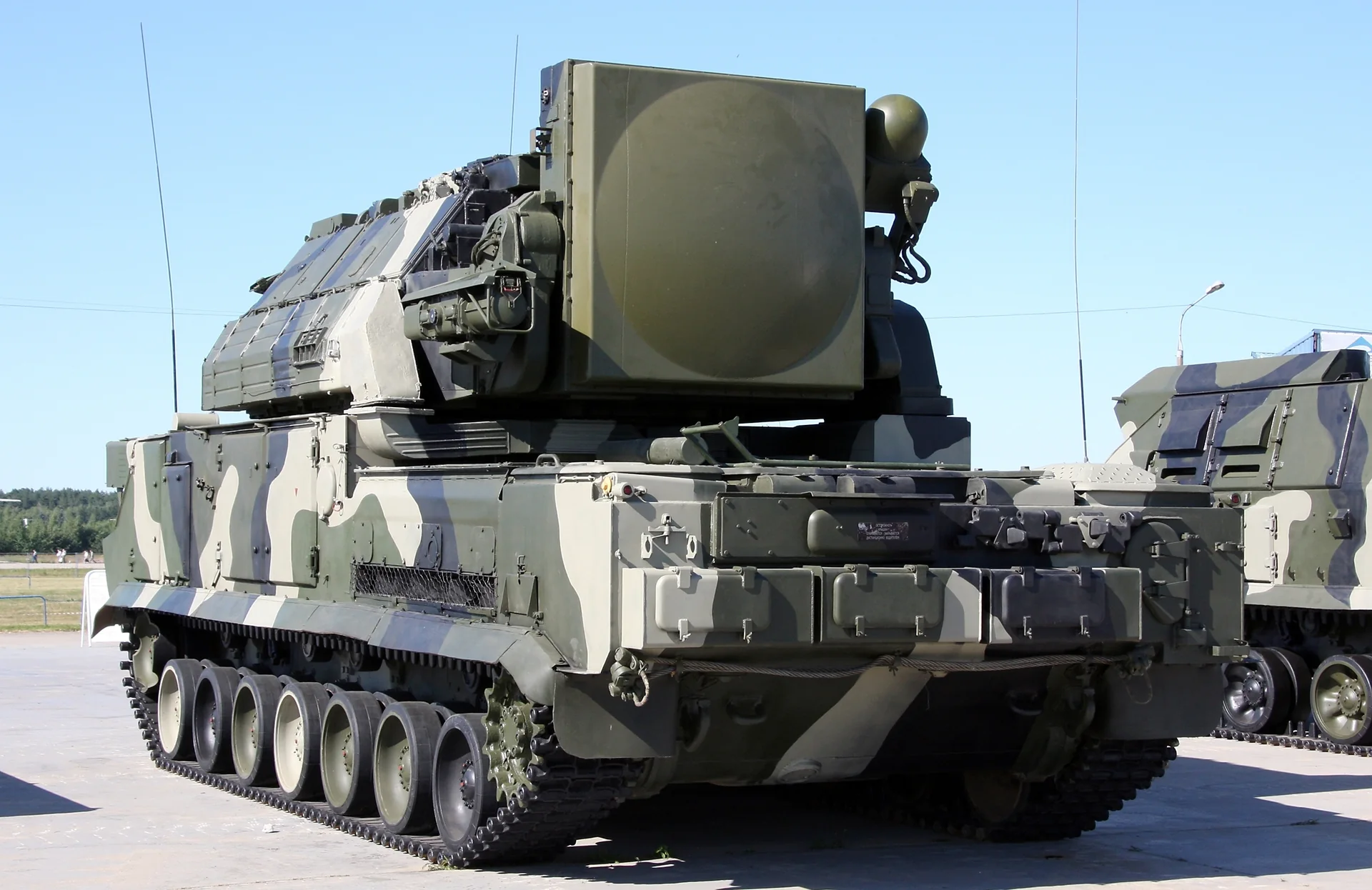
The original Tor combat vehicle integrated radar antennas, missile cells, fire-control equipment, crew stations, and the tracked automotive system on one chassis. Unlike rail-launched missile vehicles, Tor stored its missiles for vertical launch, allowing engagement hardware to remain compact around the turret structure. The self-contained arrangement reduced the number of separate vehicles required to create a local engagement capability. 1, 2, 3
Weapons and engagement concept
Early Tor variants used vertically launched 9M330/9M331-family missiles carried within the vehicle. Later Tor-M2 versions introduced improved missiles and, in some configurations, increased ready-round capacity through more compact canisters. The weapon was designed around rapid short-range engagements and command guidance, with the missiles forming one part of a tightly integrated radar and digital fire-control system. 1, 2, 3
Sensors, fire control, and target information
Tor paired a surveillance radar with a separate engagement radar and digital processing, allowing the vehicle to search, track, and guide missiles autonomously. This was a major conceptual step beyond systems that depended heavily on a battery-level radar. Later M1 and M2 models expanded target channels, improved resistance to countermeasures, and increased effectiveness against small or fast targets while retaining external command links. 1, 2, 3
The radar changes are more specific than a general claim of better electronics. The illustrated Tor study distinguishes the earlier curved surveillance antenna from the planar-array installation associated with Tor-M2E. It also separates surveillance from the engagement equipment mounted on the turret face. Those installations perform different jobs: finding a possible target is not the same process as maintaining the information used to guide a missile. An externally similar tracked hull can therefore carry a substantially different mission system. Conversely, a new chassis does not by itself demonstrate that the radar or missile standard has changed. 4
Mobility, protection, and sustainment
Tracked Tor vehicles used GM-series chassis intended to accompany maneuver forces across the same general terrain as tanks and infantry fighting vehicles. The chassis had to carry a large radar-and-missile payload while preserving cross-country mobility and rapid displacement. Later family members also appeared on wheeled platforms and the articulated Tor-M2DT Arctic carrier, showing that the mission package could migrate when environmental or logistical requirements changed. 1, 2, 3
The same study documents the support equipment around the combat vehicle, including a 9T244 crane-equipped loading vehicle and a 9T245 transport vehicle. These are a useful corrective to the description of Tor as self-contained. The firing vehicle integrates the immediate sensing and weapon functions, but ammunition movement and handling still require other vehicles and personnel. Its autonomy is an architectural description of the combat installation, not a claim that a deployed unit needs no external support. 4
Place in the air-defense system
Although a Tor vehicle could conduct local engagements, batteries and regiments still used command vehicles and networked target information to create coordinated coverage. Autonomy mattered because a single combat vehicle could continue to function when communications were degraded, while higher-echelon cueing reduced search burden and helped allocate targets. The combination of local capability and networked control became a defining feature of later Russian SHORAD. 1, 2, 3
Variants and modernization
Tor-M1 improved the original system and became a major export model. Tor-M2 and related subvariants introduced new radar and processing capability, newer missiles, and platform options including wheeled and Arctic vehicles. ODIN also identifies Tor-M1-2U and Tor-M2K among the family. These names can be confusing, so variant-specific missile counts, radar performance, and chassis details should not be transferred across the entire family. 1, 2, 3
Service history and operators
Tor served with Soviet forces and later Russian and export operators in several configurations. National service histories therefore concern particular vehicle, missile and electronic standards rather than one universal Tor specification. This account does not treat reports of losses, captures or individual engagements as a comprehensive measure of the family's effectiveness or present availability. 1, 2, 3
Constraints and changing threat environment
The sophistication that gave Tor autonomy also made it an expensive and maintenance-intensive vehicle. Missile capacity was finite, radar performance remained constrained by terrain and line of sight, and the system had to distinguish small fast targets in a cluttered battlefield. Newer variants addressed processing and weapon capacity, but the basic problem of defending a point against growing numbers of inexpensive aerial threats continues to pressure the family. 1, 2, 3
Historical place
Tor is significant because it moved short-range missile defense toward a highly autonomous, vertically launched, digitally controlled armored system. It demonstrated that a battlefield SAM could carry enough sensing and computation to operate as a complete local engagement unit while still belonging to a larger network. That architecture remains visible in contemporary short-range air-defense development, even as sensors and missiles continue to change. 1, 2, 3
Sources and further reading
- U.S. Army ODIN — 9K330 Tor family
- GlobalSecurity — Antey history and Tor development
- GlobalSecurity — Russian SAM family reference
- Air Power Australia, Tor technical study, architecture and support vehicles
Visit an Armor Museum
Explore the worldwide museum directory to find armored vehicles, collections, and visitor-planning information.
Browse armor museums