
Historical overview
The Type 80 / Type 88 was a Chinese second-generation main battle tank family created to move the People’s Liberation Army beyond incremental Type 59 and Type 69 upgrades. In project terms, the family begins with late-1970s development and prototype work and reaches operational form with the Type 88 designation in 1988. Sources
The tank mattered because it represented a real transition in Chinese armored-vehicle design. Earlier Chinese tanks had largely remained within the Type 59 and Type 69 pattern, using five large roadwheels, Soviet-style hull and turret logic, and technology that had fallen behind the T-72, M60A3, Leopard 1, Leopard 2, and other late-Cold-War armored vehicles. The Type 80/88 line introduced a new six-roadwheel chassis, a 730 hp diesel, improved fire-control equipment, night-vision fittings, NBC protection, smoke launchers, and a 105 mm rifled gun compatible with Western-style ammunition. Sources
The most important production-relevant variant was the Type 88, especially the Type 88B and Type 88A. The Type 88B is usually described as improving the loading and fire-control arrangement, while the Type 88A is usually described as receiving a longer or improved 105 mm gun and improved protection using FY-series explosive reactive armor. Public sources do not agree perfectly on the order, naming, and technical detail of these variants, so published accounts describe Type 88A/B details as medium or uncertain unless supported by multiple sources. Sources
Published Type 80/85/88 totals describe different groupings. Tank-AFV and MilitaryFactory give roughly 3,000–3,500 for the wider family, while narrower Type 88 estimates commonly range around 400–500. Those figures do not establish several thousand Type 88 tanks alone. Sources
The Type 80/88 was not a fully competitive peer of the most advanced Western and Soviet tanks of the late 1980s, but it was a decisive industrial and doctrinal stepping-stone. It gave Chinese industry experience with a more modern chassis, Western-caliber armament, improved fire control, and the difficult problem of evolving an old Soviet-derived design architecture into a more capable domestic MBT. Its most important legacy is not battlefield fame; it is its role as a bridge toward the Type 85, Type 90-II/MBT-2000, Type 96, and later Chinese MBT development. Sources
The Type 80/88 story begins with the strategic and industrial pressure created by the Sino-Soviet split and by the obsolescence of China’s Type 59 fleet. China had built a large armored force around tanks derived from the Soviet T-54A, but the battlefield and technological standards of the 1970s had moved forward. New Soviet tanks such as the T-64 and T-72, and Western designs such as the Leopard 1, AMX-30, Chieftain, and later the Leopard 2 and M1 Abrams, made the older Type 59/69 pattern increasingly inadequate as a modern main battle tank. Sources
China’s Type 69 and Type 79 programs added fire-control equipment, laser rangefinders, improved guns, and export-market improvements, but those designs remained tied to an older five-roadwheel hull and traditional rounded turret architecture. Public references agree that the Type 80 represented a more ambitious step: not a clean-sheet Western-style MBT, but a more substantial modernization that combined an inherited Chinese-Soviet layout with a new chassis, more powerful engine, Western-caliber gun technology, and improved sighting and protection systems. Sources
The military problem was straightforward: the PLA needed a tank that could keep pace with modern armored doctrine while Chinese industry was still maturing. A fully modern composite-armored, high-power, smoothbore-gunned tank was beyond immediate reliable production. The Type 80/88 path therefore used an evolutionary solution: preserve enough familiar design features to be manufacturable, but introduce enough new components to build industrial experience. Sources
Doctrine mattered because fire-on-the-move, night fighting, crew survivability, and rapid operational movement became more important in late-Cold-War armored warfare. The Type 80/88 family’s 105 mm gun, stabilized sights, laser rangefinding, ballistic computing, smoke launchers, NBC system, and improved mobility were all answers to a battlefield where simply fielding more Type 59s was no longer sufficient. Sources
Industrial constraints shaped the design as much as battlefield logic. Chinese factories could not immediately leap to a Leopard 2 or T-72-level domestic tank, and public accounts show a pattern of prototype experiments, partial use of foreign-influenced technology, and incremental acceptance of more mature systems. The Type 80/88 is best understood as a transition vehicle: its imperfections are part of its historical significance, and it did not solve every PLA armor problem. Sources
Development and variants
The development line includes Type 80, Type 80-I and II, and Type 88, 88A, and 88B, alongside associated recovery vehicles. WZ-1224 and WZ-1226 belong to the experimental background. The related Type 85 and Type 96 developments were distinct later branches. Sources
The account excludes the South Korean K1 / Type 88 family from the main the cited accounts search shows a separate KR-K1 family and accounts for the South Korean Type 88/K1. That vehicle belongs to South Korea and U.S.-assisted development and cannot be combined with China’s ZTZ-80/ZTZ-88 family simply because both used the “Type 88” name in English-language sources. Sources
The account also excludes the Type 85 export family as a standalone family except as a related branch. Type 85 and Type 88C/Type 96 issues are therefore treated as lineage and boundary material, not as the central subject. Sources
It is well-documented that the Type 80/88 line was a Chinese late-Cold-War MBT transition family; it is less certain that narrow Type 88 production ran roughly several hundred vehicles; it is uncertain that all public Type 80-I/II, Type 88A/B, and ARV details can be precisely reconciled from open sources. Sources
Published accounts describe Type 80/88 development as beginning in the 1978-1988 frame, with WZ-1224 listed as a 1978 prototype and WZ-1226/WZ-1226F2 listed as late-1970s to early-1980s prototypes. These prototype records are uncertain in the available accounts, but they show Chinese experimentation with more ambitious tank concepts before the production Type 88 emerged. Sources
Open public references generally connect the Type 80/88 line with Factory 617, later known as the First Inner Mongolia Machinery Factory and associated with NORINCO, along with the 201 Institute and other supporting factories. Tank Encyclopedia lists 617 Factory as the main contractor and also refers to 616 Factory, 477 Factory, and 201 Institute as associated organizations in the Type 88 development context. Tank-AFV similarly places the design under 617 Factory / First Inner Mongolia Machinery Factory / NORINCO. Sources
The Type 80 appears to have been a development and prototype family rather than a widely fielded PLA production tank under that exact designation. Army Guide says the Type 80/Type 88 was first revealed in 1984 and describes Type 80-I and Type 80-II as experimental or prototype/export configurations. MilitaryFactory describes Type 80 as a model evolved into several variants and then treats Type 88 as the local Chinese Army version. The cited accounts splits Type 80 and Type 80-II as variant records under the Type 80/88 family but gives Type 80-II uncertain. Sources
Type 88 was the operationally important development of Type 80. Published accounts place its PLA introduction in 1988 and describe Type 88/88B production or conversion during 1988–1995. Sources
Development did not stop with the Type 88. Type 85 and Type 88C/Type 96 boundary issues reflect the way Chinese designers used the Type 80/88 chassis and lessons as the basis for export and domestic successor tanks. The Type 96 is especially important as a successor: the U.S. Army ODIN result states that ZTZ-96 replaced the previous Type 88 MBT in production. That relationship makes the Type 80/88 a bridge rather than an endpoint. Sources
The cancellation or abandonment story is therefore not a single event. WZ-1224 and WZ-1226 were prototype/testbed paths; Type 80 and Type 80-II were development/export-oriented steps; Type 88 reached PLA service; Type 88A/B refined the production configuration; and Type 85/Type 96 moved the lineage into a more modern generation. Sources
Design and performance
The Type 80/88 retained a conventional tank layout: driver in the front hull, fighting compartment and turret in the center, engine and transmission at the rear. Army Guide specifically describes the Type 88 as having a conventional hull layout with four crewmembers and a driver compartment located at the left front. MilitaryFactory gives the same four-person crew arrangement: driver, commander, gunner, and loader. Sources
The hull was larger and more modern than earlier Type 59/69 hulls. The most visible recognition feature was the shift from five large roadwheels to six smaller double roadwheels per side. This gave the vehicle a different profile and marked one of the clearest external departures from the Type 59/69/79 family. Sources
The Type 80 and Type 88 retained a rounded cast-turret form similar in spirit to earlier Chinese tanks, unlike the later Type 85 branch with welded turret forms. Sources differ over when welded or composite turret features appeared on Type 85, Type 88C, and Type 96. For this Type 80/88 account, the safe formulation is that the basic Type 80/88 used a rounded cast-turret arrangement, while Type 85 and Type 96 successor branches moved further toward welded/composite-turret logic. Sources
Armor values remain uncertain and in many public references are listed as classified or not precisely disclosed. The vehicle had rolled/welded hull armor, a cast turret in the core Type 80/88 forms, rubber or composite-rubber side skirts over the running gear, smoke launchers, and later ERA options on Type 88A/B-related configurations. Army Guide and Tank-AFV agree that later variants removed some turret storage racks or added reactive armor arrangements. Sources
The main weapon was a 105 mm rifled gun derived from the Western L7 family. Published accounts describe Type 80 and Type 88 with the 105 mm Type 83, Army Guide identifies the Type 88 gun as the Type 83 105 mm rifled gun, and MilitaryFactory lists a 105 mm rifled main gun. Type 88A is usually described as using an improved longer 105 mm gun, commonly described as Type 83-I or ZPL-94 in public sources. Sources
Secondary armament generally consisted of a coaxial 7.62 mm machine gun and a roof-mounted 12.7 mm anti-aircraft heavy machine gun. MilitaryFactory lists forty-four 105 mm rounds for the Type 80, 500 rounds of 12.7 mm ammunition, and 2,250 rounds of 7.62 mm ammunition. Army Guide lists forty-eight rounds for the Type 88; this likely reflects Type 88 or Type 88A/B internal stowage differences rather than a direct contradiction for the entire family. Sources
The Type 80/88’s fire-control suite was one of its most important modernization features. Army Guide attributes a Type 37A fire-control system to the Type 80/88, including dual-axis stabilized optical sight, light-spot fire-control, onboard computer, and laser rangefinder. It further says the Type 88A/B replaced this with a more advanced JSFCS-212 integrated fire-control system. Tank-AFV similarly emphasizes the improved fire-on-the-move capability compared with earlier Chinese tanks. Sources
The family used a 12150L-7BV/BW or related 12150ZL-series diesel developing roughly 730 hp. Public references give road speed figures in the 55-60 km/h range and range figures of about 430 km, with some extended-range claims using external fuel drums. The suspension was torsion-bar based, and the six-roadwheel arrangement was a defining external and mechanical difference from older Chinese tanks. Sources
Most reliable references retain a four-person crew for Type 80 and Type 88: commander, gunner, loader, and driver. Some public descriptions of Type 88 loading improvements use “autoloader” language or suggest a reduced crew, but this conflicts with Army Guide and MilitaryFactory and is probably a confusion between an assisted loading mechanism, Type 88B loading improvements, and later Type 85/Type 88C/Type 96 autoloader arrangements. Published accounts describe the core Type 80/88 crew as four, with Type 88B loading-system claims marked uncertain. Sources
Public sources provide less detail on radios and communications than on armament and mobility. The family is generally described with NBC/CBRN protection, automatic fire suppression, smoke grenade launchers, and night-vision equipment. Reliability concerns appear most strongly in prototype and export-development accounts, especially claims that Type 80-II trials exposed automotive or engine-change issues; those claims are useful but not sufficiently authoritative to quantify without additional archival sources. Sources
Known weaknesses were evolutionary rather than catastrophic. The rounded turret and conservative armor architecture limited growth potential compared with welded/composite designs. The 105 mm gun was a practical improvement over older 100 mm weapons but was already less future-proof than 120 mm or 125 mm smoothbore guns by the late 1980s. Public source disagreement over loading systems, production totals, and export use also shows that the open record is thin compared with better-documented Soviet, U.S., British, or German MBT families. Sources
Production, operators, and combat record
The key industrial organization was China’s armored-vehicle production base centered on Factory 617 / First Inner Mongolia Machinery Factory, later associated with NORINCO. Tank-AFV identifies 617 Factory as the requester’s design/build organization and says it was later renamed the First Inner Mongolia Machinery Factory and then NORINCO. Tank Encyclopedia similarly places Type 88 development in a 617 Factory-led group with other factories and the 201 Institute. Sources
Production chronology is partly clear and partly disputed. Published accounts describe Type 88 / Type 88B a 1988 introduction date and a 1988-1995 production/conversion frame. Tank-AFV says production of the Type 88 series stopped in 1995. Army Guide and MilitaryFactory support the basic sequence of Type 80 development followed by Type 88 and Type 88A/B variants, although they do not reconcile all production counts. Sources
The largest production-data problem is whether a source is counting only Type 88 production, all Type 80/88 production, or the broader Type 80/85/88 family. Tank-AFV’s main text and specifications include a broad “around 3500” claim, while its Type 88 section also gives about 400 to 500 Type 88/A/B in service. MilitaryFactory gives “as many as 3,000 units” but its page title groups Type 80/85/88 and lists China, Pakistan, Sudan, and Uganda, which strongly suggests it is using a broader family/derivative accounting rather than a narrow Type 88-only count. Sources
Secondary sources describe several hundred Type 88-family production vehicles, commonly giving 400–500 or more than 500. These are estimates rather than a reconciled official total. Sources
Cost, monthly production, and factory-year output data are not available in the open sources reviewed. This is a gap compared with well-documented Soviet, U.S., British, or German tank production histories. Sources
China was the principal operator. The published account’s China account gives Type 80/88 service starting in the 1980s and describes current/reserve upgraded status as less certain. Public sources are mixed. MilitaryFactory says Type 80 tanks were no longer in Chinese service as of 2005 but also says Type 88A/B models remained in use as of 2020. Tank-AFV says Type 80, Type 85, and Type 88 were not kept in use after 2005 except in reserve, yet also says about 400 to 500 Type 88/A/B were in PLA service. Sources
Official Chinese military media provides at least one valuable anchor: a 2018 China Military Online / PRC Ministry of National Defense result identified Type-88 MBTs attached to a PLA Xinjiang Military Command regiment during training. Sources
Tank-AFV reports more than 230 Type 88B vehicles purchased by Myanmar and suggests later combat use. The cited material does not independently establish that quantity or a complete vehicle-specific combat history; the export claim remains less certain than Chinese operation. Sources
Pakistan, Sudan, and Uganda often appear in broad Type 80/85/88-family summaries, but these are primarily Type 85/Type 85-IIAP/Type 85-II-M or related derivative matters rather than narrow Type 88 service. Sources
There is no well-documented, well-documented combat history for Chinese-operated Type 80/88 tanks comparable to better-known records for the M1 Abrams, T-72, T-55, or Type 69 export family. Most sources focus on development, specifications, parade/training use, and later Chinese tank-lineage significance rather than battle performance. Sources
China’s Type 88 appears in training and regional-force contexts. The 2018 China Military Online / PRC Ministry of National Defense result places Type-88 MBTs in Xinjiang Military Command training. Blasko’s 2024 SSI paper gives the wider strategic context for the PLA’s Aksai Chin and Xinjiang Military District reinforcement environment after 2020, but it is not a Type 88 combat-use source. Sources
Myanmar combat-use claims remain uncertain. Tank-AFV says Myanmar purchased Type 88B tanks and that they have seen action recently in Myanmar’s civil war. This remains unconfirmed. Sources
The most important combat-history interpretation is negative evidence: the Type 80/88 did not become famous through major tank battles. Its significance is industrial and developmental. It helped China move from Type 59/69-derived tanks toward a more modern MBT ecosystem; it did not transform PLA armor through a decisive wartime demonstration. Sources
Legacy and historical evidence
Against earlier Chinese tanks such as the Type 59, Type 69, and Type 79, the Type 80/88 was a major improvement. It had a more modern six-roadwheel chassis, better engine power, improved range and speed, a 105 mm gun compatible with Western-style ammunition, improved fire control, and more systematic protection and night-fighting equipment. Its battlefield value inside the PLA was therefore much greater than another incremental Type 59 refit. Sources
Against Western second-generation tanks such as the M60A3, Leopard 1, AMX-30, and Type 74, the Type 80/88 was roughly comparable in broad category: a mobile, 105 mm-gunned MBT with improved optics and fire control but limited protection by the standards of later composite-armored tanks. Army Guide even states that general performance was estimated comparable to the U.S. M60, British Chieftain, French AMX-30, German Leopard 1, and Japanese Type 74, although that represents a broad estimate rather than a tested combat ranking. Sources
Against the Soviet T-72 and later Western third-generation tanks, the Type 80/88 was less impressive. A 105 mm rifled gun, cast turret architecture, and modest protection growth could not fully match the protection, gun power, and growth potential of the T-72, Leopard 2, M1 Abrams, or Challenger line. This explains why later Chinese designs moved toward welded/composite turret logic, 125 mm armament, autoloaders, improved thermal sights, and more modern hull/turret architecture. Sources
In reliability and production terms, the family’s value was practical but limited. It allowed Chinese industry to absorb lessons about modern powertrains, fire-control integration, roadwheel/suspension changes, and manufacturing of a more advanced tank without requiring an immediate jump to a world-class clean-sheet MBT. That makes it strategically useful even if it was never the final answer to China’s armored-force modernization. Sources
The Type 80/88’s legacy is best measured through later Chinese designs. The Type 85 export branch, Type 90-II/MBT-2000 path, Type 96 domestic line, and eventually the Type 99 generation all belonged to the larger movement away from the Type 59/69 pattern. The Type 80/88 helped create that bridge by proving the need for better fire control, more capable engines, improved chassis design, and more modern protection arrangements. Sources
The Type 96 link is especially important. The U.S. Army ODIN Type 96 result states that ZTZ-96 replaced the previous Type 88 MBT in production. That places Type 88 at the end of an older generation and the beginning of a new one: it was mature enough to be a production PLA tank, but transitional enough to be replaced when China could field a more modern 125 mm/autoloader/composite-armored design. Sources
Modern reputation is mixed. Enthusiasts sometimes understate the Type 80/88 because it lacks the iconic status of T-72, M1 Abrams, Leopard 2, or Type 99. Others overstate it by blending Type 80, Type 85, Type 88, Type 88C, and Type 96 into one production or combat story. The careful historical position lies between those extremes: the family was technologically important but not a single unified “super tank” lineage. Sources
Common misconceptions include confusing Chinese Type 88 with South Korea’s K1 / Type 88, treating Type 88C as a straightforward Type 88 variant rather than a Type 85/Type 96 boundary issue, and accepting 3,000-plus production figures as narrow Type 88 totals. Sources
Some references group Type 80, Type 85, and Type 88 together, obscuring which variant their production and operator figures describe. Several technical details are documented in secondary accounts rather than original manuals. Sources
Type 80/88 belongs to the Chinese late-Cold-War main battle tank development line and is not the same vehicle as South Korea’s K1 / Type 88. Sources
Type 88 entered PLA service around 1988 as an improved Type 80-related vehicle. Sources
The core family used a 105 mm rifled gun, four-person crew in the safer interpretation, a 730 hp diesel, and a six-roadwheel chassis. Sources
Type 96 succeeded/replaced Type 88 in the later Chinese MBT production path. Sources
Narrow Type 88 production was several hundred, often given around 400-500 or 500+. Sources
Type-88 vehicles were still in PLA training or regional unit use in 2018, based on official Chinese military media search results. Sources
Exact production breakdown for Type 80, Type 80-II, Type 88, Type 88A, and Type 88B. Sources
Myanmar Type 88B acquisition quantity and combat-use claims without IISS/SIPRI/imagery confirmation. Sources
Precise WZ-1224 and WZ-1226 technical lineage into Type 80/88 based only on open web sources. Sources
Statements that Type 88 used a true autoloader or reduced crew unless tied to later Type 85/Type 88C/Type 96 configurations. Sources
Sources and further reading
Background reading and references. Each photograph has its own source and credit.
- [S1] Tank-AFV.com. “Type 80 and Type 88 Chinese main battle tanks (1981).” Accessed 3 June 2026.
- [S2] Army Guide. “Type 88 (Main battle tank).” Accessed 3 June 2026.
- [S3] MilitaryFactory.com. “NORINCO ZTZ-88 (Type 80/85/88) Main Battle Tank (MBT).” Accessed 3 June 2026.
- [S4] U.S. Army TRADOC ODIN / Worldwide Equipment Guide. “ZTZ-80 (Type 80) Chinese Main Battle Tank (MBT).” Accessed 3 June 2026 through live search/open result.
- [S5] U.S. Army TRADOC ODIN / Worldwide Equipment Guide. “ZTZ-88 (Type 88) Chinese Main Battle Tank (MBT).” Accessed 3 June 2026 through live search/open result.
- [S6] GlobalSecurity.org. “Type 88B MBT.” Accessed 3 June 2026 through live search result because the page itself produced a decoding error in the browser.
- [S7] U.S. Army TRADOC ODIN / Worldwide Equipment Guide. “ZTZ-96.” Accessed 3 June 2026.
- [S8] China Military Online / PRC Ministry of National Defense. “Armored recovery vehicle tows damaged Type-88 MBT during training.” 23 August 2018. URL: and mirror search result at. Accessed 3 June 2026 through search result; direct page fetch returned server/time-out errors.
- [S8] China Military Online / PRC Ministry of National Defense. “Armored recovery vehicle tows damaged Type-88 MBT during training.” 23 August 2018. URL: and mirror search result at. Accessed 3 June 2026 through search result; direct page fetch returned server/time-out errors.
- [S9] Dennis J. Blasko. “A Baseline Assessment of the PLA Army’s Border Reinforcement Operations in the Aksai Chin in 2020 and 2021.” U.S. Army War College Strategic Studies Institute, 9 April 2024. Accessed 3 June 2026.
- [S10] Tank Encyclopedia. “People’s Republic of China (Cold War).” Accessed 3 June 2026.
- [S11] Wikipedia. “WZ-122 main battle tank” and “Type 80/88 main battle tank.” URLs: and. Accessed 3 June 2026. Further reading; not independently consulted.
- [S11] Wikipedia. “WZ-122 main battle tank” and “Type 80/88 main battle tank.” URLs: and. Accessed 3 June 2026. Further reading; not independently consulted.
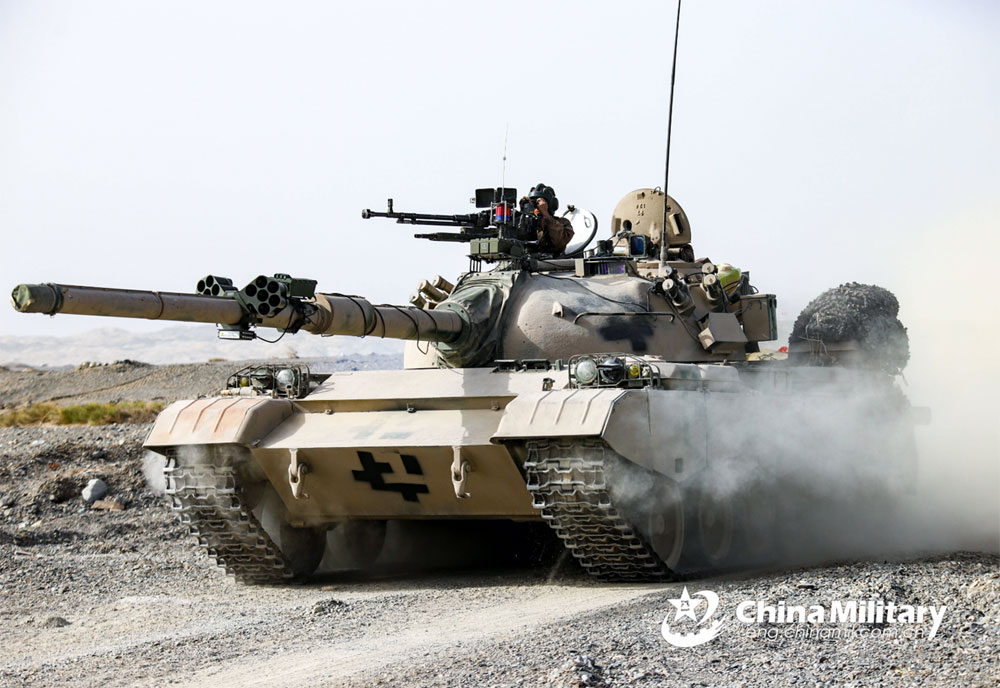
- [IMG1] MilitaryFactory. “type-80-main-battle-tank_2.jpg.” The parent page credits Chinese Ministry of Defense / China Military. Exact variant, date, and location remain uncertain. Source
- [IMG2] MilitaryFactory direct image file type-80-main-battle-tank.jpg. Parent page credits image as public domain. Embedded as Figure 2 with caution that exact variant/date/location are not supplied by the source
![[IMG2] MilitaryFactory direct image file type-80-main-battle-tank.jpg. Parent page credits image as public domain. Embedded as Figure 2 with caution that exact variant/date/location are not supplied by the source](https://www.militaryfactory.com/armor/imgs/lrg/type-80-main-battle-tank.jpg)