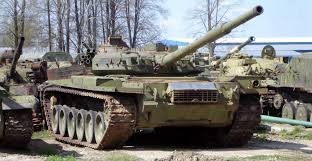

Historical overview
Object 187 was the more ambitious, less production-friendly alternative to the vehicle that became T-90. It began within late-Soviet T-72B improvement programs, usually associated with the 1986 Sovershenstvovanie T-72B / Sovershenstvovanie-88 effort at the Ural Design Bureau of Transport Machine-Building (UKBTM) under V. I. Potkin. [S2] Sources
It mattered because it pushed T-72-based design far beyond a conservative upgrade. Object 187 experimented with a redesigned glacis, relocated driver vision devices, welded turret, replaceable frontal module, composite/titanium/ERA protection concepts, the 2A66 higher-energy 125 mm gun, alternative engines including 840 hp, 1,200 hp, and 1,500 hp options, and 1A45/1A45M fire-control suites. [S2] Sources
The most important variants are the six prototypes rather than named production marks. The first two early vehicles began testing in 1988-1989; the third became a rebuilt test platform with a welded turret and GTD-1500G gas turbine; the fourth used the A-85-2 X-type diesel; the fifth added hydrostatic steering and improved FCS; the sixth tested a heavily modified hydromechanical transmission and the 1,500 hp 2V-12-3 engine. [S2] Sources
The major controversy is not whether Object 187 existed, but how much of its technical data can be trusted from open sources. Many details remain drawn from Russian-language armor-history reporting, secondary summaries, or photographs of surviving vehicles. Object 187 was a powerful developmental dead end that likely influenced later Russian design thinking, but it lost to Object 188/T-90 for cost, production, and economic-collapse reasons. [S2] Sources
By the mid-1980s the Soviet Union faced a layered MBT problem. T-64, T-72, and T-80 families had created parallel production and maintenance ecosystems. T-72B was robust and manufacturable, but the next generation needed better frontal protection, fire control, night fighting, and firepower against newer NATO armor. The Sovershenstvovanie T-72B and Sovershenstvovanie-88 themes sought either deep modernization of existing equipment or new vehicles based on it. [S2] Sources
The strategic context was a late-Cold-War race for protection and lethality under mounting fiscal stress. Soviet designers were studying high-energy 125 mm guns, 152 mm possibilities, welded turret structures, improved electronics, and powerpack modernization. These improvements had to compete not only with Western tanks but also with internal Soviet industrial politics and the need to keep proven production lines running. Sources
Object 187 arose when Ural designers pushed a T-72B modernization so far that it effectively became a new tank. TopWar's account says UKBTM under V. I. Potkin seriously reworked the original design, proposing new hull and turret protection, different power-unit options, prospective armament, and other changes. [S2] Sources
Development and variants
Published accounts describe Object 187 as a prototype family. It includes the six built/rebuilt prototype vehicles, Object 187A paper/unbuilt 152 mm branch, the Object 188/T-90 comparison necessary to understand cancellation, and legacy claims involving Object 195 only as influence, not as a full separate family. It excludes serial T-90/T-90A/T-90M history except where needed for comparison. Sources
Classification is a prototype main battle tank. classification notes marks it as a separate prototype/paper entry rather than an include-in-master production family. Sources
The main boundary issue is chronology: development began before the USSR collapsed, but testing and cancellation continued into the Russian Federation. Sources
Work began in the 1986 improvement studies. Between 1988 and 1992, six prototype tanks of differing design and equipment were built or rebuilt, with two additional planned machines not constructed. The project was continuously modified, making Object 187 less a single prototype than an evolving test series. [S2] Sources
The first two prototypes began in early 1988. Prototype No. 1 used the V-84MS 840 hp diesel and T-72B-based transmission, ran over 3,000 km, and was later rebuilt. Prototype No. 2 entered trials in 1989, ran about 1,800 km, then underwent firing tests that reportedly demonstrated better protection before it was written off and scrapped. [S2] Sources
Prototype No. 3 was built from the repaired No. 1 platform and tested new systems, including a welded turret, chassis information-management components, and a GTD-1500G gas turbine. Prototype No. 4 introduced a major redesign with improved turret and chassis systems and the A-85-2 1,200 hp X-type diesel; by the end of 1991 it reportedly ran more than 12,000 km and fired 180 shots. [S2] Sources
Prototypes No. 5 and No. 6 tested later hull/turret combinations, improved 1A45M fire control, hydrostatic or hydromechanical steering/transmission elements, and the 2V-12-3 1,500 hp engine on No. 6. In parallel, Object 188 offered a cheaper and more unified modernization path. Object 188 entered state trials in 1989, was recommended in 1991, entered pilot-series assembly in 1992, and was adopted as T-90; Object 187 ended in 1993 after the sixth prototype. [S2] Sources
Design and performance
Object 187 retained the Soviet MBT layout: driver/front hull, central fighting compartment, turret-mounted main gun, autoloader, and rear engine compartment. The engine compartment was lengthened compared with T-72B for new power units, but no additional road-wheel pair was added. [S2] Sources
The glacis was substantially redesigned. TopWar reports revised hull-front geometry to improve ricochet probability and effective thickness, removal of weakened zones, and movement of the driver's observation devices behind the hatch. A replaceable frontal unit was proposed to simplify repair after damage and support testing. [S2] Sources
The turret was a new welded design with increased internal volume and better resistance in the front side zones. Sources
Open sources describe combined frontal protection using high-strength armor steels and other materials up to armor titanium, plus explosive reactive armor on the frontal projection and Shtora electro-optical countermeasures. Exact composition and protection equivalence remain unconfirmed in public sources. [S2] Sources
The signature weapon was the 2A66 125 mm gun-launcher with higher energetic performance than 2A46. It used an enlarged breech/chamber for stronger charges, required a muzzle brake, and was paired with the 3BM39 APFSDS round; a 9M125 guided missile was also planned. [S2] Sources
Machine-gun armament followed Soviet practice: PKT coaxial machine gun and an NSV heavy machine gun on the turret roof. Smoke-laying equipment was installed behind ERA blocks on hull sides. [S2] Sources
Detailed ammunition load is not securely confirmed. The 2A66 was associated with new APFSDS and missile development, while the 2A46 and a 152 mm LP-83 option were studied. Any exact autoloader capacity claim remains uncertain unless traced to technical documents. [S2] Sources
Object 187 used the 1A45 Irtysh fire-control system, with later prototypes reportedly using improved 1A45M. The system was intended for day/night target detection and engagement in varied weather. TopWar notes that integrating the FCS with communications and data exchange was not achieved at that stage. [S2] Sources
Open information emphasizes improved day/night fire control but leaves detailed sight model fit per prototype uncertain. Photographs and prototype notes suggest differing equipment states, especially because several vehicles were incomplete, rebuilt, or stripped after trials. [S2] Sources
The prototype series tested multiple power-unit solutions: V-84MS 840 hp on No. 1, GTD-1500G gas turbine on No. 3, A-85-2 1,200 hp diesel on No. 4/5, and 2V-12-3 1,500 hp on No. 6. The program also studied a unified monoblock power unit compatible with different engine types. [S2] Sources
Despite a lengthened power compartment, the chassis retained six road-wheel pairs. Later high-power prototypes required transmission and cooling changes; No. 6 reportedly used broader hydromechanical elements and added radiators for the 1,500 hp engine. [S2] Sources
Combat weight is usually given as 46-50 tonnes, with hull length around 7.2 m. Mobility reportedly equaled or exceeded T-72B depending on powerplant, but exact speed/range figures by prototype are not well confirmed. [S2] Sources
The crew arrangement likely followed the Soviet three-man autoloaded pattern: commander, gunner, driver. Driver visibility arrangements changed because sighting devices were moved behind the hatch to eliminate frontal weak points. [S2] Sources
The communication suite is not well documented. TopWar specifically notes that the fire-control system was not integrated with communications for simplified data exchange, suggesting the project had not fully matured into a networked command architecture. [S2] Sources
Shtora electro-optical countermeasures, NBC protection, ERA, smoke systems, and blast-protected fuel tank experiments are reported. The degree to which each prototype carried complete systems varied. [S2] Sources
The project explored maintainability through modular frontal armor and a quick-change monoblock power unit. Reliability, however, was likely prototype-dependent; high-output engines and experimental transmissions required repeated redesign and added cooling capacity. [S2] Sources
The central weakness was not battlefield performance but acquisition practicality. Object 187 was technically ambitious, less unified with existing production, and more expensive. In the post-Soviet economic crisis, those traits helped Object 188/T-90 win despite lower performance. [S2] Sources
Production, operators, and combat record
Object 187 was a Uralvagonzavod/UKBTM prototype effort, not a production program. The industrial point was to test how far a T-72B-derived line could be stretched: new hull geometry, welded turret, modular protection, high-energy gun, high-output engines, and improved FCS. Six prototype vehicles were built or rebuilt, and two further Object 187A vehicles were planned but not constructed. [S2] Sources
The bottleneck was strategic-industrial rather than factory inability alone. The Soviet collapse created a procurement environment in which a more radical, less unified tank was politically and financially vulnerable. Object 188 was less advanced but cheaper, more unified with existing systems, and quicker to place into serial production. TopWar states that the army preferred the vehicle with lower characteristics but more unification and lower cost, and that work on Object 187/187A stopped in 1993. [S2] Sources
No cost figures or monthly published figures are publicly available because there was no serial production. The only reliable quantity is six prototypes built or rebuilt, with four surviving at the time of the cited 2019 report after No. 2 was scrapped and No. 1 rebuilt into No. 3. [S2] Sources
Object 187 had no operational operator. It was a Soviet/Russian test and development vehicle. Sources
Retirement is therefore best described as program cancellation rather than vehicle retirement. Surviving examples became museum/storage artifacts rather than unit equipment. Sources
Object 187 had no combat history. It never entered production, was never issued to operational units, and was never documented in wartime service. Its closest combat-history relevance is indirect: it represents a path Russia did not take when adopting T-90 in the difficult early 1990s. Sources
Strengths and weaknesses in combat can only be inferred from design intent. It would likely have offered stronger frontal protection, higher firepower with 2A66, and better modernization headroom than early T-90, but those advantages remain prototype claims. Reliability under field conditions, crew survivability, ammunition safety, thermal sight fit, and logistics compatibility cannot be treated as combat-proven. Sources
It shared some themes with later Russian tank improvements, but it was not a production-ready T-90M and did not enter service. Sources
Legacy and historical evidence
Object 187's direct legacy was failure to enter production, but its indirect legacy was significant. The prototypes tested welded turrets, revised hull geometry, removable protection concepts, high-energy gun options, high-output powerpacks, and integrated electronics ideas that later Russian projects revisited in different forms. Sources
TopWar states that, according to some data, work on prospective projects continued through UKBTM improvements to Object 187A and into Object 195, while other Object 187-based armored-vehicle ideas did not leave the design stage. This influence claim is described as uncertain unless supported by design-bureau archival publications. [S2] Sources
The modern reputation of Object 187 is shaped by counterfactual appeal: many enthusiasts view it as the better tank Russia could have adopted instead of T-90. The more balanced assessment is that Object 187 was technically attractive but acquisition-impractical in 1991-1993. Under collapsing budgets, production commonality mattered more than maximum performance. Sources
-Low to Medium. TopWar provides a detailed Russian-language secondary account with a prototype-by-prototype chronology and cites Russian armor-history websites, but open official UKBTM/UVZ archival documentation was not located in the cited sources. Wikimedia Commons gives a clear CC0 tag for one Object 187 image, but the underlying source is a WarThunder forum and the author is unknown. [S2] [S3] Sources
Sources and further reading
Background reading and references. Each photograph has its own source and credit.
- Trackpads historical compilation, 2026 (unpublished).
- Trackpads historical compilation, 2026 (unpublished).
- [S2] — Kirill Ryabov, "Object 187. What the T-90 could have been" / "Основные танки семейства Объект 187," TopWar, 4 March 2019.
- [S3] — Wikimedia Commons, "File:Object 187 N3.jpg."