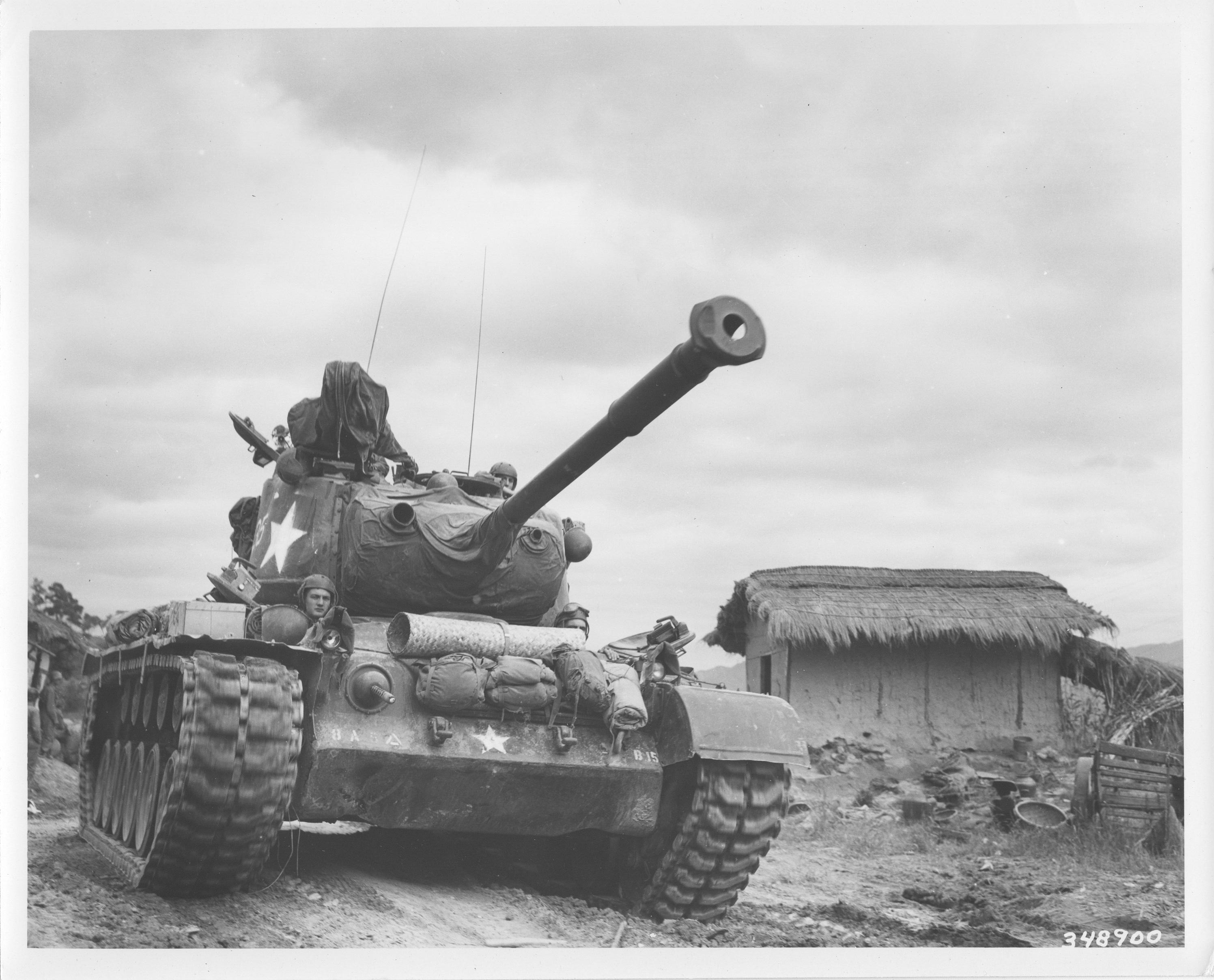
Historical overview
The M46 Patton was the first operational U.S. tank to carry the Patton name and the immediate postwar modernization of the M26 Pershing. Published accounts describe development/start as 1948-1949, production/end as 1949-1951, and total built as approximately 1,160, with a less certain rating. Sources
Its significance lies less in novelty than in timing. The M26 Pershing brought a 90 mm gun and better armor than late-war Shermans, but its mobility and reliability were unsatisfactory for the early Cold War. The M46 corrected the principal automotive problem by pairing the Continental AV-1790 gasoline engine with a General Motors/Allison CD-850 cross-drive transmission. This made the vehicle a practical fighting tank in Korea and a mechanical ancestor of later Patton-series vehicles. [AFV Database, Medium Tank M46 Patton; The Tank Museum, Keeping Up with the Pattons.] Sources
The M46 mattered because it entered service just as the United States was caught between wartime demobilization, the emerging Soviet armored threat, and the Korean War emergency. Official U.S. Army historical material emphasizes that U.S. units in Japan entered Korea with limited readiness and that North Korean formations used T-34-85 tanks in the opening phase of the war. The M46 was one of the few American tanks available with the firepower, armor, and mobility to counter that environment. [U.S. Army CMH, Korean War Campaign Summaries; U.S. Army, North Korea attacks across 38th parallel.] Sources
The most important members of the family were the base M46 and the product-improved M46A1. The M46A1 retained the same general combat characteristics but introduced detail improvements to braking, oil cooling, fire extinguishing, instrumentation/electrical wiring, and final-drive ratio according to AFV Database. [AFV Database, Medium Tank M46 Patton] Sources
The main controversies are production accounting, classification language, and export/operator AFV Database and the cited accounts support 1,160 total M46/M46A1 acceptances, with 360 M46A1 acceptances; The Tank Museum describes about half of 2,202 M26s remanufactured into M46 and 370 new-build M46A1s; the First Division Museum page lists a much higher total produced figure of 2,015. Published accounts describe 1,160 total as the best-supported working figure, but marks the breakdown between remanufacture, new build, and product-improvement conversions as an open research question. [AFV Database, Medium Tank M46 Patton; The Tank Museum, Keeping Up with the Pattons; First Division Museum, M46 Patton Tank.] Sources
The M46 was an interim vehicle, but an important one. It was not the final Cold War U.S. medium tank solution; it was the necessary bridge between the M26 Pershing and the later M47/M48/M60 line. In Korea it gave U.S. armor a more mobile and reliable 90 mm tank than the Pershing, and in design history it established the practical automotive core of the Patton lineage. S. operator claims is medium to low. Sources
The M46 grew out of a strategic problem that had become visible immediately after World War II. The United States had ended the war with a large armored force, but demobilization, budget pressure, and rapidly changing threat assumptions left many units with aging equipment and uneven readiness. The M26 Pershing was more powerful than the M4 Sherman, but it was itself a late-war compromise and its automotive performance was inadequate for the postwar medium-tank role. [The Tank Museum, Keeping Up with the Pattons; AFV Database, Medium Tank M46 Patton.] Sources
The early Cold War changed the tank problem. U.S. planners had to consider Soviet armored forces, including the T-34-85 and the emerging postwar Soviet tank line, while also maintaining occupation commitments and alliance responsibilities. Published accounts describe M46 within the Cold War tanks phase and gives its service context as a postwar medium tank with NATO/Western operator summary. Sources
The Korean War exposed the gap between paper inventory and ready armored capability. Official Army campaign summaries describe U.S. divisions in Japan as understrength, short of modern equipment, and rushed into combat. North Korean attacks from June 1950 included T-34-85 tank support, and early U.S. delaying forces lacked both armor and adequate antitank weapons. That battlefield shock shaped how the M46 was remembered: it was an interim tank pressed into a real war at the moment when an interim was urgently needed. [U.S. Army CMH, Korean War Campaign Summaries; U.S. Army, North Korea attacks across 38th parallel; U.S. Army, Korean War Timeline.] Sources
The doctrine behind the M46 was not yet a mature main battle tank doctrine. U.S. practice still distinguished light, medium, and heavy tanks, and the M46 remained in the medium category. Still, the battlefield requirements were moving toward a balanced single battle tank with enough mobility, protection, and firepower to handle most armored tasks. The M46 is best seen as a practical step along that road rather than a doctrinal revolution. [The Tank Museum, Keeping Up with the Pattons.] Sources
Industrial context was equally important. The M46 used the M26 hull and many existing components, which reduced development risk and accelerated availability. Its key change was automotive: the AV-1790 engine and CD-850 cross-drive transmission. This solution was more realistic than waiting for a clean-sheet successor, especially once Korea created urgent demand. [AFV Database, Medium Tank M46 Patton; The Tank Museum, Keeping Up with the Pattons.] Sources
Development and variants
Published accounts describe the M46 Patton as a tank family rather than as a single vehicle registration or museum survivor. Included are the base M46, the M46A1 product-improved variant, M46 dozer-kit vehicles where documented, and closely related boundary items needed to explain the family tree. The account discusses the M26 Pershing as the parent vehicle and the M47 Patton as the successor, but does not merge either into the M46 family. Sources
M46 Patton base production/acceptance configuration, introduced in 1949 after development work in 1948-1949. Sources
M46A1 Patton product-improved configuration, recorded in the available accounts as an upgrade introduced in 1951. Sources
M46 fitted with the M3 dozer conversion kit, where sources identify it as an equipment fit rather than a separate tank family. Sources
M46E1/T42-turret pilot only as a boundary/successor-development item, because it is usually treated as a step toward M47 rather than a production M46 variant. Sources
U.S. Army and U.S. Marine Corps Korean War service, plus limited non-U.S. training/export claims with certainty notes. Sources
M26 Pershing as a full family. M26 was the predecessor rather than another version of the M46. Sources
M47, M48, and M60 Patton as separate successor families. They are included only for comparative and legacy context. Sources
Unverified fictional, gaming, scale-model, or replica designations. Sources
Museum restorations as operational variants unless the restoration itself is clearly identified as a preserved M46 example. Sources
The cited sources describe M46 as a medium tank and the Key Terms sheet notes that some early Cold War vehicles can be understood both as medium tanks and as early steps toward the main battle tank concept. Sources
One official U.S. Army historical article states that a new heavy tank developed in November 1949 received the M46 Patton name. That language is potentially misleading in a technical taxonomy because the M46 is normally treated in technical references and the cited accounts as a medium tank. Published accounts describe the article as useful for the Patton-name lineage, not as controlling classification evidence. [U.S. Army, The Birth of Armored Forces; AFV Database, Medium Tank M46 Patton.] Sources
The M46 began as a modernization of the M26 Pershing rather than a new design. The Pershing had been accepted in World War II with a 90 mm gun and good armor for its time, but its engine and transmission were not ideal for a vehicle of its weight. The modernization route retained the M26 basis while replacing the major automotive group. [AFV Database, Medium Tank M46 Patton; The Tank Museum, Keeping Up with the Pattons.] Sources
Secondary summaries usually describe development work beginning in January 1948 on replacing the Pershing power plant with a Continental AV-1790 engine and a CD-850 cross-drive transmission. The cited accounts uses 1948-1949 as the development/start window, and the cited accounts item uses 1948 as the start year. Published accounts describe 1948 in. [AFV Database, Medium Tank M46 Patton.] Sources
AFV Database identifies the Detroit Tank Arsenal as the manufacturer for M46 and M46A1 acceptance records. The M46 was a remanufacture/new-build bridge program rather than a wholly new industrial ecosystem. [AFV Database, Medium Tank M46 Patton.] Sources
The modernization was initially associated with the M26E2 designation in common secondary histories, but the accumulation of changes led to a separate M46 designation. The first production-line model was completed in late 1948 according to common Patton-line summaries, and first acceptances followed in 1949. A U.S. Army historical article places the naming of the Patton tank line in November 1949, while other sources identify the first model and christening in 1948. This is a minor date conflict; the safer statement is that 1948-1949 marks the transition from M26 modernization into accepted M46 tanks. [AFV Database, Medium Tank M46 Patton; U.S. Army, The Birth of Armored Forces; The Tank Museum, Keeping Up with the Pattons.] Sources
The decisive engineering change was not the gun but the power train. The M46 mounted the 90 mm M3A1 gun, with a bore evacuator and single-baffle muzzle brake, but the battlefield need was to make the Pershing-weight chassis mobile and reliable enough for postwar service. AFV Database summarizes the M46 as basically an M26 with the new engine and cross-drive transmission, correcting the Pershing's underpowered character and adding pivot steering capability. [AFV Database, Medium Tank M46 Patton.] Sources
The M47 Patton emerged because the intended T42 medium tank development was delayed. The Tank Museum describes the M47 as a stopgap combining the T42 turret with a hull essentially derived from the M46. This makes the M46 not only an emergency combat vehicle but also a bridge in industrial design: it provided an available chassis solution while the next turret and fire-control concepts matured. [The Tank Museum, Keeping Up with the Pattons.] Sources
Design and performance
The M46 retained the conventional postwar American tank layout: driver and assistant driver/bow gunner in the front hull, turret fighting compartment in the center, and engine/transmission at the rear. AFV Database lists a five-man crew: commander, gunner, loader, driver, and assistant driver. This was a familiar U.S. arrangement and gave the tank a full-time loader and commander, but retained the bow machine-gun position that later main battle tanks would abandon. [AFV Database, Medium Tank M46 Patton.] Sources
The hull was essentially Pershing-derived, with a cast/rolled armor layout and a prominent glacis. AFV Database lists the upper front hull as 4.0 inches at 46 degrees and the lower front as 3.0 inches at 53 degrees, with thinner side, rear, top, and belly armor. The hull was not radically redesigned around the new engine; rather, the automotive replacement made the existing hull more useful. [AFV Database, Medium Tank M46 Patton.] Sources
The turret retained the Pershing/M26 family appearance, including a large rounded turret front and an external gun shield. The M46's visual distinction from earlier M26 tanks is often the 90 mm gun with bore evacuator/muzzle brake and rear fender muffler arrangement, rather than a new turret architecture. AFV Database lists turret gun shield armor at 4.5 inches and turret front armor at 4.0 inches, with 3.0 inches on sides and rear and 1.0 inch on top. [AFV Database, Medium Tank M46 Patton; The Tank Museum, Keeping Up with the Pattons.] Sources
The armor scheme provided meaningful protection against World War II-era medium-tank and antitank threats, but it was not a leap beyond the M26 class. Maximum listed protection was roughly 4.5 inches at the gun shield, and the hull front was substantially sloped. Against T-34-85 class threats in Korea this was credible; against emerging T-54-class threats it was transitional rather than future-proof. [AFV Database, Medium Tank M46 Patton; First Division Museum, M46 Patton Tank.] Sources
The main armament was the 90 mm Gun M3A1 in an M73 turret mount. AFV Database identifies the gun as the M3A1 and notes the bore evacuator and single-baffle muzzle brake that visually distinguish it from many earlier 90 mm installations. The 90 mm gun gave the M46 the ability to engage T-34-85 tanks and also to fire high-explosive ammunition against bunkers and field positions. [AFV Database, Medium Tank M46 Patton; First Division Museum, M46 Patton Tank.] Sources
The standard secondary armament consisted of.30 caliber M1919A4 machine guns and a.50 caliber M2HB machine gun. AFV Database lists coaxial and bow.30 caliber weapons and an antiaircraft.50 caliber machine gun. The First Division Museum page similarly lists.30 and.50 caliber machine guns, including a hull.30 caliber weapon. [AFV Database, Medium Tank M46 Patton; First Division Museum, M46 Patton Tank.] Sources
AFV Database lists 70 rounds of 90 mm ammunition, including 10 ready rounds. The First Division Museum summarizes the tank's ammunition types as armor-piercing, high-explosive antitank, and high-explosive. Exact wartime loadouts varied by mission and supply; the 70-round capacity is well-documented, while specific battle load mixes is described as case-specific unless supported by unit records. [AFV Database, Medium Tank M46 Patton; First Division Museum, M46 Patton Tank.] Sources
The M46 did not have the advanced stereoscopic rangefinder associated with later M47/M48-era fire-control arrangements. AFV Database lists gunner/aiming equipment including periscopes and telescopic sights such as the M16C, M10F, M46, M71E5C, and T151E1 references. The practical fire-control picture was late-1940s optical and manual/assisted gunnery rather than the integrated ballistic systems of later Cold War tanks. [AFV Database, Medium Tank M46 Patton.] Sources
AFV Database and surviving vehicles identify periscopic and telescopic sighting equipment. Those examples do not establish the exact combination fitted to every production block or every tank deployed to Korea. [AFV Database, Medium Tank M46 Patton.] Sources
The central technical change was the Continental AV-1790 series gasoline engine and General Motors/Allison CD-850 cross-drive transmission. AFV Database lists the base M46 with an AV-1790-5A engine, 810 gross horsepower and 704 net horsepower, and a CD-850-3 transmission. M46A1 used the AV-1790-5B and CD-850-4. This automotive group improved performance and maneuverability over the M26 and influenced later Patton vehicles. [AFV Database, Medium Tank M46 Patton; The Tank Museum, Keeping Up with the Pattons.] Sources
Suspension was torsion bar, retaining the general U.S. late-war/postwar medium tank pattern. AFV Database lists torsion bars and multiple road wheels with the track types T80E1, T80E4, and T84E1. The design gave acceptable cross-country mobility for the period but did not eliminate all maintenance and fuel-consumption problems. [AFV Database, Medium Tank M46 Patton.] Sources
AFV Database lists a road speed of 30 mph, approximately 80 miles range, 48 inches fording depth, 60 percent grade, 36 inches vertical wall, and 102 inches trench crossing. The First Division Museum gives the same broad speed/range picture and emphasizes high fuel consumption. These figures make the M46 much more mobile than the underpowered Pershing, but still strategically constrained by gasoline consumption and logistics. [AFV Database, Medium Tank M46 Patton; First Division Museum, M46 Patton Tank.] Sources
The five-man crew gave the commander the ability to command rather than load and preserved the assistant driver/bow gunner position. This was familiar and workable, but it also reflected an older hull concept. Later U.S. tanks eliminated the bow gunner, reduced frontal openings, and used internal volume differently. Crew experience in Korea varied by unit and terrain; the cited evidence does not establish detailed ergonomic judgments beyond documented layout. [AFV Database, Medium Tank M46 Patton.] Sources
The M46 would have used standard U.S. armored radio equipment of the late 1940s and early 1950s. The cited accounts do not firmly establish the exact radio set combinations by unit, date, and theater. Sources
Protection was primarily passive armor, ammunition stowage discipline, and fire-extinguishing equipment. The M46A1 is specifically associated with improved fire-extinguishing equipment in AFV Database and in the available accounts note. The vehicle had no modern NBC system, explosive reactive armor, laser warning, or active protection system. [AFV Database, Medium Tank M46 Patton] Sources
The automotive refit was intended to fix M26 shortcomings, but the M46 remained a remanufactured/interim vehicle with gasoline-engine logistics and short range. Korean War service proved it useful, yet the speed with which M47 and M48 followed shows that the U.S. Army did not regard the M46 as the final postwar medium tank solution. [The Tank Museum, Keeping Up with the Pattons; First Division Museum, M46 Patton Tank.] Sources
Known weaknesses include high fuel consumption, limited operational range, reliance on a gasoline engine, inherited M26 armor and internal layout compromises, production/accounting complexity from remanufacture and new-build categories, and a limited growth path compared with later Patton designs. These weaknesses did not make the M46 ineffective, but they explain its short front-line life. [AFV Database, Medium Tank M46 Patton; The Tank Museum, Keeping Up with the Pattons.] Sources
Production, operators, and combat record
AFV Database identifies Detroit Tank Arsenal as the manufacturer in both M46 and M46A1 records. Published accounts describe production/end as 1949-1951, and AFV Database lists first acceptance in 1949 for M46 and first acceptance in 1951 for M46A1. [AFV Database, Medium Tank M46 Patton] Sources
The best-supported total production/acceptance figure in the cited account is 1,160 M46/M46A1 vehicles. AFV Database gives total acceptances of 1,160 for the M46 page and 360 for M46A1. The cited accounts uses approximately 1,160 as the family total. The Tank Museum provides a slightly different framing, describing around half of 2,202 M26s remanufactured into M46 and 370 new-build M46A1s. The First Division Museum page lists total produced as 2,015, a figure that is not reconciled with the other core technical sources. [AFV Database, Medium Tank M46 Patton; The Tank Museum, Keeping Up with the Pattons; First Division Museum, M46 Patton Tank.] Sources
A cautious interpretation is that sources may be mixing completed vehicles, remanufactured M26 hulls, new-build M46A1s, program authorizations, or broader Pershing/Patton accounting categories. Sources
The M46 production story also shows an industrial compromise. Rather than wait for the T42 to mature, the Army used a remanufacture/improvement path to field a more mobile medium tank quickly. Korean War urgency reinforced that choice. Later, the same urgent logic created the M47 stopgap, which used a newer turret concept with a hull related to the M46 industrial base. [The Tank Museum, Keeping Up with the Pattons.] Sources
The United States is the only well-documented wartime operator. Sources
U.S. Army and U.S. Marine Corps use in Korea is strongly supported by official photographs and by unit-level references in armor-history literature. Official Army material confirms the Korean War crisis and shows M46 tanks in theater in 1950. Wikimedia-hosted U.S. Army and U.S. Marine Corps public-domain photographs show M46 tanks near Yangpung in March 1951, Marine indirect-fire/ammunition activity in Korea, and a Marine M46 landing in July 1952. [U.S. Army, The Birth of Armored Forces; Wikimedia Commons M46 Korean War files.] Sources
Non-U.S. operator claims remain uncertain. Several secondary references describe small numbers being leased or used for training in Belgium, France, and Italy before M47 deliveries; some sources also claim postwar Republic of Korea use. Published accounts describe those as plausible but uncertain details until a government transfer record or national archive confirms quantities and dates. [secondary operator references noted in bibliography.] Sources
The M46's defining combat history was the Korean War. The war began on 25 June 1950 when North Korean forces crossed the 38th parallel. Official U.S. Army historical material emphasizes that early U.S. forces lacked adequate armor and antitank strength, while North Korean attacks used T-34-85 tanks. This context made the arrival of M26, M46, Sherman Easy Eight, and other U.S. armored units strategically important. [U.S. Army, Korean War Timeline; U.S. Army, North Korea attacks across 38th parallel.] Sources
Accounts differ over the timing of the M46’s first Korean combat. Secondary histories mention August 1950, while the official account describes action near Kumko in September. Those references do not establish a single uncontested date for the tank’s first engagement. Sources
M46 units operated in a war that shifted from mobile crisis to positional fighting. During 1950, U.S. and United Nations forces fought defensive actions around the Pusan Perimeter, the Inchon-Seoul counterstroke, the advance north, and the intervention of Chinese forces. By 1951-1953, much of the war settled into positional fighting and limited offensives, where tanks often supported infantry, engaged bunkers, fired on ridgelines, and sometimes performed indirect-fire missions. [U.S. Army, Korean War Timeline; Wikimedia Commons, M46 Patton Tank Providing Indirect Fire in Korea.] Sources
The First Division Museum notes that the M46's 90 mm gun could destroy North Korean T-34/85 tanks and could also fire against bunkers. It adds that as tank-versus-tank engagements became less frequent, M46s were used for indirect fire support. This is consistent with the public-domain Korean War image set showing M46 tankmen preparing ammunition for another firing mission. [First Division Museum, M46 Patton Tank; Wikimedia Commons, M46 Patton Tank Providing Indirect Fire in Korea.] Sources
The M46's main strengths in Korea were a useful 90 mm gun, better automotive performance than the M26, and enough armor to be credible against T-34-85 class threats. Its weaknesses were logistical and transitional: high gasoline consumption, limited range, and a design that was improved rather than fundamentally new. Terrain and weather in Korea could punish any tank; M46 performance therefore depended as much on maintenance, supply, roads, and infantry coordination as on paper specifications. [AFV Database, Medium Tank M46 Patton; First Division Museum, M46 Patton Tank.] Sources
The cited accounts do not include translated North Korean or Chinese technical evaluations specifically of the M46. Sources
Myth versus evidence: the M46 was not a revolutionary clean-sheet main battle tank. It was a valuable bridge. Its combat reputation comes from arriving at the right time with the right practical improvements, not from a dramatic new gun, new armor concept, or radical layout. Sources
Legacy and historical evidence
Overall battlefield value: against the immediate Korean War threat set, M46 was a strong practical solution. Against the next generation of Cold War tanks, it was short-lived. Its strategic impact came from accelerating the Patton lineage and providing combat-capable tanks during an emergency, not from long-term dominance. Sources
The M46's most durable legacy is the Patton lineage. The Tank Museum traces the Patton family from M26 through M46, M47, M48, and M60. Although the M26 predated the name, the M46 made the Patton designation operational and tied it to the U.S. Army's Cold War medium-tank transition. [The Tank Museum, Keeping Up with the Pattons.] Sources
Technically, the AV-1790/CD-850 automotive solution mattered. The M46 showed that a more powerful engine and cross-drive transmission could transform the usefulness of a Pershing-weight tank. This was a practical design lesson, even though later tanks needed better turrets, improved fire control, and eventually dieselization or improved fuel economy approaches. [AFV Database, Medium Tank M46 Patton.] Sources
Doctrinally, M46 belongs to the moment when medium tanks were becoming the ancestors of main battle tanks. It did not erase U.S. light/medium/heavy categories overnight, but it demonstrated the direction: a balanced tank expected to fight enemy armor, support infantry, and remain operationally mobile. Sources
Surviving vehicles preserve the M46's transitional appearance. Publicly documented survivors include examples at the First Division Museum/Cantigny, the U.S. Army Heritage and Education Center, Korean War memorial/museum settings, and other collections. Museum vehicles can move between storage, restoration, and display, making an exact current survivor inventory uncertain. [First Division Museum, M46 Patton Tank; AFV Database, M46 Patton image/museum notes; Shadock survivor-list lead.] Sources
Common misconceptions include treating the M46 as simply an M26 with a new name, treating it as the final Patton solution, or treating all tiger-striped M46 photographs as typical of the whole fleet. A better interpretation is that M46 was a heavily consequential interim: close enough to the M26 to be available, improved enough to fight, and temporary enough to be replaced quickly. Sources
The source base is good for broad identity, specifications, general production total, and Korean War role. Army sources provide Korean War background and public-domain imagery. The largest weaknesses are production sub-totals, non-U.S. operators, and variant/equipment boundaries. Sources
M46 was a U.S. medium tank and the first operational Patton-series tank. Sources
It was derived from the M26 Pershing and used the Continental AV-1790 / CD-850 automotive solution to improve mobility. Sources
The main armament was the 90 mm Gun M3A1, with 70 rounds listed in AFV Database. Sources
The base M46 first acceptance year was 1949; M46A1 first acceptance year was 1951. Sources
M46 served in the Korean War and was photographed in theater by U.S. Official sources. Sources
Total M46/M46A1 family production/acceptances at approximately 1,160. This is well supported but still subject to accounting definitions. Sources
M46A1 subtotal of 360 or 370, depending source. Sources
Precise retirement date, often summarized as mid-1950s or 1957. Sources
Non-U.S. training/lease use by Belgium, France, and Italy. Sources
First exact combat engagement date in Korea. Sources
Republic of Korea postwar operator status and quantities. Sources
Universal radio set fit and detailed optical sub-variant combinations. Sources
Photographs and image credits
Background reading and references. Each photograph has its own source and credit.

.jpg)

Sources and further reading
Background reading and references. Each photograph has its own source and credit.
- AFV Database, "Medium Tank M46 Patton" — Core technical specifications, armor, armament, automotive data, acceptance totals, manufacturer, and M46A1 improvement notes
- The Tank Museum, Ian Hudson, "Keeping Up with the Pattons" — Patton-family lineage, M26-to-M46 bridge, M47 stopgap context, and production/accounting statements requiring reconciliation
- First Division Museum at Cantigny, "M46 Patton Tank" — Public museum summary of Korean War role, T-34/85/bunker/indirect-fire use, automotive data, and production-number conflict
- U.S. Army, Dr. Arthur W. Bergeron Jr., "The Birth of Armored Forces" — Patton-name lineage and official U.S. Army image source for M46 in Korea
- U.S. Army Center of Military History, Korean War Campaign Summaries — Official campaign context, readiness issues, Task Force Smith context, and broad war chronology
- U.S. Army, Korean War Timeline — Official high-level Korean War timeline
- U.S. Army, "North Korea attacks across 38th parallel 60 years ago" — Official article for opening attack, T-34 support, and early U.S. antitank/armor crisis context
- Wikimedia Commons, "6th Tank Battalion Yangpung, Korea M46 Patton.jpg" — Public-domain U.S. Army image used in photographs
- Wikimedia Commons, "M46 Patton Tank Providing Indirect Fire in Korea (127-GK-233E-A159450).jpg" — Public-domain U.S. government/NARA-associated image used in photographs
- Wikimedia Commons, "M46-Patton-Korea-19520708.jpg" — Public-domain U.S. Marine Corps image used in photographs
- Wikimedia Commons, "M46 Patton Medium Tank (10466772826).jpg" — CC0 museum-survivor photograph used in photographs
- DVIDS, "Tank Static Display" — Non-embedded lead for a recent U.S. Army National Guard photo of M46 static display at Fort Indiantown Gap, 2024
- Tank-AFV / online armor reference, "M46 Patton" — Secondary operator and overview lead
.jpg)