
Historical overview
The M10 Booker was a tank-like, turreted, tracked, direct-fire combat vehicle intended to give U.S. Army infantry brigade combat teams a mobile, protected, precision-fire capability against bunkers, fortified positions, heavy machine guns, dismounted troops, and light armored vehicles. It was not designed or officially framed as a main battle tank. The cited accounts correctly preserves it as a tank-adjacent assault-gun/direct-fire family rather than as a normal tank fleet. [DOT&E FY2024; U.S. Army Yuma, 2025] Sources
The program mattered because it attempted to repair a long-standing gap after the retirement of the M551 Sheridan and cancellation of the M8 Armored Gun System. Infantry branch writing in 2023 described the Booker as the long-awaited return of protected, long-range direct fire to light infantry formations; official acquisition documents described MPF/M10 as a new Army tracked vehicle design entering production after an accelerated Middle Tier Acquisition effort. [Flowers and Heaton, 2023; OSD MSAR, 2023; U.S. Army Public Affairs, 2022] Sources
Its central historical significance is therefore double-edged. On one hand, the Army selected GDLS, awarded a $1.14 billion LRIP contract for up to 96 vehicles in June 2022, named the vehicle M10 Booker in June 2023, and accepted its first production vehicle in February 2024. On the other hand, the Army issued a termination for convenience in June 2025 and stated that M10 would not proceed to full-rate production as originally planned. [U.S. Army Public Affairs, 2022; U.S. Army Public Affairs, 2023; John, 2024; U.S. Army Public Affairs, 2025] Sources
The most important variants are the GDLS Griffin II MPF prototype, which won the MPF competition and evolved into the production-standard M10, and the M10 Booker LRIP vehicle. No command, recovery, engineering, bridge-layer, flamethrower, tank-destroyer, or export variant is documented in the available accounts or public official sources at the time of preparation. Sources
The major controversies concern classification, deployability, and acquisition judgment. The Army repeatedly treated the vehicle as an armored infantry support vehicle or assault gun rather than a battle tank. Public debate nevertheless called it a “light tank,” partly because of its appearance and tactical niche. Post-cancellation reporting and official termination language point to a strategic reprioritization under the Army Transformation Initiative; secondary reporting also emphasizes weight growth, right-to-repair terms, logistics, and a gap between the original light-infantry promise and the delivered vehicle. Those secondary explanations is described as interpretive unless confirmed in official post-program documentation. [U.S. Army Yuma, 2025; U.S. Army Public Affairs, 2025; Defense News, 2025; Task & Purpose, 2025] Sources
The M10 Booker was a plausible tactical answer to a real infantry direct-fire problem, but it failed as a force-wide acquisition solution. It is best understood as a late-modern American armored assault-gun program that reached LRIP and troop testing but not a stable fielded fleet. The vehicle’s historical value may ultimately be greater as a case study in requirements, force design, and the limits of rapid acquisition than as a combat vehicle lineage. Sources
The M10 Booker emerged from a recurring U.S. Army problem: light infantry could move rapidly and fight in difficult terrain, but lacked an organic, protected, mobile, long-range direct-fire platform. Infantry units could employ Javelin, TOW, Carl Gustaf, artillery, aviation, and attached armor, but none of those options reproduced a protected vehicle that could accompany assaulting infantry, suppress a bunker or machine-gun position, and keep pace in terrain where an infantry brigade was expected to operate. [CRS, 2025; Flowers and Heaton, 2023] Sources
The historical touchpoints were the M551 Sheridan and the M8 Armored Gun System. Infantry branch authors noted that the Sheridan gave the 82nd Airborne Division a ground precision-fire platform during the 1990–91 Gulf War but suffered from survivability and reliability limitations. The M8 Buford/Armored Gun System then failed to enter production for cost reasons. After the Sheridan’s 1997 retirement, light formations went more than two decades without an intrinsic long-range precision direct-fire capability. [Flowers and Heaton, 2023] Sources
The MPF requirement also reflected a broader post-2014/2018 modernization climate. The Army was redesigning ground combat vehicle portfolios, reemphasizing large-scale combat operations, and using Middle Tier Acquisition authorities to accelerate capability delivery. GAO warned in 2020 that the Army’s rapid vehicle efforts, including MPF, needed stronger cost-estimating and systems-engineering discipline. The later Booker cancellation makes that oversight context especially important. [GAO, 2020; OSD MSAR, 2023] Sources
Doctrinally, MPF sat between traditional armor and infantry. The target set was not a peer main battle tank in a deliberate armor duel. Official descriptions emphasized bunkers, hardened fortifications, machine-gun positions, dismounted personnel, and light armored threats. Booker therefore sat closer to an infantry assault gun in the classic sense than to a reconnaissance light tank or Abrams replacement. [DOT&E FY2022; DOT&E FY2024; U.S. Army Yuma, 2025] Sources
Industrial constraints also mattered. The Army wanted mature technologies and rapid prototyping, not a clean-sheet, multi-decade armored vehicle. CRS summarized the MPF approach as an integration of mature technologies and components to avoid extended development. GDLS, BAE Systems, Rolls-Royce/mtu, the Joint Systems Manufacturing Center at Lima, Merrill Technologies in Saginaw, and Anniston Army Depot formed the core public industrial network for the selected design. [CRS, 2025; DOT&E FY2024; Rolls-Royce, 2023] Sources
Development and variants
Included are the Mobile Protected Firepower requirement, the GDLS Griffin II prototype lineage, the LRIP M10 Booker production design, planned fielding concepts, official cancellation, and the classification problem that comes from including a “tank-like” but non-MBT combat vehicle in a tank-history project. Sources
GDLS Griffin II MPF prototype and pre-LRIP lineage. Sources
M10 Booker LRIP combat vehicle and official U.S. Army program milestones. Sources
MPF doctrine, infantry direct-fire mission, acquisition pathway, testing, production, and cancellation. Sources
Boundary analysis against light tanks, assault guns, main battle tanks, M1128 Stryker MGS, M8 AGS, M551 Sheridan, and Bradley fire-support roles. Sources
BAE Systems’ M8 Armored Gun System MPF competitor except as competition context. Sources
The broader ASCOD / Ajax / Griffin family beyond its relevance to the GDLS Griffin II lineage. Sources
Speculative export, foreign adoption, or post-cancellation conversions not supported by official evidence. Sources
Classified armor arrays, detailed vulnerabilities, and unreleased IOT&E conclusions. Sources
That handling is sound. The vehicle has the external architecture of a tank—a tracked hull, rotating turret, large-caliber gun, and four-person crew—but the Army’s public framing emphasizes support to infantry formations, not reconnaissance or tank-on-tank combat. Sources
Booker occupied a direct-fire support role adjacent to, but distinct from, the main battle tank. It is close enough to tank history to warrant a full account, but it cannot be silently merged into either the M1 Abrams family or a generic “light tank” category. Its cancellation before full-rate production also makes it different from a normal operator fielding record. Sources
The program’s formal acquisition lineage began before the M10 name. The MSAR lists an Initial Capabilities Document approval in December 2015, a Materiel Development Decision in October 2016, Analysis of Alternatives completion in September 2017, and an MTA rapid-prototyping request for proposals in November 2017. The Army Acquisition Executive approved Middle Tier Acquisition rapid prototyping on 25 September 2018. [OSD MSAR, 2023] Sources
On 17 December 2018, the Army awarded two Section 804 rapid-prototyping contracts for MPF, one to General Dynamics Land Systems and one to BAE Systems Land and Armaments. CRS states that each contract required delivery of 12 preproduction vehicles for developmental and operational testing and a Soldier Vehicle Assessment. [CRS, 2025] Sources
The Soldier Vehicle Assessment began in 2021, with soldiers evaluating candidate vehicles in operational scenarios. DOT&E later summarized the MTA phase as involving BAE Systems and GDLS, after which the Army selected the GDLS design in June 2022 to support LRIP. [CRS, 2025; DOT&E FY2022] Sources
On 24 June 2022 the Army Acquisition Executive approved transition from MTA rapid prototyping to the Major Capability Acquisition pathway, approved Milestone C, and authorized LRIP. On 28 June 2022 the Army announced a $1.14 billion award to GDLS for production and fielding of up to 96 MPF vehicles. The Army called the program a benchmark for accelerated prototyping and soldier touchpoints. [U.S. Army Public Affairs, 2022; OSD MSAR, 2023] Sources
GDLS publicly described its selected MPF offering as a direct-fire combat vehicle with a four-person crew, enhanced thermal viewer, large-caliber cannon, lightweight hull and turret, modern diesel engine, transmission, and suspension. GDLS also emphasized that the vehicle was designed for capability upgrades, a point that would have mattered had the program continued beyond LRIP. [GDLS, 2022; GDLS, 2023] Sources
The MPF vehicle was officially named the M10 Booker in June 2023. The name honors Private Robert D. Booker, a World War II Medal of Honor recipient, and Staff Sergeant Stevon A. Booker, a tank commander awarded the Distinguished Service Cross after actions during Operation Iraqi Freedom. Army messaging highlighted the unusual fact that the platform honored soldiers from both World War II and the post-9/11 era. [U.S. Army Public Affairs, 2023] Sources
LRIP proceeded through 2023–2024. Rolls-Royce announced in October 2023 that it had delivered the first mtu 8V 199 PowerPacks to GDLS for the M10 Booker program, assembled and tested at Aiken, South Carolina. In April 2024 the Army announced that the first production M10 had been delivered in late February 2024 at Anniston Army Depot, with three production M10s delivered by the date of the article. [Rolls-Royce, 2023; John, 2024] Sources
Testing continued into 2024–2025. DOT&E reported that live-fire testing began in June 2024 and that operational and live-fire testing would support a planned full-rate production decision. Yuma Proving Ground then publicly described M10 performance, reliability, accessibility, maintainability, desert-road-course, slope, fording, armament, cold-chamber, and Arctic testing. [DOT&E FY2024; U.S. Army Yuma, 2025] Sources
The program did not survive to full-rate production. On 11 June 2025 the Army issued a termination for convenience of the current LRIP effort and stated that it would not enter full-rate production as originally planned. The Army also stated that the ongoing contract termination process would determine the disposition of remaining assets. [U.S. Army Public Affairs, 2025] Sources
Design and performance
The M10 Booker used a conventional tank-like arrangement: a tracked armored hull, a rotating turret with a large-caliber direct-fire gun, a four-person crew, and a diesel powerpack. Official sources describe it as a fully tracked armored vehicle transportable by C-17 and intended to accompany infantry rather than replace main battle tanks. [DOT&E FY2024; John, 2024] Sources
The hull was described by GDLS as lightweight and by Yuma Proving Ground personnel as “all new,” even though the cited accounts tracks the Griffin II lineage as ASCOD-derived. Public sources do not provide a complete compartment layout, dimensional drawing, or armor-array breakdown. The hull carried side skirts, front glacis protection, smoke launchers, and fittings associated with a modern armored fighting vehicle. [GDLS, 2022; U.S. Army Yuma, 2025] Sources
The turret mounted the M35 105 mm gun and resembled an Abrams-derived crew/gunner environment in some respects. Yuma Proving Ground quoted the test officer as saying there were many similarities to Abrams “as far as the turret is concerned,” while the Army delivery article identified an Abrams primary weapon sight. This does not mean the vehicle was an Abrams derivative; it means selected crew-interface and sighting technologies were familiar to tank crews. [U.S. Army Yuma, 2025; John, 2024] Sources
Armor details remain unreleased. DOT&E lists armor, smoke grenade launchers, ammunition blow-off panels, and an automatic fire-suppression system among the protective features. DOT&E also reported that some vulnerability findings from live-fire testing were classified and that fixes or recommendations were required. The cited public evidence does not establish reliable armor-thickness figures. [DOT&E FY2022; DOT&E FY2024; DOT&E FY2025] Sources
The primary weapon was the M35 105 mm low-recoil tank gun. The Army described it as significantly larger than the 25 mm Bradley chain gun and able to give infantry formations direct-fire reach against fortified positions and light armored targets. [U.S. Army Yuma, 2025; John, 2024] Sources
The standard publicly described secondary armament was a 7.62 mm coaxial machine gun and a commander’s 12.7 mm M2 heavy machine gun. Some public sources identify the coaxial weapon as an M240-series gun, but Published accounts describe the more conservative Army-public description where exact model naming is not consistently provided. [John, 2024; U.S. Army Yuma, 2025] Sources
DOT&E states that the system fires a broad suite of munitions for its 105 mm main gun. Public official sources reviewed here do not give an ammunition stowage count. Infantry magazine discussions warned that fuel and 105 mm ammunition would impose a new sustainment burden on light formations. [DOT&E FY2024; Flowers and Heaton, 2023] Sources
The Booker incorporated an Abrams primary weapon sight and an enhanced thermal viewer according to Army and GDLS public releases. Public technical sources do not provide a complete fire-control architecture, ballistic computer, thermal generation, laser rangefinder, or hunter-killer description. [John, 2024; GDLS, 2022] Sources
Confirmed public detail includes the Abrams primary weapon sight and enhanced thermal viewing capability. Sources
The powerpack was the mtu 8V 199 PowerPack delivering 600 kW / 800 hp. Rolls-Royce described the integrated powerpack as including engine, transmission, cooling system, air filtration, energy system, preheating equipment, power management, and vehicle-integrated features. The exact transmission model is not asserted here because the most authoritative cited source describes the integrated powerpack but does not name the transmission model. [Rolls-Royce, 2023] Sources
The vehicle used a modern suspension; Yuma Proving Ground described the suspension as hydraulic and similar to advanced running gear tested previously on a Bradley surrogate. Exact geometry and supplier details are not well-documented in the official public record. [U.S. Army Yuma, 2025] Sources
Army sources give a maximum speed of approximately 40 mph. The vehicle was intended for rapid deployment with infantry formations and, in Army messaging, for two vehicles to fit in a C-17. Official pre-cancellation sources stress C-17 transportability; post-cancellation reporting stresses that the delivered vehicle did not meet some light-force mobility expectations. [John, 2024; U.S. Army Yuma, 2025; Defense News, 2025] Sources
The crew was four: commander, gunner, loader, and driver. This preserved a human loader rather than moving to an autoloader. DOT&E reported high levels of toxic fumes when firing the main gun during development, requiring crew procedures and later design changes to reduce fumes. Cooling improvements were also tracked before operational testing. [DOT&E FY2022; DOT&E FY2024] Sources
The public sources reviewed do not provide enough detail to identify the exact radio, battle-management, Blue Force Tracking, or tactical network fit. This is an unresolved question. Post-cancellation commentary has criticized network integration, but a published official final operational evaluation was not found in the sources used here. [DOT&E FY2025; AUSA, 2025] Sources
Known public protection features include armor, smoke grenade launchers, ammunition blow-off panels, and automatic fire suppression. No hard-kill active protection system is confirmed in the cited official sources. UAS and loitering-munition vulnerability became an explicit congressional oversight issue in CRS reporting before cancellation. [DOT&E FY2024; CRS, 2025] Sources
DOT&E FY2022 found satisfactory progress toward operational effectiveness and reported that reliability and availability supported IBCT operations in testing, but DOT&E FY2024 was still unable to report operational effectiveness, suitability, and survivability while testing was ongoing. Yuma testing in 2025 included reliability, accessibility, and maintainability events. The program ended before a stable public full-rate production baseline could be validated. [DOT&E FY2022; DOT&E FY2024; U.S. Army Yuma, 2025] Sources
Documented or well-supported weaknesses include classification mismatch, growing weight/deployability tension, toxic-fume and cooling issues during development, classified survivability concerns, new fuel/ammunition burdens for light infantry, and a cancellation decision that left final disposition uncertain. Secondary press reporting also highlights acquisition culture and right-to-repair concerns; those remain less certain unless supported by official audit or acquisition documents. [DOT&E FY2022; Flowers and Heaton, 2023; U.S. Army Public Affairs, 2025; Defense News, 2025; Task & Purpose, 2025] Sources
Production, operators, and combat record
GDLS was the prime contractor for the selected MPF/M10 design. The June 2022 LRIP award was valued at $1.14 billion and covered production and fielding of up to 96 MPF vehicles. A July 2023 GD announcement reported a $257.6 million contract modification calling up 26 additional M10 vehicles for a second LRIP phase. CRS later noted a further $322.7 million award in August 2024 for continued LRIP work. [U.S. Army Public Affairs, 2022; GDLS, 2023; CRS, 2025] Sources
DOT&E FY2024 identifies the major production actors as Joint Systems Manufacturing Center in Lima, Ohio for turrets; Merrill Technologies in Saginaw, Michigan for hulls; and GDLS Anniston, Alabama for integration and final assembly. Rolls-Royce/mtu delivered the first 8V 199 PowerPacks to GDLS from its Aiken, South Carolina facility. [DOT&E FY2024; Rolls-Royce, 2023] Sources
The MSAR baseline before cancellation gives a useful view of planned industrial scale. It reported a development quantity of 27, a procurement quantity of 350, and an Army Acquisition Objective of 504, while explaining that the Army Procurement Objective excluded some additional objective quantities. It also stated that LRIP would total up to 96 vehicles over three LRIP lot buys from FY2022–FY2024. Those plans were superseded by the June 2025 termination. [OSD MSAR, 2023; U.S. Army Public Affairs, 2025] Sources
The only confirmed operator is the United States Army, and even that is described as a testing/LRIP status rather than a mature fielded fleet. The first production M10 was delivered in late February 2024 at Anniston Army Depot. The 82nd Airborne Division participated in testing and was central to planned fielding, but the Army’s June 2025 termination superseded the previously planned first-unit-equipped path. [John, 2024; U.S. Army Public Affairs, 2025] Sources
Captured use, lend-lease use, postwar service, training after retirement, and museum survival are not applicable or not yet documented. The future of accepted vehicles—storage, training use, redistribution, sale, demilitarization, or museum preservation—remains an open question. Sources
The M10 Booker has no documented combat history. Public record shows prototype testing, soldier assessment, live-fire testing, Yuma and Arctic testing, C-17 loading/airlift handling, and low-rate initial production acceptance. It did not deploy to a named combat theater before the June 2025 cancellation. [DOT&E FY2024; U.S. Army Yuma, 2025; DVIDS, 2024; U.S. Army Public Affairs, 2025] Sources
Without combat employment, assessments of tactical capabilities depend on testing and the intended role rather than battlefield losses or crew experience in action. Strengths would likely have included protected direct fire, better precision engagement of point targets than dismounted weapons, a turreted 105 mm gun, and armored mobility with infantry. Weaknesses would likely have included exposure to modern top-attack and drone threats, significant logistics demands for fuel and 105 mm ammunition in light formations, and the strategic mobility limits that helped fuel cancellation debate. [DOT&E FY2022; Flowers and Heaton, 2023; CRS, 2025] Sources
No reliable enemy assessments, combat losses, or survivability statistics exist in the public combat record. Any claim that the Booker “proved” itself or “failed” in combat would be unsupported. Sources
Legacy and historical evidence
The most useful comparisons are not with modern MBTs alone, but with vehicles that tried to provide mobile firepower to light or medium forces. The Booker sat between the Abrams, Bradley, Stryker MGS, and unfielded M8 AGS in both role and mass. Sources
Overall battlefield value remains hypothetical. Against the target set it was designed for—bunkers, machine-gun positions, light armor, and infantry support—the Booker would probably have added useful overmatch. Against a peer integrated battlefield with loitering munitions, drones, heavy armor, anti-tank guided missiles, and contested airlift, its value is harder to defend without a mature concept of employment and logistics package. [CRS, 2025; DOT&E FY2024] Sources
The Booker’s legacy will likely be conceptual rather than operational. It demonstrates that the need for protected direct fire in light infantry formations remains real, but also that building such a vehicle into a deployable, affordable, supportable, and doctrinally integrated force package is hard. [Flowers and Heaton, 2023; U.S. Army Public Affairs, 2025] Sources
The program is also a warning about classification. The public wanted to call it a light tank because it looked like one; the Army avoided that label because the mission was infantry support, not reconnaissance or tank warfare. Doctrine, procurement, training, and public expectations follow the label. [U.S. Army Yuma, 2025; CRS, 2025] Sources
Doctrinal influence may survive in later robotic, optionally crewed, or lighter direct-fire concepts. If the Army still wants a protected gun in light formations, future solutions may be less tank-like, more modular, unmanned, networked with drones, or paired with precision missiles rather than a traditional turreted 105 mm system. This is interpretation, but it follows from the official cancellation’s emphasis on Army Transformation Initiative priorities. [U.S. Army Public Affairs, 2025] Sources
Museum survival is likely but not yet documented. No public museum accession record is established in the cited sources. Sources
Army acquisition and termination announcements establish M10 Booker’s program status, while Army, DOT&E, GDLS, and engine-manufacturer publications describe its principal features. Sources
The M10 Booker was formerly Mobile Protected Firepower and came from the GDLS Griffin II MPF selection. [U.S. Army Public Affairs, 2022; OSD MSAR, 2023] Sources
The Army awarded GDLS a $1.14 billion LRIP contract for up to 96 vehicles in June 2022. [U.S. Army Public Affairs, 2022] Sources
The vehicle was named M10 Booker in June 2023. [U.S. Army Public Affairs, 2023] Sources
The first production vehicle was delivered in late February 2024. [John, 2024] Sources
The Army terminated LRIP and did not proceed to full-rate production in June 2025. [U.S. Army Public Affairs, 2025] Sources
The main gun was the 105 mm M35; crew was four; powerpack was an mtu 8V 199 rated at 600 kW/800 hp. [U.S. Army Yuma, 2025; Rolls-Royce, 2023] Sources
The practical reasons for cancellation beyond the official Army Transformation Initiative framing. Secondary sources discuss weight, deployability, right-to-repair, and acquisition culture, but official causal documentation remains limited. Sources
Detailed fire-control/commander sight configuration beyond the Abrams primary sight and enhanced thermal viewer. Sources
Exact prototype commonality with ASCOD/Ajax/Griffin family components, beyond the cited accounts lineage and public secondary descriptions. Sources
Specific armor thickness, armor composition, and classified survivability vulnerabilities. Sources
Exact operational range and complete dimensions from low-quality or uncited secondary summaries. Sources
Final number of vehicles accepted after termination. Sources
Any claim of combat service, export service, or post-cancellation assignment. Sources
Photographs and image credits
Background reading and references. Each photograph has its own source and credit.
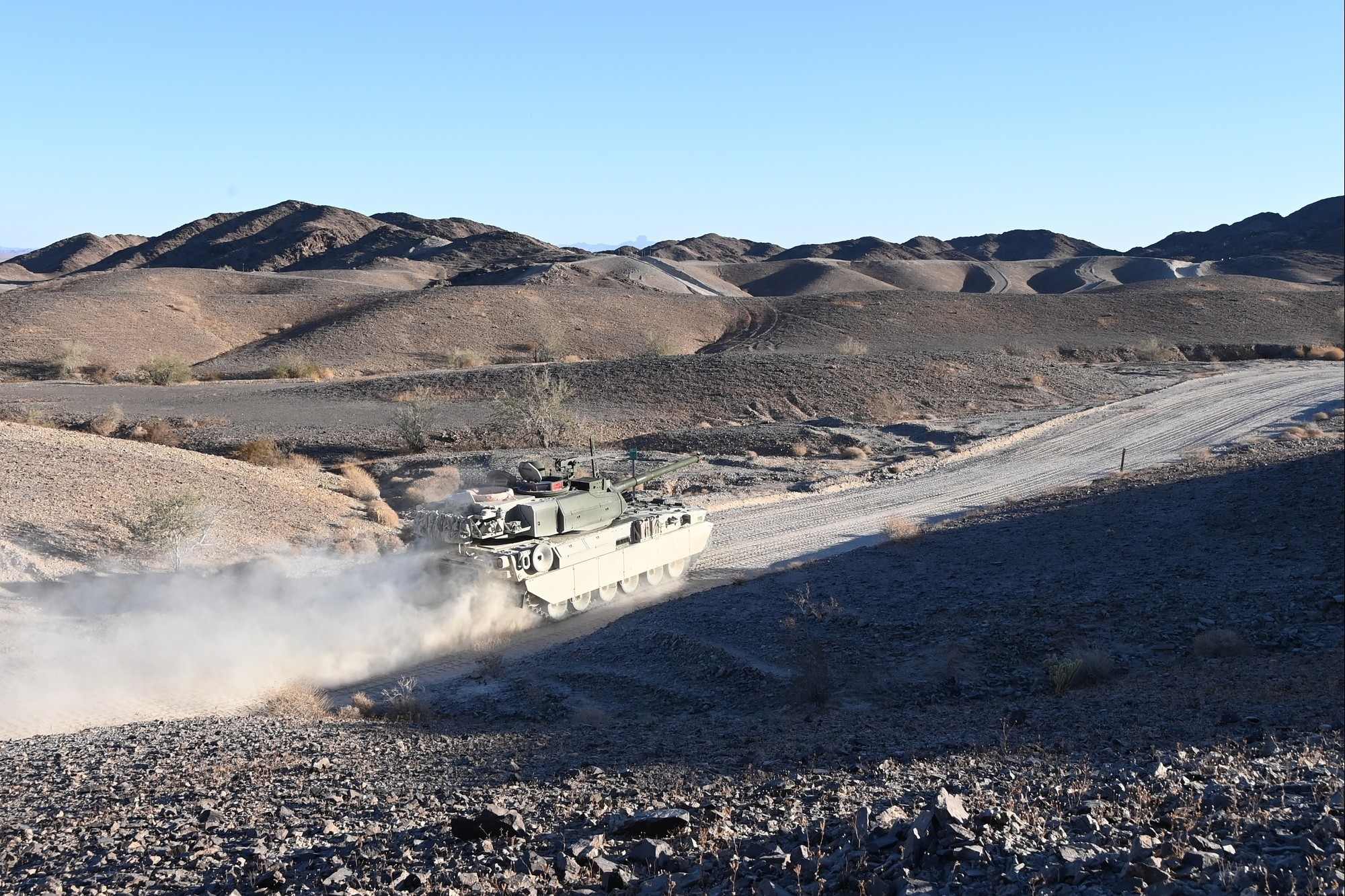
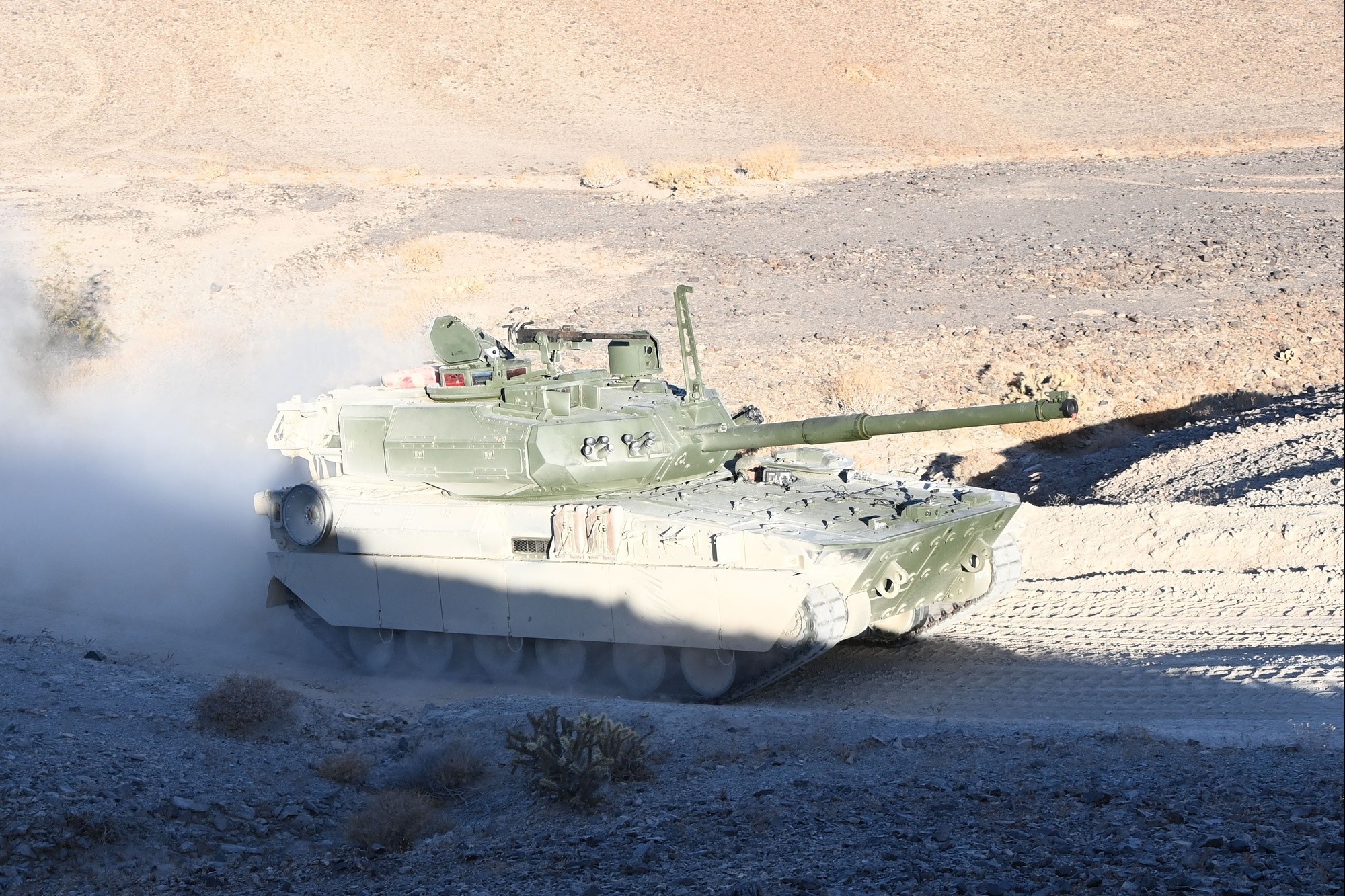
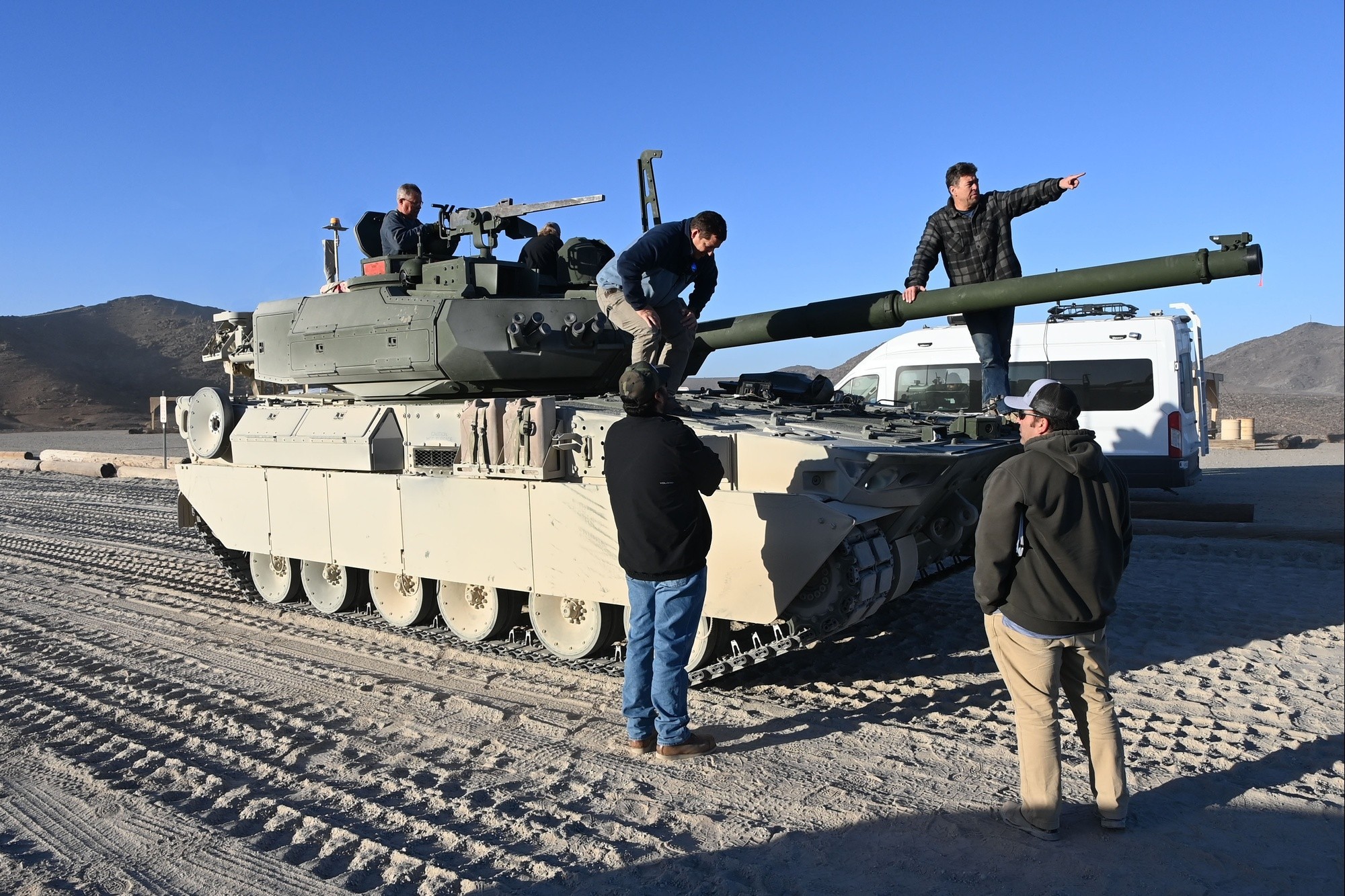
Sources and further reading
Background reading and references. Each photograph has its own source and credit.
- U.S. Army Public Affairs, 2022. “Army approves Milestone C and awards LRIP contract for the Mobile Protected Firepower program.” The United States Army, 28 June 2022. Accessed 2026-06-05. Supported Milestone C/LRIP, $1.14B award, up to 96 vehicles, intended infantry capability, and first-unit-equipped planning
- GDLS, 2022. General Dynamics Land Systems. “General Dynamics Land Systems Wins U.S. Army Competition for Mobile Protected Firepower Vehicles.” 29 June 2022. Accessed 2026-06-05. Supported industry description of the selected MPF offering
- U.S. Army Public Affairs, 2023. “Army names its newest combat vehicle after WWII and Operation Iraqi Freedom Soldiers.” The United States Army, 14 June 2023. Accessed 2026-06-05. Supported official M10 Booker naming and namesake background
- GDLS, 2023. General Dynamics Land Systems. “General Dynamics Land Systems Awarded $258 Million by U.S. Army for 26 Additional M10 Booker Combat Vehicles.” 6 July 2023. Accessed 2026-06-05. Supported LRIP phase and industry design summary
- Rolls-Royce, 2023. Rolls-Royce / mtu. “Rolls-Royce delivers first mtu Series 199 PowerPacks for M10 Booker Combat Vehicle Program.” 11 October 2023. Accessed 2026-06-05. Supported engine/powerpack details and Aiken assembly
- OSD MSAR, 2023. Office of the Secretary of Defense. “Modernized Selected Acquisition Report (MSAR): M10 Booker (Booker), FY 2025 President’s Budget, Effective December 31, 2023.” Accessed 2026-06-05. Supported program description, acquisition timeline, planned quantities, costs, and schedule
- Flowers and Heaton, 2023. LTC Gary Flowers and Dan Heaton. “M10s to Transform Light Infantry Forces.” Infantry, Fall 2023. Accessed 2026-06-05. Supported light-infantry doctrinal rationale, Sheridan/M8 background, planned 504 vehicles, and logistics discussion. Pre-cancellation source; superseded for program status
- DOT&E FY2022. Director, Operational Test and Evaluation. “Mobile Protected Firepower (MPF).” FY2022 Annual Report. Accessed 2026-06-05. Supported test history, mission, protection features, operational progress, toxic-fume issue, and classified vulnerability context
- DOT&E FY2024. Director, Operational Test and Evaluation. “M10 Booker.” FY2024 Annual Report. Accessed 2026-06-05. Supported mission, system description, 105 mm armament, protection features, testing plan, and production facilities
- DOT&E FY2025. Director, Operational Test and Evaluation. “M10 Booker.” FY2025 Annual Report. Accessed 2026-06-05. Supported cancellation/testing status and removal from DOT&E oversight after cancellation
- CRS, 2025. Andrew Feickert. “The Army’s M-10 Booker (Formerly Known as Mobile Protected Firepower [MPF]) System.” Congressional Research Service IF11859, updated 4 March 2025; accessed via EveryCRSReport. Accessed 2026-06-05. Supported requirement, acquisition strategy, planned 504 vehicles, LRIP costs, fielding plans, and congressional oversight issues. Pre-cancellation source; superseded for program status
- John, 2024. Ashley John. “Army takes delivery of first M10 Booker Combat Vehicle.” The United States Army, 18 April 2024. Accessed 2026-06-05. Supported first delivery, armament, speed, C-17 statement, sights, planned testing, and photo metadata
- DVIDS, 2024. Staff Sgt. Reanna Hartgrove. “The 145th Airlift Wing loads an M10 Booker Combat Vehicle [Image 3 of 6].” Defense Visual Information Distribution Service, 3 August 2024 / posted 16 August 2024. Accessed 2026-06-05. Supported C-17 loading image and image-rights status
- U.S. Army Yuma, 2025. Mark Schauer. “M10 Booker tested at US Army Yuma Proving Ground.” The United States Army, 12 February 2025. Accessed 2026-06-05. Supported classification as armored infantry support vehicle/assault gun, 105 mm M35, 800 hp, 40 mph, hydraulic suspension, testing, and photos
- U.S. Army Public Affairs, 2025. “Army to cease procurement of M10 Booker Combat Vehicles.” The United States Army, 11 June 2025. Accessed 2026-06-05. Supported official LRIP termination, no full-rate production, up to 96 LRIP contract, and unresolved asset disposition
- GAO, 2020. U.S. Government Accountability Office. “Next Generation Combat Vehicles: As Army Prioritizes Rapid Development, More Attention Needed to Provide Insight on Cost Estimates and Systems Engineering Risks.” GAO-20-579, 6 August 2020. Accessed 2026-06-05. Supported acquisition-risk context
- Safran, 2025. Safran Electronics & Defense. “PASEO – Long Range Panoramic Targeting Sight for land vehicles.” Accessed 2026-06-05.
- Defense News, 2025. Jen Judson. “Dead on arrival: Army pulls plug on M10 Booker light tank.” Defense News, 12 June 2025. Accessed 2026-06-05. Secondary source for post-cancellation reporting on cost, accepted vehicles, termination context, and Secretary Driscoll comments; used with caveats
- Task & Purpose, 2025. Matt White and Patty Nieberg. “The Army cancels the M10 Booker, a ‘light tank’ that was too heavy.” Task & Purpose, 2 May 2025. Accessed 2026-06-05. Secondary source for right-to-repair and post-cancellation comments; used with caveats